
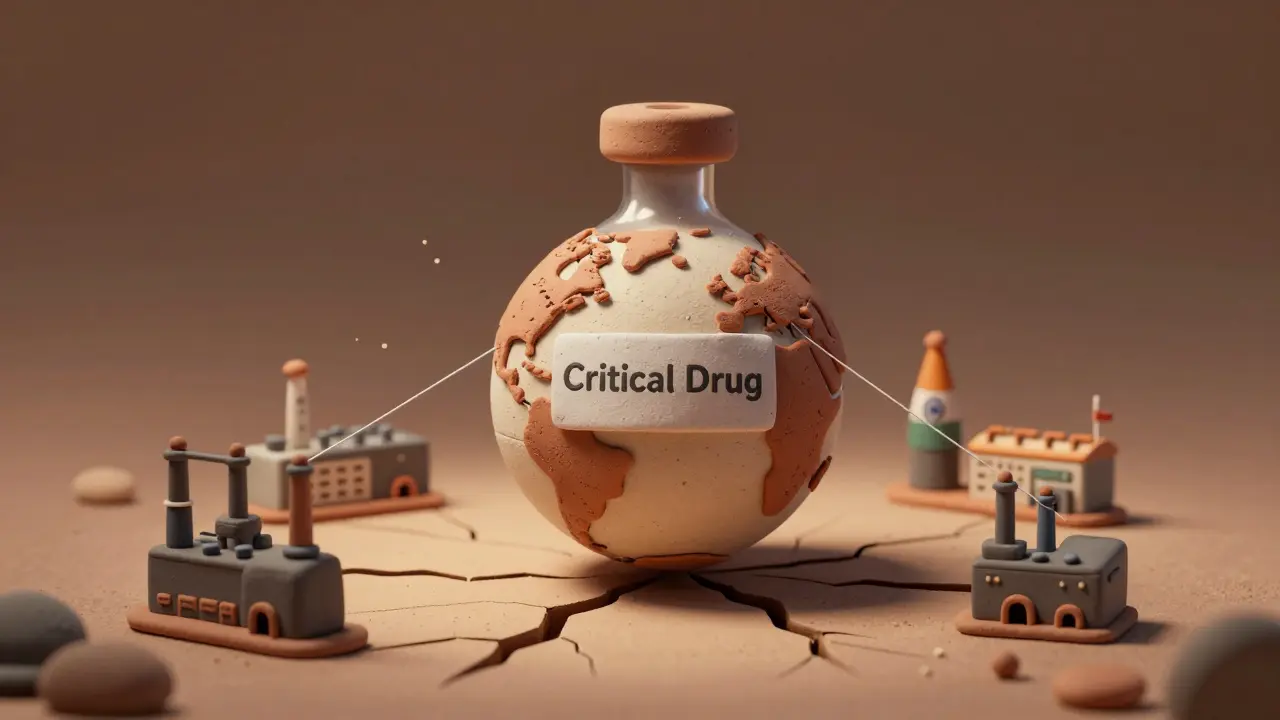
When a life-saving injection runs out, it’s not just a logistical problem-it’s a crisis. In 2022, the FDA recorded 245 drug shortages, and more than half of them involved sterile injectables used in hospitals for emergencies, surgeries, and cancer treatments. These aren’t rare glitches. They’re symptoms of a system built to be cheap, not tough. The truth is, we’ve been lucky so far. But luck isn’t a strategy. To stop seeing patients wait for meds they can’t get, we need to rebuild the drug supply from the ground up-not with quick fixes, but with lasting resilience.
Why the system keeps breaking
The global drug supply chain was optimized over decades for one thing: cost. Companies moved manufacturing overseas because labor and materials were cheaper. Today, 72% of the active ingredients in U.S. drugs come from outside the country, with nearly 30% of that coming from just two nations: China and India. That sounds efficient-until a flood, a political standoff, or a cyberattack shuts down a single facility. Then, hundreds of medicines vanish overnight. It’s not just geography. The system runs on just-in-time inventory. That means manufacturers don’t keep extra stock. They order what they need, when they need it. Sounds smart-until something interrupts the flow. There’s no buffer. No backup. No Plan B. And when a shortage hits, hospitals scramble. Patients delay treatments. Costs spike. The U.S. healthcare system spends an estimated $216 million extra every year just to deal with these disruptions.What resilience actually means
Resilience in the drug supply isn’t about having more stock. It’s about designing a system that can bend without breaking. Experts from the National Academies of Sciences, Engineering, and Medicine laid out a clear framework: three pillars-anticipation, planning, and risk management. Anticipation means knowing what could go wrong before it happens. That requires mapping every step of the supply chain, from the raw chemicals all the way to the pharmacy shelf. Right now, only 12% of drug companies can see past their third-tier suppliers. Most don’t even know who’s making the raw ingredients. How can you protect something you can’t see? Planning means building in redundancy. Instead of relying on one factory for a critical drug, you need at least two-ideally in different countries. For the most vital medicines, manufacturers should have dual-sourced active pharmaceutical ingredients (APIs). That means if one plant goes offline, another can step in without delay. Risk management means having tools ready to use when things go wrong. That includes strategic stockpiles. Experts recommend keeping 6 to 12 months’ worth of essential drugs on hand. It sounds expensive. But compared to the cost of a shortage, it’s cheap. A 2023 analysis showed that stockpiling alone would cost $3.5 billion a year. Yet it only prevents about 45% of shortages. The real value isn’t in one tool-it’s in using them together.The smartest mix: Hybrid resilience
There’s no single solution that works for every drug. Some medicines are so critical that they deserve domestic production. Others can be safely sourced internationally. The most effective approach is a hybrid model. For drugs used in emergencies-like epinephrine, insulin, or antibiotics for sepsis-manufacturing should be reshored. Federal incentives have already helped companies like Merck bring API production back to the U.S. for 12 key antibiotics. Yes, it costs 30% more. But when lives are on the line, cost isn’t the only factor. For less critical drugs, diversification works better. Instead of relying on China or India alone, manufacturers can spread production across Southeast Asia, Eastern Europe, and Latin America. This adds only a 15-20% cost premium but delivers 70% of the resilience benefits of full reshoring. The Duke-Margolis Center estimates this balanced strategy would cost $1.2 to $1.8 billion annually-but prevent 85% of critical shortages. That’s the sweet spot. It’s not about bringing everything home. It’s about protecting what matters most.
The invisible threat: Cybersecurity
You can’t talk about supply chain resilience without talking about cyberattacks. Between 2020 and 2023, cyberattacks on healthcare supply chains jumped 214%. Hackers don’t just steal data-they shut down production lines, erase inventory records, and lock up warehouses with ransomware. The Healthcare Distribution Alliance found that companies using the NIST Cybersecurity Framework reduced response times by nearly half. That’s not optional anymore. Every supplier, from the chemical plant to the shipping warehouse, needs strong digital defenses. And they need to share threat intel. A coordinated network of public and private actors can spot an attack before it hits.Technology that’s changing the game
AI is no longer a buzzword in drug supply chains-it’s a lifeline. Companies using AI for demand forecasting, like Pfizer, cut stockouts by 38%. These systems analyze everything: weather patterns, political news, shipping delays, even social media trends that might signal sudden demand spikes. But AI only works if you have clean data. Right now, 78% of companies struggle with incompatible systems across their suppliers. One uses Excel. Another uses SAP. A third uses a custom tool built in 2010. Without integration, AI can’t see the full picture. The FDA’s Drug Supply Chain Security Act (DSCSA), fully enforced by 2024, is forcing electronic tracking of every drug package. That’s a huge step. When every vial has a digital trail, it’s easier to trace problems, recall faulty batches, and reroute supplies during a crisis.What’s holding us back?
Progress is happening-but slowly. Why? Three big barriers. First, money. Manufacturers don’t invest in resilience because buyers (hospitals, insurers, government programs) pay based on price, not reliability. If a supplier offers a cheaper drug, even if it’s from a single-source factory, they win the contract. Resilience gets ignored. Second, skills. Only 35% of pharmaceutical companies have staff trained in supply chain risk analytics. Most teams were hired to manage production, not predict disasters. Third, data. Without full visibility into Tier 3 suppliers, companies are flying blind. You can’t fix what you don’t know is broken.
What’s changing in 2025 and beyond
The federal government is stepping up. The HHS 2024 Supply Chain Resilience Plan allocates $520 million to bring domestic production of 50 critical drugs online by 2027. The FDA now requires annual vulnerability assessments from all manufacturers-enforced by Q3 2025. Even bigger: Medicare is considering a rule that would tie reimbursement to supply chain transparency. Starting in 2026, drugmakers may have to publicly disclose where their ingredients come from, how many suppliers they use, and how much stock they keep. That’s a game-changer. When the public can see your supply chain, you’ll have real pressure to make it strong. Meanwhile, venture capital is pouring $2.3 billion into supply chain tech startups. AI tools, blockchain tracking systems, and digital twin simulations are emerging fast. The tools are here. The question is: are we ready to use them?What needs to happen next
Resilience isn’t a project. It’s a habit. Here’s what needs to change:- Revalue procurement. Hospitals and insurers must stop choosing drugs solely on price. They need to factor in supplier diversity, stock levels, and cybersecurity scores.
- Invest in mapping. Every company should map its supply chain to Tier 3. If you don’t know where your API comes from, you can’t protect it.
- Build buffer stocks. Start with the top 50 critical drugs. Keep 6-12 months’ supply. It’s not overkill-it’s insurance.
- Share data. Public-private partnerships for threat intelligence must become standard. No company should face a cyberattack alone.
- Train people. Supply chain risk analysts need to be as common as pharmacists. By 2027, we’ll need 125,000 more of them.
It’s not about more drugs-it’s about smarter systems
We don’t need to make more pills. We need to make the system that delivers them smarter, tougher, and more transparent. The tools exist. The data is there. The cost of doing nothing is higher than the cost of fixing it. The next time a drug runs out, it shouldn’t be because we didn’t plan. It should be because we did-and it still happened. And that’s okay. Because with resilience, even when things break, we’re ready to fix them.What causes most drug shortages today?
The top causes are manufacturing disruptions (especially in overseas facilities), raw material shortages, regulatory delays, and cyberattacks. Over 60% of shortages in 2022 involved sterile injectables, often because they rely on a single supplier for their active ingredient. Geographic concentration-especially in China and India-makes the system fragile.
Is stockpiling drugs a good long-term solution?
Stockpiling helps, but it’s not enough on its own. Keeping 6-12 months of critical drugs on hand prevents about 45% of shortages. The real value comes from combining stockpiles with supplier diversification, dual sourcing, and better forecasting. Relying only on stockpiles is expensive and doesn’t stop new problems from arising.
Why isn’t more drug manufacturing done in the U.S.?
Domestic production is 25-40% more expensive than overseas manufacturing due to labor, environmental regulations, and infrastructure costs. Many companies avoid it because buyers prioritize low prices. But federal incentives, like those used by Merck, are helping shift that. For life-saving drugs, the higher cost is now seen as a necessary investment in safety.
How does AI help prevent drug shortages?
AI analyzes data from shipping routes, weather events, political trends, and supplier performance to predict disruptions before they happen. Companies using AI for demand forecasting have reduced stockouts by up to 38%. It also helps optimize inventory levels and identify weak links in the supply chain that humans might miss.
What role does cybersecurity play in drug supply resilience?
Cyberattacks have surged 214% since 2020, targeting everything from production systems to inventory databases. A single ransomware attack can halt manufacturing for days. Using the NIST Cybersecurity Framework and sharing threat intelligence across companies cuts incident response time by nearly half. Cyber resilience is now as critical as physical supply chain security.
Will the FDA’s new rules make a difference?
Yes. Starting in 2025, all drug manufacturers must complete annual vulnerability assessments and submit supply chain maps. This forces transparency. Combined with the DSCSA’s full electronic tracing by 2024, these rules are turning supply chain resilience from a voluntary best practice into a legal requirement-making it harder to ignore.
How can patients help push for change?
Patients can ask their doctors and pharmacists: "Is this drug sourced from multiple suppliers?" They can also support policies that prioritize supply chain transparency over price alone. Public pressure helped pass the DSCSA. Continued awareness can drive lawmakers to fund resilience initiatives and tie Medicare payments to supply chain strength.



Stephen Alabi
While the post presents a compelling narrative, it fundamentally misunderstands the nature of market-driven systems. Resilience is not a design feature-it's a cost externality that rational actors avoid. The notion that 'cost isn't the only factor' when lives are at stake is emotionally appealing but economically incoherent. If hospitals were truly prioritizing resilience over price, we wouldn't have 72% of APIs sourced abroad. The market is signaling something: consumers (hospitals, insurers) value low cost above all else. To assume otherwise is to confuse moral posturing with economic reality.
Furthermore, the proposal to reshore critical drug manufacturing ignores the fact that the U.S. lacks the chemical engineering workforce, regulatory agility, and capital allocation efficiency to compete with China’s vertically integrated, state-subsidized model. This isn't a failure of will-it's a failure of comparative advantage.
And let’s not pretend that stockpiling 6–12 months of inventory is a silver bullet. The FDA’s own data shows that 40% of stockpiled drugs expire before they’re used. That’s not resilience-it’s waste disguised as preparedness.
Agbogla Bischof
Thank you for this meticulously researched analysis. I appreciate the emphasis on dual-sourcing APIs and the concrete data points-particularly the 70% resilience gain from geographic diversification at only a 15–20% cost premium. This is precisely the kind of pragmatic, evidence-based approach that policy makers need to adopt.
However, I must underscore a critical omission: the role of local manufacturing hubs in emerging economies. Nigeria, for instance, has developed regional API production capacity for antiretrovirals and antibiotics, with WHO prequalification and GMP compliance. These models should not be dismissed as 'less sophisticated'-they represent adaptive, context-sensitive resilience.
Also, the cybersecurity section is spot-on. The NIST framework isn't optional; it's foundational. Yet, most supply chain audits still treat cybersecurity as an IT issue, not a pharmaceutical safety issue. We need auditors who understand both.
Pat Fur
I’ve worked in rural hospitals. When the epinephrine ran out? We used a syringe and a vial of concentrated solution we’d dilute ourselves. No one panicked. We just… did it.
But the real tragedy isn’t the shortage-it’s that we’ve let ourselves believe this is normal. That it’s just ‘how things are.’
Resilience isn’t about stockpiles or AI. It’s about dignity. About trusting that when someone’s heart stops, the medicine will be there-not because we got lucky, but because we chose to build it that way.
I’m tired of talking about cost. Let’s talk about care.
Anil Arekar
The structural vulnerabilities in the pharmaceutical supply chain are indeed profound, and the proposed hybrid resilience model represents a statistically and economically sound pathway forward.
It is imperative to recognize that the geopolitical concentration of active pharmaceutical ingredient (API) production-particularly in China and India-creates systemic risk that is neither sustainable nor ethically defensible. The reliance on just-in-time inventory, while economically optimal under conditions of perfect information and zero disruption, is fundamentally incompatible with the stochastic nature of global supply chains.
Furthermore, the assertion that domestic reshoring incurs a 30% premium must be contextualized: this figure fails to account for externalized costs such as delayed patient care, increased mortality, and the erosion of public trust in healthcare institutions. A cost-benefit analysis that excludes these variables is incomplete.
Investment in supply chain mapping, workforce development, and digital infrastructure must be treated as public goods, not private expenditures.
Elaine Parra
Let’s cut the fluff. This whole article is a liberal fantasy wrapped in data. You want to reshore manufacturing? Fine. But then why not also reshore the 125,000 new supply chain analysts you say we need? Where are they going to come from? The same universities that can’t graduate enough engineers to build a bridge without a permit?
And let’s not forget: the U.S. is the largest consumer of drugs in the world. We don’t make them because we don’t want to. We want cheap pills and perfect outcomes. You can’t have both. And pretending you can is dangerous.
Stop romanticizing ‘resilience.’ Start demanding accountability. If you want your insulin to be safe, pay for it. Don’t blame the manufacturers. Blame the politicians who won’t let them charge what it costs to make.
Natasha Rodríguez Lara
I really appreciate how this post ties together the technical, economic, and human dimensions of drug shortages. But I think we’re missing a key piece: patient advocacy.
When I was in chemo, my oncologist had to switch my drug three times because of shortages. Each switch meant new side effects, new anxiety, new delays. I didn’t know about API sourcing or supply chains-but I knew I was being treated like a puzzle piece, not a person.
That’s the real failure: we treat medicine as a commodity, not a right.
Maybe the real ‘hybrid resilience’ isn’t just in factories and AI-it’s in giving patients a voice in how these systems are designed.
Caroline Bonner
Oh my goodness, this is such an important conversation-and I’m so glad it’s happening! I’ve been thinking about this nonstop since I read the article. Like, seriously, I woke up at 3 a.m. thinking about how we could use blockchain to track API shipments from the farm to the pharmacy, and then I started dreaming about digital twins of warehouses, and I just had to write this down!
And you know what? The more I think about it, the more I believe we need a national drug resilience task force-like the one we had for pandemic response-but permanent. With funding. And maybe even a public dashboard so everyone can see where shortages are happening in real time-like a weather map for medicine!
Also, I love how you mentioned cybersecurity. I read about a hospital in Ohio that got hit by ransomware and couldn’t access prescriptions for a week. I cried. I’m not even in healthcare, but I just… I couldn’t stop thinking about all the people who needed their meds. We have to do better. We have to.
And I think we can! We just need to believe it’s possible. And then build it.
P.S. I’ve started a Reddit thread about this. Let’s connect!
Chris Crosson
Caroline, your energy is contagious-but let’s ground this. A public dashboard for drug shortages? That’s not impossible. The FDA already tracks them. The problem is they’re not public in real time. The DSCSA’s electronic tracing system will be fully live by 2024. We have the tech. We just need to force transparency.
And yes, we need to build it. But we also need to stop pretending that every problem has a tech solution. Sometimes, it’s just about paying more. And that’s okay.
Linda Foster
The assertion that reshoring critical drug manufacturing is economically infeasible is not supported by empirical evidence. The U.S. government has already demonstrated its capacity to subsidize domestic production through the Defense Production Act, as evidenced by the recent reestablishment of API manufacturing for antibiotics. The cost differential of 25–40% is not a structural constraint but a reflection of current market distortions.
Moreover, the notion that resilience is a cost externality mischaracterizes the role of public policy. Public goods-including pharmaceutical supply chain integrity-are not subject to market pricing mechanisms. Their value is measured in lives preserved, not in quarterly earnings.
Therefore, the policy imperative is not to optimize for cost, but to institutionalize resilience as a non-negotiable standard of care.
Kevin Siewe
Elaine, you’re right about one thing: we do need to stop pretending. But I think the answer isn’t to give up on resilience-it’s to stop letting profit drive every decision.
I’ve worked with small manufacturers who want to do the right thing. They’re willing to invest in dual sourcing. They’re willing to build buffer stocks. But they can’t compete with the $2.50 vial from a single-source factory in China when the hospital’s contract says ‘lowest bid wins.’
We need to change the rules. Not the people.