

What Are Workplace Accommodations for Medication Side Effects?
When someone takes medication that causes drowsiness, nausea, dizziness, or trouble concentrating, it doesn’t mean they’re lazy or unreliable. It means their body is reacting to something necessary for their health. Many people on prescription meds-whether for epilepsy, diabetes, depression, chronic pain, or high blood pressure-experience side effects that make standard work hours or tasks harder. That’s where workplace accommodations come in.
Under the Americans with Disabilities Act (ADA), employers must make reasonable changes to help employees do their jobs safely when medication side effects interfere with performance. These aren’t special favors. They’re legal requirements. The Equal Employment Opportunity Commission (EEOC) made this clear in its 2022 guidance: if a side effect limits a major life activity like thinking, moving, or staying awake, it can qualify as a disability under the law-even if the underlying condition doesn’t.
Think about it this way: if someone needs glasses to see the computer screen, you don’t fire them for not seeing clearly. You give them glasses. Medication side effects are no different. The goal isn’t to make work easier for the sake of comfort. It’s to make sure people can do their jobs without being punished for taking care of their health.
When Does a Side Effect Qualify for Accommodation?
Not every side effect triggers a legal obligation. The key is whether it’s substantial and persistent. A one-day headache after starting a new pill? Probably not. But ongoing drowsiness from an epilepsy drug that makes it unsafe to operate machinery? That’s different.
The EEOC says employers must look at three things:
- What’s the specific side effect?
- How does it affect job duties?
- Can it be managed with a simple change?
For example, an employee on antidepressants might feel foggy in the morning. If they’re an accountant who works best after lunch, a shift to 10 a.m. to 6 p.m. could fix the problem. That’s reasonable. But if the same person worked as a crane operator, the risk might be too high-even with a schedule change. Then the employer has to dig deeper: Is the dosage low? Has the employee had this med for months without incident? Are there alternatives?
Crucially, the law doesn’t let employers assume risk based on the drug’s name. You can’t say, “All opioids cause drowsiness, so no one on them can drive.” That’s blanket discrimination. The EEOC says you have to look at the individual. One person on oxycodone might feel fine after two weeks. Another might not. You have to find out which one you’re dealing with.
Common Accommodations That Actually Work
Most accommodations are simple, low-cost, and make everyone’s life better. Here’s what works based on real cases tracked by the Job Accommodation Network (JAN):
- Flexible hours - Shifting start or end times to avoid peak side effect windows. A nurse on a blood pressure med that causes dizziness at 8 a.m. might start at 10 a.m. and leave at 6 p.m. instead.
- Modified break schedules - Allowing extra or longer breaks to rest, eat, or hydrate. Someone on chemo might need to lie down for 20 minutes after lunch. That’s not laziness-it’s survival.
- Remote or hybrid work - Since the pandemic, 43.8% of medication-related accommodations now include working from home. This is especially helpful for people with nausea, fatigue, or brain fog.
- Temporary reassignment - If someone can’t lift heavy boxes due to muscle weakness from a new medication, they might temporarily handle inventory tracking instead.
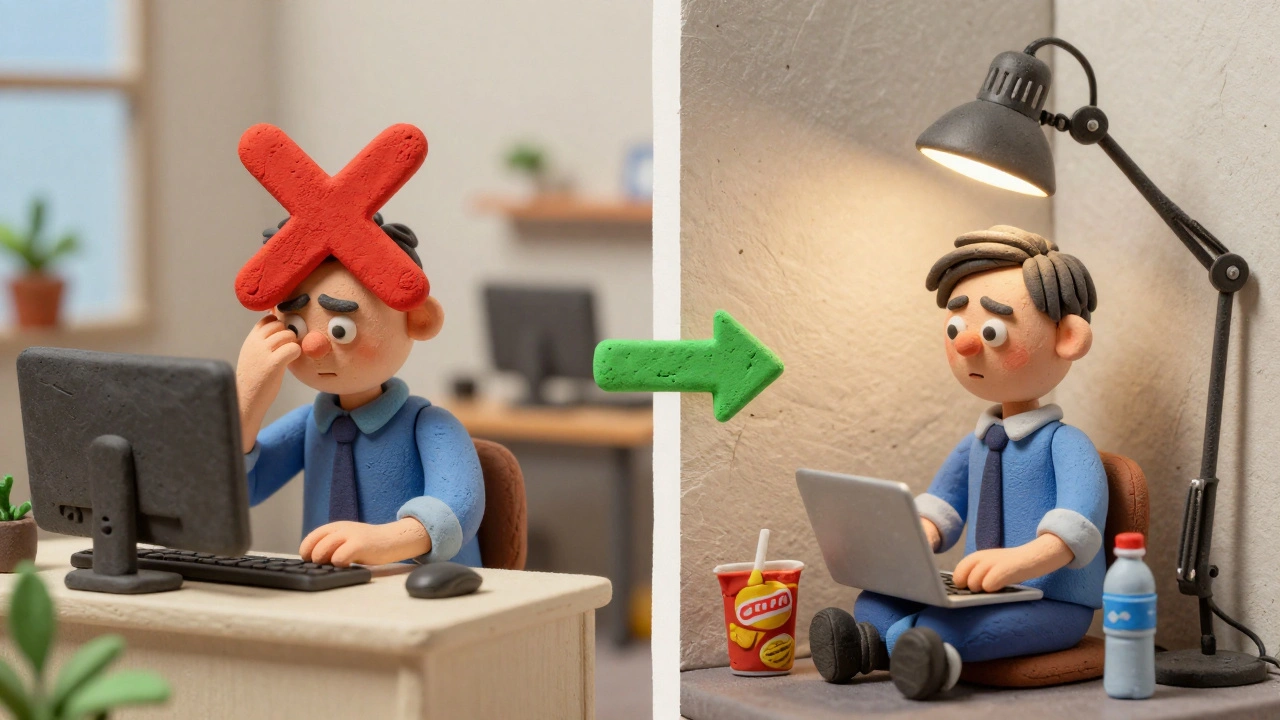
- Permitting food or drinks at workstations - Some meds cause dry mouth, nausea, or low blood sugar. Allowing water, snacks, or gum at a desk isn’t a perk-it’s a medical need.
- Adjustable lighting or noise levels - Bright lights or loud environments can trigger migraines or anxiety in people on psychiatric meds. Simple tweaks like moving to a quieter corner or using a desk lamp can help.
These aren’t radical changes. They’re adjustments. And they work. Companies that offer them see 19.3% lower turnover among employees managing medication side effects.
What Employers Can’t Do
Accommodations aren’t a free pass. There are hard limits. The EEOC is clear: employers don’t have to:
- Lower performance standards
- Remove essential job functions
- Pay someone for work they don’t do
- Excuse illegal drug use
For example, if a warehouse worker can’t lift 50-pound boxes because of medication-induced weakness, and lifting is a core part of the job, the employer isn’t required to eliminate that duty. But they might be required to offer a different role-like quality control or shipping coordination-that doesn’t require heavy lifting.
Also, employers can’t demand to know the exact name of the medication. They only need to know how the side effects affect work. That’s a privacy protection built into the law. You don’t need to share your prescription bottle. You just need to explain what’s happening and how it’s impacting your ability to do your job.

Safety-Sensitive Jobs: The Tougher Cases
Here’s where things get complicated. In jobs like truck driving, surgery, firefighting, or machine operation, safety isn’t optional. One mistake can cost lives. So employers in these fields often push back harder on accommodation requests.
But even here, blanket bans are illegal. A 2023 court case in California, Garcia v. Costco, ruled that a warehouse worker on opioid treatment couldn’t be automatically barred from operating a forklift just because of the drug’s reputation. The court said the employer had to assess his performance, his dosage, and his medical history-not just the drug’s label.
Employers in safety-sensitive roles must do a “direct threat” assessment. That means:
- Getting objective medical evidence
- Looking at the employee’s actual track record
- Considering whether accommodations reduce risk
For example, a pilot on ADHD medication might be cleared to fly if their doctor confirms they’ve been stable for six months with no side effects. But if they’ve had two episodes of dizziness in the last month? That’s a red flag. The key is evidence-not fear.
Approval rates tell the story: 89.7% of schedule adjustments are approved in non-safety jobs. Only 62.3% are approved in safety-sensitive roles. That gap isn’t because the law is different-it’s because the stakes are higher, and the scrutiny is too.
The Interactive Process: How It Should Work
Accommodations don’t happen by accident. They happen through conversation. The law calls this the “interactive process.” Here’s how it’s supposed to go:
- The employee requests an accommodation (verbally or in writing). No need for fancy forms.
- The employer responds within 3 business days. Silence is a violation.
- Both sides talk. The employer asks: What’s the issue? What’s your doctor saying? What change would help?
- The employee provides medical documentation-not their whole chart, but a note that says: “This patient experiences drowsiness from [medication] that affects alertness between 8-10 a.m. A schedule adjustment would allow safe performance.”
- They try a solution. It might be temporary. It might be permanent.
- They check in. Did it work? Does it need tweaking?
Companies that follow this process successfully accommodate 89.2% of requests. Those that skip steps? Only 56.7% succeed. And the ones that ignore it entirely? They end up in court.
A 2022 SHRM survey found that 31.8% of employees who complained about accommodations said their boss demanded too much medical info. That’s not helping. It’s intimidating. The law doesn’t require a medical thesis. It requires enough to understand the problem and the fix.
What Happens When It Goes Wrong?
Too often, employees are met with suspicion. “You’re just using your meds as an excuse.” “Everyone gets tired-why are you special?” That’s discrimination. And it’s common.
One Reddit user, a nurse on migraine medication, said her manager told her to “tough it out.” She requested a two-week schedule shift to avoid morning drowsiness. Her manager refused. She filed a complaint. Within three weeks, her employer agreed to the change-and her error rate dropped 37%. That’s not a miracle. That’s common sense.
On the flip side, a truck driver in Texas was denied flexible hours for blood pressure meds. He sued. The EEOC sided with him. Why? Because his doctor proved his specific medication caused almost no side effects at his dosage. The employer had assumed the worst. The law doesn’t let you assume.
Legal costs are real. The average settlement for a denied accommodation case is $68,400. And if the employer didn’t even try to talk things through? There’s a good chance they’ll pay punitive damages too.
What Employees Should Do
- Know your rights. You don’t have to disclose your diagnosis or medication name.
- Be specific. Don’t say, “I feel tired.” Say, “I get drowsy from 8-10 a.m. after starting this med. Can I start at 10 a.m. for two weeks?”
- Get a note from your doctor. It doesn’t need to be long. Just: “This patient has side effects from [medication] that affect alertness during [time]. A schedule adjustment would allow safe and effective performance.”
- Document everything. Keep copies of emails, notes from meetings, and your doctor’s letter.
- If you’re denied and it feels unfair, contact the EEOC. They don’t charge for help.
What Employers Should Do
- Train managers. 42.3% fewer complaints happen when supervisors get annual ADA training.
- Don’t panic over medication names. Focus on function, not the pill.
- Start the conversation fast. Waiting more than 3 days is a legal risk.
- Keep logs. Track the side effect, the accommodation, how long it lasted, and whether performance improved.
- When in doubt, consult the Job Accommodation Network (JAN). They offer free, confidential advice for employers.
Looking Ahead
More people are on medication than ever. In 2021, over half of Americans took at least one prescription drug. That number’s climbing. Mental health meds, ADHD treatments, and pain medications are all rising fast. By 2026, requests for accommodations related to psychiatric drugs are projected to grow 15.2% per year.
The law isn’t changing. But the expectations are. Courts keep ruling that blanket policies are illegal. Employers who treat accommodation as a burden are losing. Those who treat it as part of good management are thriving.
The future belongs to workplaces that understand: taking care of your health shouldn’t cost you your job. And helping someone stay on the job-because they’re doing everything right-isn’t a concession. It’s smart business.



David Palmer
i dunno why people make such a big deal about this. if you're too tired to work, maybe don't take the meds? or get a job that doesn't require you to be awake?
Michaux Hyatt
this is such an important topic! honestly, most accommodations are just common sense. if someone needs to start at 10 instead of 8 because their med makes them foggy, why not? it’s not costing the company anything, and they keep a skilled employee. win-win.
also, side note: the EEOC’s 2022 guidance is a game-changer. so many managers still think ‘meds = excuse’ - they need training, stat.
Aileen Ferris
like… why do we even have to talk about this? its 2025. if you take a pill to not die, you shouldnt get fired for it. i mean… really? we still need a whole article on this?
Regan Mears
I’ve seen this play out in real life-my cousin, a pharmacy tech on antidepressants, was told to ‘tough it out’ during morning shifts. She requested a 10 a.m. start. They said no. She filed with the EEOC. Three weeks later? They offered her the shift. Her error rate dropped by 40%.
It’s not about coddling. It’s about fairness. And the law is crystal clear: if a side effect impacts major life activities, it’s covered. Period. Employers who ignore this aren’t being tough-they’re being legally reckless. And honestly? They’re losing good people over nothing.
Ben Greening
The data presented here is compelling. The Job Accommodation Network’s statistics regarding retention and accommodation success rates suggest a strong correlation between reasonable adjustments and workplace stability. One might reasonably infer that organizational resistance stems more from ignorance than from legitimate operational concerns.
Neelam Kumari
oh wow. so now we’re treating people like fragile glass figurines because they take pills? next you’ll tell me we need a nap pod for the guy who gets sleepy after coffee. maybe if people didn’t take so many meds, they wouldn’t need so many accommodations. just saying.
Queenie Chan
I love how the article calls it ‘smart business’-because that’s exactly what it is. It’s not charity. It’s not pity. It’s like giving someone glasses so they can see the screen. You don’t fire them for needing them. You don’t make them squint and blame their eyes. You just… fix it.
And yet, we still treat brain chemistry like it’s a moral failing. Like if you’re on anxiety meds, you’re ‘weak.’ But if you’re on insulin? Oh, that’s ‘responsible.’ Funny how we pick and choose what counts as ‘real’ medicine.
Also, the part about not needing to disclose the drug name? YES. My boss asked me what med I was on once. I said, ‘The one that keeps me from crying in the bathroom every day.’ He didn’t ask again.
Stephanie Maillet
It’s fascinating, really, how society has built entire systems around productivity and efficiency… yet still refuses to acknowledge that the human body is not a machine that can be reset with a cup of coffee.
We demand focus, alertness, consistency-yet we treat biological reality as if it’s a personal flaw. The real tragedy isn’t the person needing accommodation. It’s the system that still sees accommodation as an exception… instead of a natural, inevitable part of human diversity.
And yet… here we are. Still arguing about whether someone deserves to work while managing their health. We’ve built rockets. We’ve mapped DNA. But we still can’t accept that a person on medication isn’t ‘less than’-they’re just… human.
Doris Lee
This is so good. Just keep doing this. People need to hear it.