

Anticoagulant Procedure Risk Calculator
How to Use This Tool
Enter your medication type and procedure details to get personalized recommendations based on current medical guidelines. This tool helps you understand whether to continue or temporarily stop your blood thinners before a cosmetic procedure.
Recommendations
When you're considering a cosmetic procedure - whether it's a simple skin biopsy, a laser treatment, or a facelift - one of the most overlooked but critical questions is: What happens if you're on blood thinners? Many people assume they need to stop their medication before any procedure. That’s not always true. In fact, stopping blood thinners can be riskier than keeping them on, especially for minor treatments. The old rule - stop everything before surgery - has changed. Today, doctors use smart, personalized plans based on the type of procedure, the drug you're taking, and your personal health history.
Why Blood Thinners Matter in Cosmetic Procedures
Blood thinners, or anticoagulants, aren’t just for heart patients. Millions of people take them daily to prevent strokes, clots, or heart attacks. In the UK alone, over 1.2 million people are on warfarin or direct oral anticoagulants (DOACs) like apixaban or rivaroxaban. Many of them also want to improve their appearance - through fillers, eyelid surgery, or skin resurfacing. But here’s the problem: these drugs increase the chance of bruising and bleeding. The real question isn’t whether they cause bleeding - it’s whether stopping them causes more harm than good.A 2014 study of 168 facial surgeons found that when patients stopped their blood thinners, they had 46 serious clotting events - including strokes and deaths. Five times more people had strokes after stopping aspirin than after continuing it. That’s not a fluke. It’s a pattern. The risk of a life-threatening clot from stopping your medication often outweighs the risk of a little extra bruising.
Not All Blood Thinners Are the Same
You can’t treat all blood thinners the same way. There are three main types, and each behaves differently around surgery:- Warfarin: This older drug requires regular blood tests (INR). If your INR is below 3.5, most dermatologists and plastic surgeons say you can safely continue it for minor procedures. But if your INR is higher, or you’re having a major facial surgery, stopping it a few days ahead might be needed.
- Direct Oral Anticoagulants (DOACs): These include apixaban, rivaroxaban, dabigatran, and edoxaban. They leave your system faster than warfarin - usually within 12 to 24 hours. For minor procedures like mole removals or laser treatments, you can often skip your morning dose the day of surgery. For more invasive surgeries, stopping 24-48 hours before is typical.
- Antiplatelets (aspirin, clopidogrel): Surprisingly, these cause almost no extra bleeding in skin procedures. Multiple studies confirm that people taking daily aspirin don’t have more bruising or bleeding than those who aren’t. You don’t need to stop them for most cosmetic work.
Here’s the kicker: stopping aspirin doesn’t reduce bleeding - it increases your chance of a heart attack or stroke. The British Society of Dermatologists (BSDS) 2023 guidelines say clearly: “Aspirin and clopidogrel can be continued without significant bleeding risk following skin surgery.”
Procedure Type Matters More Than You Think
Not every cosmetic procedure carries the same bleeding risk. Think of it like this:- Low-risk procedures: Shave biopsies, mole removals, chemical peels, Botox, dermal fillers, laser hair removal. For these, you almost always keep your blood thinner. Stopping offers no benefit and adds serious risk.
- Moderate-risk procedures: Excisions larger than 2 cm, eyelid surgery (blepharoplasty), neck lifts. Here, timing matters. For DOACs, skipping the morning dose is usually enough. For warfarin, check your INR. If it’s under 3.5, you’re likely fine.
- High-risk procedures: Full facelifts, rhinoplasty, body contouring, breast surgery. These involve large blood vessels and deep tissue. In these cases, your surgeon may recommend stopping DOACs 24-48 hours before. Warfarin may need to be stopped 5 days out, with careful monitoring. Never stop without medical advice.
Facial procedures are especially tricky. The face has a dense network of blood vessels. Even a small bleed can cause swelling that affects breathing, vision, or healing. That’s why surgeons are extra cautious here - but still don’t automatically stop your meds.
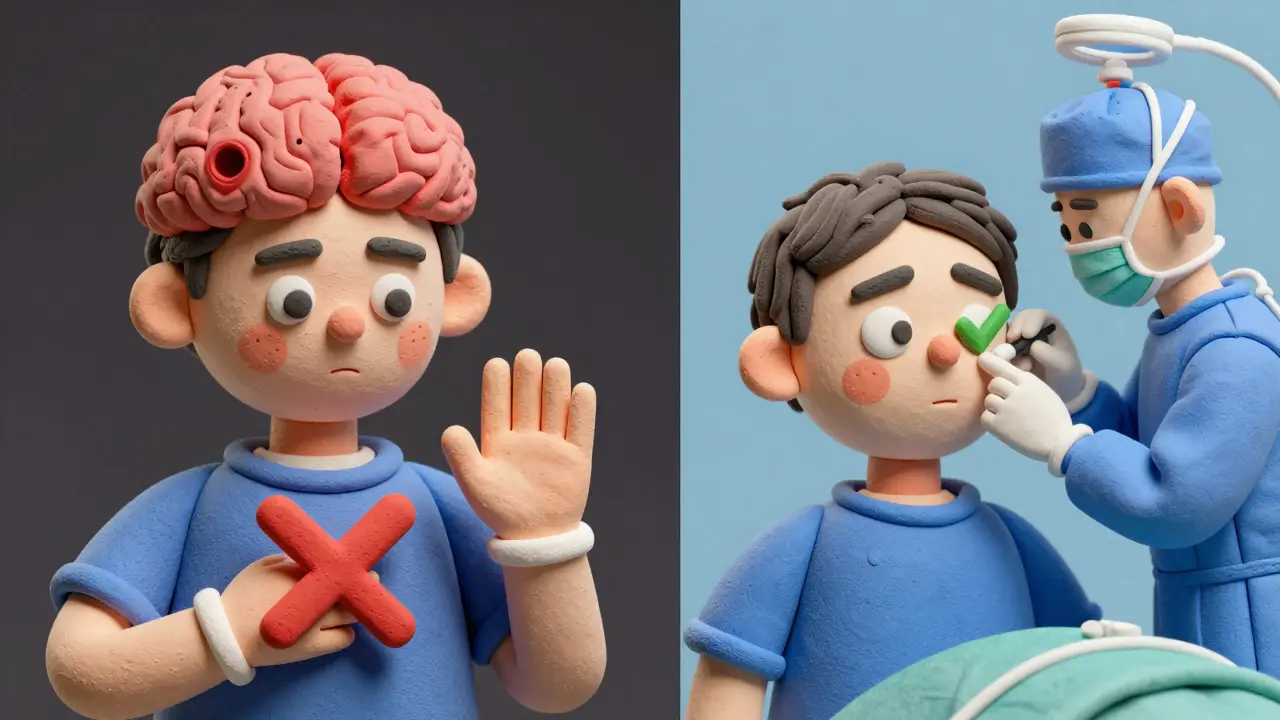
What About Bruising?
Yes, you’ll likely bruise more. That’s normal. If you’re on blood thinners, expect darker, wider bruises after injections or minor cuts. It doesn’t mean something went wrong. It just means your blood isn’t clotting as fast. Most bruises fade in 1-2 weeks. Cold compresses, keeping your head elevated, and avoiding aspirin or NSAIDs (like ibuprofen) after the procedure help reduce swelling.One study of 703 patients on rivaroxaban showed 11 bleeding events (9.8%) - but when they stopped the drug, 17.6% had bleeding. That difference wasn’t even statistically significant. In other words: stopping didn’t help. It just made you vulnerable to clots.
What You Should Do - Step by Step
If you’re on anticoagulants and thinking about a cosmetic procedure:- Don’t stop your medication on your own. Ever. Not even for a day.
- Tell your cosmetic provider - not just your GP - exactly what you’re taking. Include the name, dose, and how long you’ve been on it.
- Ask for an INR check if you’re on warfarin. Make sure it’s below 3.5.
- For DOACs: Ask if skipping your morning dose on the day of surgery is safe. For most minor procedures, it is.
- For aspirin or clopidogrel: You almost certainly don’t need to stop. Confirm this with your doctor.
- Never use heparin bridges unless you have a mechanical heart valve. For cosmetic surgery, they increase bleeding without reducing clot risk.
Many patients worry about looking “too bruised.” But in reality, the risk of a stroke or pulmonary embolism after stopping your drug is far more dangerous - and permanent - than a temporary bruise.
What the Experts Say
The British Society of Dermatologists’ 2023 guidelines are now the gold standard. They say:- Antiplatelets (aspirin, clopidogrel) - continue.
- Warfarin - continue if INR < 3.5.
- DOACs - continue for low-risk procedures; hold morning dose for moderate ones.
Dr. Otley’s 1996 study - which looked at over 650 patients - was the first to prove that stopping blood thinners didn’t reduce bleeding. Since then, every major update has reinforced that message. In fact, a 2022 review of 1,572 patients undergoing body contouring found that those on blood thinners had only a 1.27% rate of complications requiring surgery. That’s lower than the rate of complications from stopping them.
The Bigger Picture
Around 25-40% of patients in cosmetic dermatology and facial surgery are already on anticoagulants. That’s not rare. It’s common. With an aging population and more people managing heart conditions while wanting to look younger, this intersection is only growing. The medical community has responded with clear, evidence-based rules - not fear-based ones.The key takeaway? Your health comes before your appearance - but sometimes, your appearance doesn’t have to wait for your health to be “perfect.” With the right plan, you can safely get the procedure you want without putting your life at risk.
Should I stop taking aspirin before a cosmetic procedure?
No, you should not stop aspirin. Multiple studies, including those from the British Society of Dermatologists, show that aspirin does not significantly increase bleeding risk in minor cosmetic procedures like skin biopsies, fillers, or laser treatments. Stopping aspirin can increase your risk of heart attack or stroke, especially if you're taking it for a reason like prior heart disease or stroke. Always consult your doctor before making any changes.
Can I have a facelift while on blood thinners?
Yes, but it requires careful planning. For DOACs like apixaban or rivaroxaban, your surgeon may ask you to skip the morning dose on the day of surgery. For warfarin, your INR must be below 3.5. In some cases, especially if you're on dual therapy (like aspirin + warfarin), your doctor might delay the procedure until you're on a single medication. The goal is to minimize both bleeding and clotting risks - not to avoid the surgery altogether.
How long should I stop my DOAC before surgery?
For low-risk procedures (like fillers or laser treatments), you usually don’t need to stop at all. For moderate-risk procedures (e.g., eyelid surgery), skip your morning dose on the day of surgery. For high-risk procedures (like a full facelift), stop the DOAC 24-48 hours before. Your surgeon will give you exact timing based on the drug and your kidney function. Never guess - always follow medical advice.
Is bruising normal after cosmetic procedures if I’m on blood thinners?
Yes, bruising is more common and often more noticeable if you’re on anticoagulants. This doesn’t mean something went wrong - it’s a normal side effect of thinner blood. Bruises typically fade within 1-2 weeks. Avoid NSAIDs like ibuprofen, use cold compresses, and keep your head elevated to reduce swelling. If bruising is accompanied by severe pain, rapid swelling, or difficulty breathing, contact your provider immediately.
What if I’m on both aspirin and a DOAC?
Being on dual antithrombotic therapy (like aspirin + rivaroxaban) increases bleeding risk. Most guidelines recommend delaying elective cosmetic procedures until you’re on a single agent, if possible. If the procedure can’t wait, your doctor will weigh the risks of bleeding against the danger of stopping one of the drugs. In most cases, they’ll continue both but take extra precautions during surgery - like using precise techniques and compression.



andres az
So let me get this straight - we’re telling people to keep taking anticoagulants during cosmetic procedures because the *risk of a clot* is worse than a bruise? That’s like saying ‘don’t wear a seatbelt because the car crash might be worse than a bruised hip.’
Who approved this? The FDA? A pharmaceutical lobby? Because I’ve seen patients with hemorrhagic strokes after ‘minor’ fillers. This isn’t evidence-based - it’s corporate risk transfer wrapped in medical jargon.
And don’t even get me started on ‘DOACs leave the system in 12–24 hours.’ That’s lab data. Real people have variable metabolism. Renal clearance? Liver enzymes? CYP3A4 polymorphisms? Nobody checks that. They just say ‘skip the dose’ and hope for the best.
Wake up. This isn’t medicine. It’s liability minimization dressed as protocol.
Steve DESTIVELLE
The body is not a machine to be optimized like a smartphone app and the blood is not a fluid to be controlled like a faucet and the clot is not an enemy to be eradicated but a natural response to rupture and the fear of bruising is the fear of vulnerability and the fear of vulnerability is the fear of death and we have turned medicine into a performance art where appearance trumps essence and we forget that life is not about looking young but about living fully even if it means a little purple on the cheek
Stephon Devereux
This is one of the most important posts I’ve read in years. Seriously - if you’re on blood thinners and you’re scared to get a simple mole removed because you ‘might bleed too much’ - you’re falling for the wrong fear.
Let me break it down: Bruising fades. A stroke doesn’t.
I’ve worked with dozens of patients on DOACs - we do laser hair removal, chemical peels, even biopsies - and not one had a serious bleed. Meanwhile, I’ve seen three patients have strokes after stopping aspirin ‘just for a few days.’
The key? Communication. Tell your provider. Get your INR checked. Don’t self-diagnose. And if your doctor says ‘stop everything’ - get a second opinion from someone who actually reads the 2023 BSDS guidelines.
You’re not being reckless. You’re being smart. Keep your meds. Trust the data. Your life matters more than a bruise.
Reggie McIntyre
Whoa. I just got my first filler yesterday and I was sweating bullets thinking I’d turn into a human blood balloon.
Turns out? I got a lil’ purple patch under my eye - looked like a cute panda for two days. Then poof - gone.
Meanwhile, my buddy who stopped his rivaroxaban ‘just to be safe’ ended up with a pulmonary embolism. He’s still on oxygen. I’m back at the gym.
So yeah - keep the meds. Bruising is just your body saying ‘I’m alive, not dead.’ And honestly? It’s kinda hot when you’re a little bruised. Like a badge of courage.
Jim Johnson
yo i just had a lasered my upper lip and i was on plavix and aspirin and i swear i thought i was gonna bleed out but nope just a lil redness and some puffiness
my derm was like ‘nah you good’ and honestly i’m so glad i didn’t listen to my cousin who said ‘stop everything’
also i ate a bag of chips after and i’m still alive so like… trust the docs not the reddit lore
Vamsi Krishna
Interesting. But let me ask you something - if the guidelines say DOACs can be continued for minor procedures, why are there still hospitals that refuse to perform even a simple biopsy on patients on apixaban? Is this really about science or is it about insurance policies and fear of litigation?
And while we’re at it - why is aspirin treated like a miracle drug while clopidogrel is treated like a ticking bomb? Both are antiplatelets. Both have similar mechanisms. The inconsistency is not scientific - it’s arbitrary.
Also, did anyone notice that the 2022 body contouring study had a 1.27% complication rate? That’s lower than the rate of patients who had complications from *stopping* their meds. So why are we still having this conversation?
Someone’s profit margin depends on you being scared.
Skilken Awe
Oh wow. So the medical-industrial complex has finally decided bruising is ‘acceptable risk.’ That’s rich. You know what’s not acceptable? Being told to ‘skip your morning dose’ when your nephrologist says your creatinine clearance is 42 mL/min.
And let’s not pretend DOACs are ‘safer.’ They’re just more expensive. And more profitable.
Warfarin requires monitoring. DOACs? No labs. No follow-up. Just ‘take it daily.’ That’s not progress - that’s abandonment.
Also - ‘don’t stop aspirin’? Sure. But what if you’re on it for primary prevention? 70-year-old with no history? You’re increasing bleeding risk for a 0.1% lifetime benefit.
This isn’t evidence-based medicine. It’s algorithmic groupthink with a white coat.
steve sunio
so u say dont stop meds but what if u get a big bruise and its not just a bruise its a hematoma and u need surgery to drain it and then u get infected and then u get sepsis and then u die
who pays for that
not the doc
not the clinic
u do
so yeah keep ur meds
and die happy
Neha Motiwala
I can't believe this. I'm on warfarin. I had a mole removed last month. I was told to keep it. I got a massive bruise. It spread to my jaw. I looked like I'd been in a bar fight. My daughter cried. My husband asked if I was okay. I had to wear a scarf for two weeks. I felt like a monster.
And now you're saying this is normal? That it's 'acceptable'? What about the emotional toll? The shame? The fear? Who cares about that?
And what if I'm a woman? What if I'm going to a wedding? What if I'm on a date? What if I'm trying to feel beautiful again after cancer?
This isn't just about blood. It's about dignity. And nobody talks about that.
athmaja biju
India has over 100 million people on anticoagulants. We do not have access to INR monitoring in rural clinics. We do not have DOACs available at affordable prices. We do not have plastic surgeons trained in these protocols.
So while you in the US debate whether to skip a morning dose, here we are turning away patients because we don’t have the tools to manage risk.
Don’t tell me ‘trust the guidelines’ when the guidelines assume you have a smartphone, a pharmacy, and a $200 co-pay.
This isn’t medicine. It’s luxury.
Robert Petersen
I just want to say - this post is a gift.
My mom is on apixaban after her stent. She’s been too scared to get her crowns fixed for 5 years because she thought she’d ‘bleed to death.’
I showed her this. She called her dentist. They said ‘skip the dose the morning of, no problem.’
She got it done yesterday. No bruising. No issues. Just a brighter smile.
Thank you for giving people permission to live - not just survive.
Carla McKinney
It’s amusing how quickly medicine abandons caution in favor of convenience.
‘Bruising is normal’ - yes, but so is infection. So is scarring. So is nerve damage. We don’t say ‘eh, it’s normal’ for those.
And who decided that ‘major’ procedures are the only ones that need caution? What about the patient with undiagnosed vascular malformation? Or the one with undetected platelet dysfunction?
This isn’t science. It’s statistical optimism. And optimism without safeguards is negligence.
Ojus Save
got my eyelid surgery last week on rivaroxaban
skipped morning dose
no bleed
just a lil puffiness
also i drank coffee after
no probs
doc said same thing as post
so yeah
trust the process
Jack Havard
So let me get this straight - we’re now telling people to keep blood thinners for cosmetic procedures because the risk of clotting is higher than the risk of bleeding…
But if you ask me, the real risk is that this becomes a precedent.
Next thing you know, we’ll be telling diabetics to keep their insulin during surgery because ‘a little hypoglycemia is better than a stroke.’
Or telling people with epilepsy to keep their meds during rhinoplasty because ‘a seizure is less likely than a clot.’
It’s not logic. It’s a slippery slope dressed in a lab coat.