
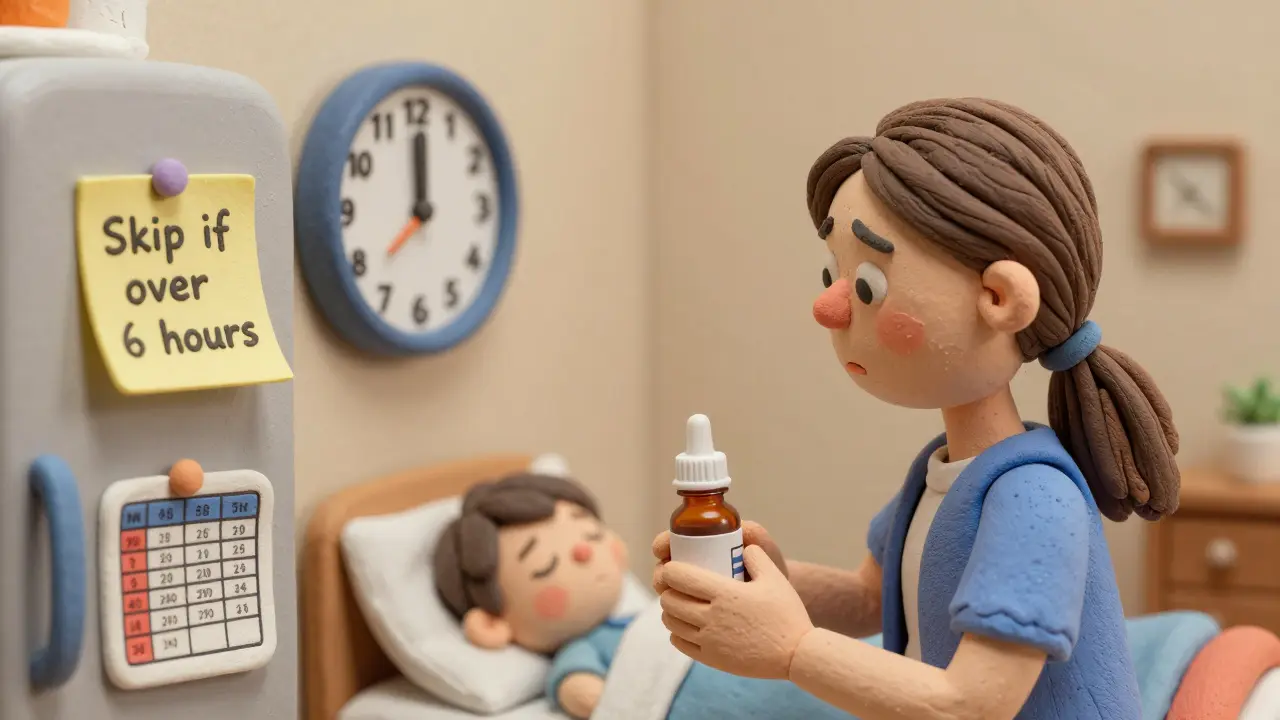
When a child misses a dose of medication, panic is common. Parents often wonder: should I give it now? Should I wait? Should I double the next dose? The truth is, never double a dose-and that’s just the start. Getting this right matters more than most realize. A single error can lead to overdose, underdosing, or even hospitalization. In fact, medication errors contribute to nearly 1 in 10 preventable harms in children’s hospitals. But the good news? With clear, simple rules, you can handle missed doses safely-every time.
Why Timing Matters More Than You Think
Pediatric bodies don’t process drugs like adults. Kids’ livers and kidneys are still developing, so even small changes in drug levels can cause big problems. That’s why timing isn’t just about staying on schedule-it’s about safety. For example, giving too much acetaminophen too close together can damage the liver. Too little antibiotics can let an infection grow stronger. The goal isn’t perfection; it’s staying in the safe zone.General Rules Based on Dosing Frequency
The time window for making up a missed dose depends on how often the medicine is given. Here’s what works for most common pediatric medications:- Once-daily: If you remember within 12 hours of the missed time, give it. If it’s been more than 12 hours, skip it. Don’t double up the next day.
- Twice-daily (every 12 hours): If you remember within 6 hours of the missed dose, give it. If it’s been longer, skip it and wait for the next scheduled dose.
- Three times daily (every 8 hours): Give the missed dose only if you remember within 3 hours. After that, skip it.
- Four times daily (every 6 hours): Give the missed dose only if you remember within 2 hours. Otherwise, skip it.
- Every 2-4 hours (like some pain or seizure meds): Skip any dose missed by more than 2 hours. These meds are often narrow-therapeutic-index, meaning small changes can be dangerous.
These time thresholds come from major children’s hospitals like Children’s Wisconsin and Cincinnati Children’s. They’re based on how long drugs stay active in a child’s body and how quickly levels rise to unsafe levels.
When to Skip the Dose-No Exceptions
There are times when skipping is not just okay-it’s required:- If it’s almost time for the next dose. Don’t give the missed one. Just wait.
- If the child is vomiting, has a fever, or is unusually sleepy. These can be signs the body is struggling. Call the doctor before giving anything.
- If the medicine is meant to be given on an empty stomach and the child just ate. Wait until the next scheduled time.
Many parents think skipping means the treatment won’t work. But in reality, skipping one dose and returning to the regular schedule is safer than forcing in an extra one. The body can handle a short gap better than a sudden spike in drug levels.
High-Risk Medications Need Special Care
Some medicines are more dangerous if missed-or if given late. These include:- Chemotherapy drugs: Any missed dose must be reported to the oncology team immediately. Even one delay can affect treatment success.
- Seizure medications (like levetiracetam or valproate): Missing a dose can trigger a seizure. If you’re unsure, call the neurologist. Don’t guess.
- Insulin: Never skip or double insulin without talking to the pediatric endocrinologist. Blood sugar swings can be life-threatening.
- Heart medications (like digoxin or beta-blockers): These have very tight safety margins. A missed dose can cause arrhythmias. Always call the provider.
These are called “high-alert” medications. They’re labeled as such for a reason. If your child takes any of these, ask your doctor for a written plan. Keep it on the fridge. Review it monthly.
Why Doubling Doses Is Dangerous
You might think, “I’ll just give double next time to make up for it.” That’s a mistake. Children’s bodies are smaller, and their ability to break down drugs is less efficient. A 2023 study found that doubling doses increases the risk of severe reactions by 278% in kids under 12. Why? Their liver enzymes aren’t fully mature. A dose that’s safe for an adult can become toxic in a child-even if it’s just 10% too much.One real case from Birmingham: A 4-year-old was given double the dose of amoxicillin after a missed dose. Within hours, he developed severe diarrhea and dehydration. He ended up in A&E. The doctor said it was preventable. That’s why the rule is simple: Never double.
How to Avoid Missed Doses in the First Place
Prevention beats correction. Here’s what works:- Use a dosing app: The American Academy of Pediatrics released a free app in 2023 called Pediatric Medication Safety Calculator. It tells you exactly what to do if a dose is missed, based on the medicine, frequency, and time elapsed.
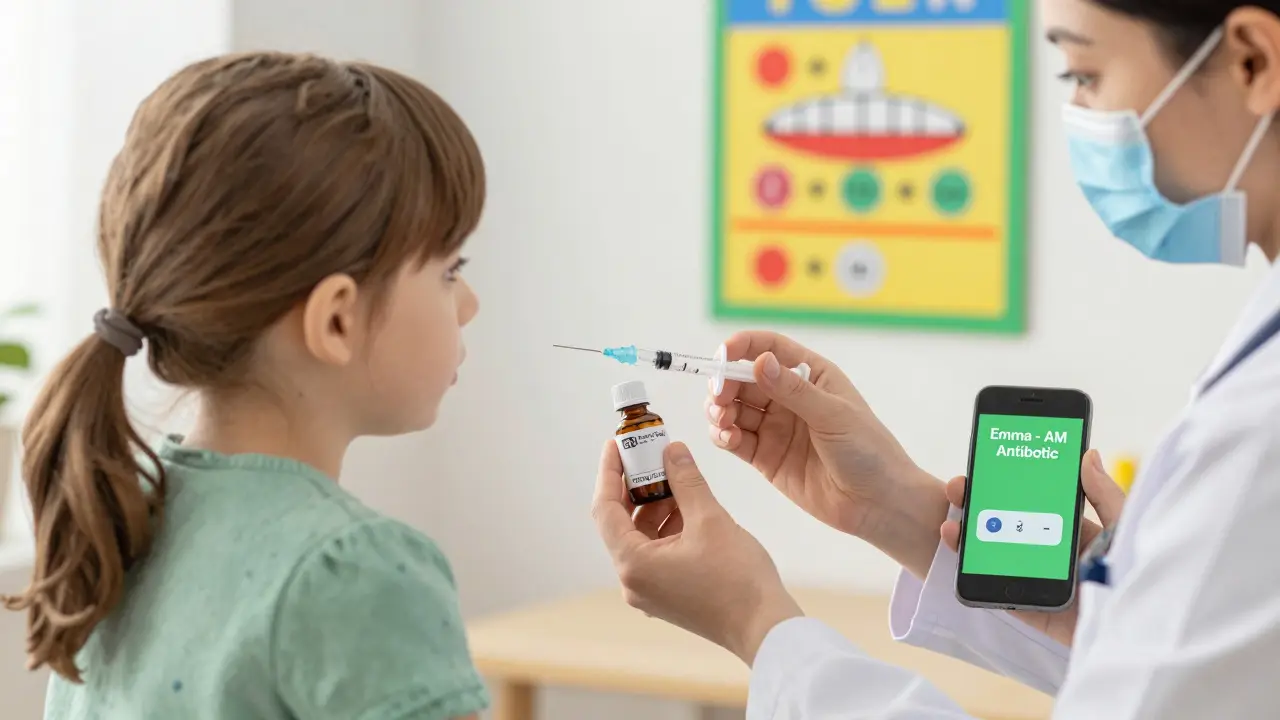
- Set phone alarms: Label them clearly: “Emma - AM Antibiotic,” “Liam - PM Seizure Med.”
- Use oral syringes: Not teaspoons. Not coffee spoons. A 2021 FDA study found that using household spoons led to 22% more dosing errors. Oral syringes are accurate and come in 0.5 mL increments.
- Color-code charts: Boston Children’s Hospital found that color-coded charts (red for morning, blue for afternoon) reduced missed doses by 44%. Tape one to the fridge.
- Teach-back method: After your doctor explains the schedule, ask your child to repeat it back. If they can’t, ask again. If you can’t, ask the nurse to demonstrate.
What to Do If You’re Still Unsure
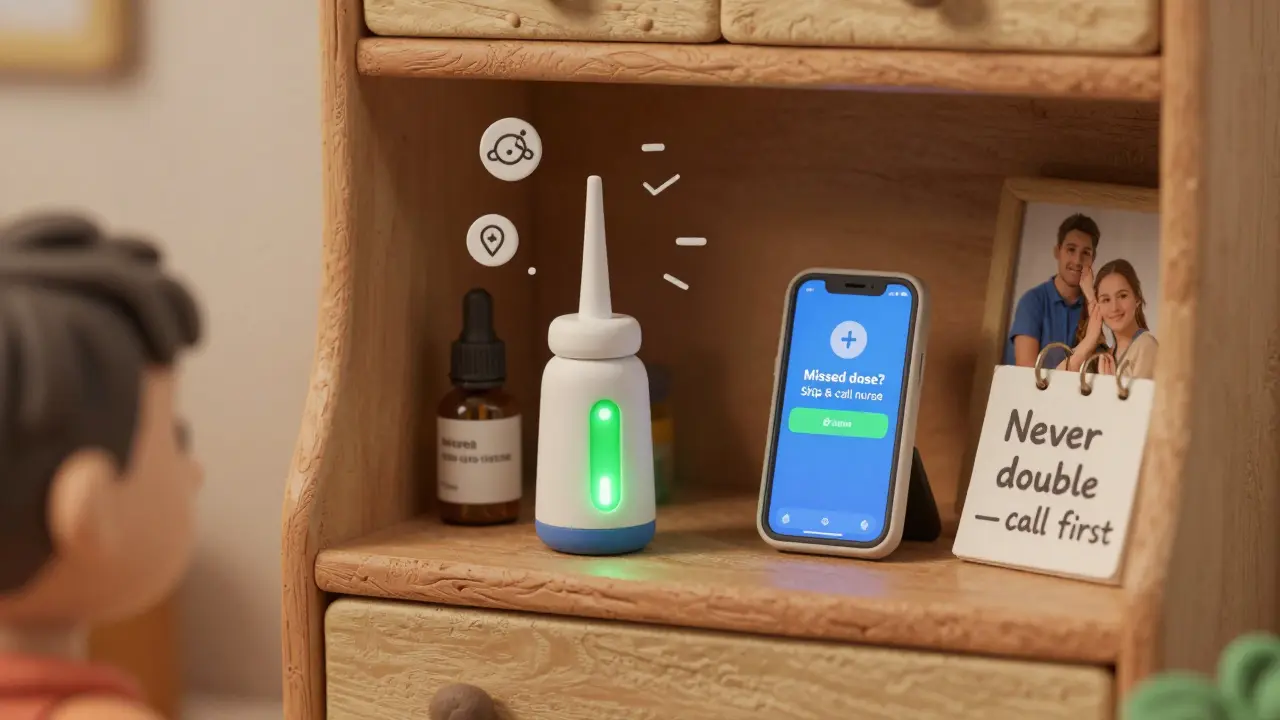
If you’re confused-don’t guess. Call your pediatrician. Or, if it’s after hours, call NHS 111. You don’t need to wait until morning. Most clinics have a nurse line for exactly this kind of question. Don’t feel bad for calling. You’re doing the right thing.One parent in Manchester said, “I called at 10 p.m. because I missed my daughter’s 8 p.m. seizure med. The nurse said, ‘Skip it. Don’t give it now. Give the next one at 8 a.m.’ I was so relieved.” That’s the kind of support you need.
What’s Missing from Medicine Labels
Here’s the hard truth: 1 in 4 high-risk pediatric medications have no missed dose instructions on the label. That’s according to the National Patient Safety Agency. You can’t rely on the leaflet. You need a plan from your doctor. Always ask: “What should we do if I miss a dose?” Write it down. Keep it with the meds.Also, check the concentration. Many liquid medicines come in different strengths (e.g., 125 mg/5 mL vs. 250 mg/5 mL). Mixing them up is a common error. Always double-check the label before giving it.
What’s Changing for the Better
The field is improving. Smart dispensers that beep when a dose is due are now used in homes and clinics. In trials, they reduced missed doses by 68%. The NHS is starting to pilot them for kids with chronic conditions. AI systems that predict when a dose is likely to be missed are being tested too. One NIH-funded project alerts caregivers 30 minutes before the scheduled time-based on past behavior. Early results show a 68% drop in missed doses.But the biggest change? Doctors are finally asking parents, “What’s your plan if you miss a dose?” Not just, “Can you give this medicine?” That shift is saving lives.
What should I do if I realize I missed a dose hours ago?
Check the dosing frequency. If you’re within the safe window (e.g., 12 hours for once-daily, 6 hours for twice-daily), give it now. If it’s past that window, skip it. Never double the next dose. When in doubt, call your pediatrician or NHS 111.
Can I give the missed dose if my child is sleeping?
If the medicine is not urgent (like a routine antibiotic), wait until they wake up. For critical meds like seizure drugs, gently wake them if you’re within the safe window. If it’s been too long, skip it. Never force a child to take medicine while deeply asleep-it’s a choking risk.
My child vomited right after taking the medicine. Should I give another dose?
If they vomited within 15 minutes of taking it, give another full dose. If it was more than 15-30 minutes later, the medicine was likely absorbed-don’t give another. If you’re unsure, call your doctor. Don’t assume they didn’t absorb it.
Is it safe to use a kitchen spoon to measure liquid medicine?
No. Kitchen spoons vary widely in size. A teaspoon might hold 3 mL or 7 mL. The FDA says this causes 22% of dosing errors. Always use the oral syringe or dosing cup that came with the medicine. If you lost it, ask the pharmacy for a new one-free of charge.
What if I miss a dose for several days?
Call your doctor immediately. For antibiotics, the infection might return. For seizure meds, the risk of a seizure increases. For chronic conditions like asthma or diabetes, skipping multiple doses can lead to serious complications. Don’t wait to restart. Get professional advice.


christian jon
OH MY GOD. I JUST REALIZED I’VE BEEN DOUBLING DOSES FOR MY KID’S ANTIBIOTICS FOR 8 MONTHS!!!
MY 5-YEAR-OLD HAS BEEN HAVING ‘BLOODY DIARRHEA’ SINCE JANUARY-AND I THOUGHT IT WAS JUST ‘STOMACH FLU’!!
THIS ARTICLE JUST GAVE ME A HEART ATTACK. I’M CALLING THE PEDS RIGHT NOW. I’M GOING TO SEND THEM A LINK TO THIS POST AND DEMAND A REFUND ON MY PARENTING CREDIBILITY.
WHY DOESN’T THE PHARMACY PUT THIS ON THE LABEL?!?!?!?!
THEY JUST SAY ‘TAKE AS DIRECTED’ LIKE WE’RE ROBOT DOCTORS!!
I’M TAKING A PICTURE OF THIS AND PUTTING IT ON MY REFRIGERATOR NEXT TO THE ‘DO NOT TOUCH THE OVEN’ NOTE.
THIS ISN’T JUST ADVICE-IT’S A LIFESAVING MANUAL.
THANK YOU. I’M SO EMBARRASSED. I’M SO GRATEFUL. I’M SO SCARED.
IF YOU’RE READING THIS AND YOU’RE DOUBLING-STOP. NOW. CALL YOUR DOCTOR. YOU’RE NOT ALONE.
WE’RE ALL JUST TRYING TO NOT KILL OUR KIDS WITH GOOD INTENTIONS.
PS-WHY ISN’T THIS ON TV?!?!
steve sunio
this post is kinda long fr but i get it like u dont double doses but like honestly who remembers every 8 hours?? my kid sleeps 12 hours straight and i dont wake him up for meds like im not a nurse lmao
Robert Petersen
Hey, just wanted to say-this is such a thoughtful, clear guide. I’ve been stressing over my daughter’s seizure meds since she started on them, and this actually calmed me down.
I started using the dosing app they mentioned, and it’s been a game-changer. The alarms with her name on them? So helpful. I even printed out the color-coded chart and stuck it next to the fridge.
And honestly? The part about calling the nurse line at night? I did that last week. She was so kind. No judgment. Just clarity.
You’re not alone. We’re all figuring this out one missed dose at a time.
Sonja Stoces
LMAO so you’re telling me I shouldn’t just shove the pill down her throat while she’s asleep? 😳 I mean… I’ve done it like 3 times. She didn’t choke. She just spit it out. So… technically it worked?
Annie Joyce
Y’all need to stop overcomplicating this. The real issue? Most of us don’t have access to oral syringes because pharmacies don’t give them out unless you ask.
I had to call my pharmacy THREE times before they mailed me one. FREE. No charge. Just ask.
And if your kid vomits? Don’t panic. Wait 30 minutes. If they’re acting normal? Don’t redose. If they’re lethargic or feverish? Call. Don’t guess.
Also-color-coded charts? YES. I made mine with crayons. My 3-year-old points to the blue square. It’s cute. It works.
You don’t need to be a nurse. You just need to be consistent. And ask for help. That’s it.
Rob Turner
i remember when my son missed his insulin dose for two days last winter and we ended up in a&e. the doctor said "you’re lucky he’s still here." i didn’t sleep for 3 days after that. i keep a laminated card in my wallet now. "what to do if you miss a dose." it’s small. it’s simple. it saved me. you’re not alone. call. always call.
Luke Trouten
The underlying assumption here-that parents are capable of following complex dosing schedules-isn’t universally true.
Many families juggle multiple children, irregular work hours, language barriers, or lack of access to consistent healthcare.
While the guidelines are medically sound, they assume ideal conditions: stable housing, reliable transportation, and access to apps and syringes.
Real-world parenting isn’t a flowchart. It’s chaos with love.
What we need isn’t just better instructions-it’s systemic support: subsidized dosing tools, nurse hotlines available 24/7, and pediatricians who don’t make you feel guilty for being human.
Gabriella Adams
I have to say-this is one of the most thorough, well-researched pieces on pediatric medication I’ve ever read. The citations from Children’s Wisconsin and the NHS? Spot on. The 2023 study on doubling doses? Validated. The emphasis on oral syringes? Critical. I’m a pediatric nurse, and I’m sharing this with every family I see. Thank you for the clarity, the compassion, and the courage to say: "Don’t guess. Call." That’s the golden rule.
Kristin Jarecki
The section on high-alert medications should be mandatory reading for every caregiver. I work in a children’s hospital, and I’ve seen too many preventable admissions from missed insulin or seizure med doses. The fact that 1 in 4 labels lack instructions is unacceptable. We need standardized, plain-language inserts-printed, not digital. And they need to be in multiple languages. This isn’t just advice-it’s public health infrastructure.
Craig Staszak
I just started using the app and the alarms and honestly its a game changer i used to rely on my memory and now i have a little bell that goes off and says "Liam - PM Seizure Med" and i just smile and go "yep got it" its like having a tiny robot nurse in my pocket
Jason Pascoe
I missed my daughter’s dose for 3 days last month. I called the doctor. She said, ‘It’s okay. We’ll adjust.’ No panic. No shame. Just a plan. That’s the kind of care we need. Not fear. Not guilt. Just clear, calm guidance. Thank you for writing this. It’s the kind of thing I wish I’d had when I was terrified.