
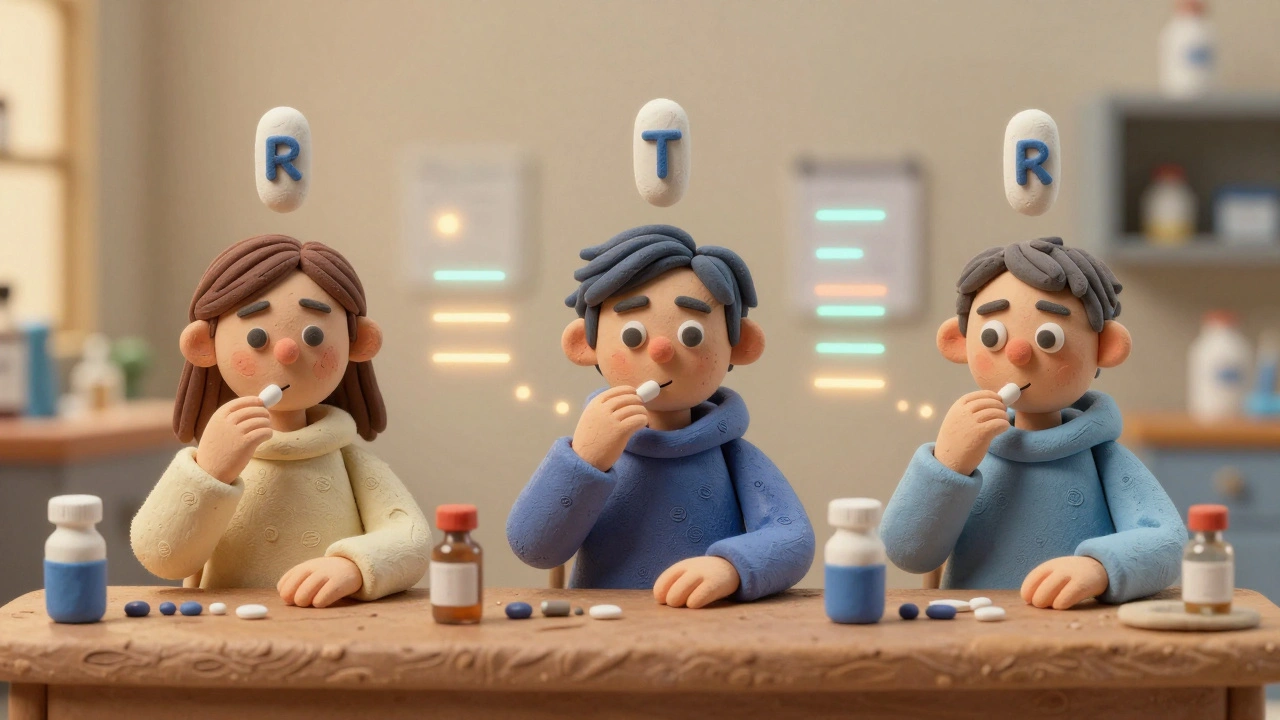
When a drug is highly variable-meaning its absorption in the body changes a lot from person to person-standard bioequivalence studies often fail. You might test 100 people and still not get a clear answer. That’s where replicate study designs come in. These aren’t just fancy versions of the old two-period crossover studies. They’re engineered solutions for drugs that play by different rules: things like warfarin, levothyroxine, or certain antiepileptics. If you’re working in generic drug development, regulatory affairs, or clinical research, understanding these designs isn’t optional-it’s the difference between a submitted application and an approved product.
Why Standard Designs Fall Apart with Highly Variable Drugs
The classic two-period, two-sequence crossover (TR, RT) works fine for drugs with low variability. But when the within-subject coefficient of variation (ISCV) hits 30% or higher, things get messy. The problem isn’t that the drug doesn’t work-it’s that the body’s response to it is too unpredictable. A 10% difference in absorption might look like a 40% difference just because of natural biological noise. Regulatory agencies like the FDA and EMA realized this in the early 2000s. If you stick with the old 80-125% bioequivalence limits for these drugs, you’d either reject safe, effective generics or approve ones that aren’t truly equivalent. Neither is acceptable.That’s why they introduced reference-scaled average bioequivalence (RSABE). Instead of using fixed limits, RSABE lets the acceptance range widen based on how variable the reference drug is. But to do that, you need data-lots of it-from the same person taking the same drug multiple times. That’s the core idea behind replicate designs: repeat dosing to measure within-subject variability accurately.
The Three Types of Replicate Designs
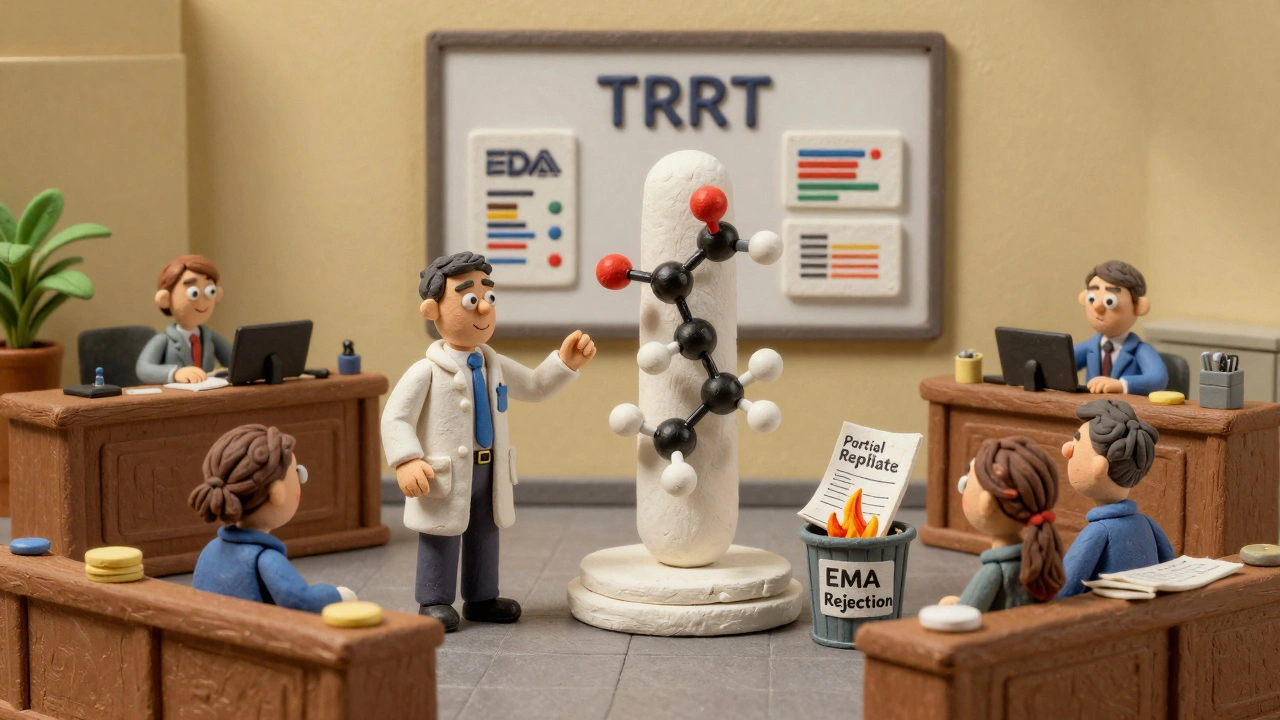
There are three main replicate designs used today, each with different strengths and regulatory acceptance.- Full replicate (four-period): TRRT or RTRT. Each subject gets both the test and reference drug twice. This lets you calculate variability for both products separately. The FDA requires this for narrow therapeutic index (NTI) drugs like warfarin because precision matters.
- Full replicate (three-period): TRT or RTR. Subjects get the test once and the reference twice (or vice versa). This is the most popular design in industry right now. It’s cheaper and faster than four-period, and still gives you enough data to estimate reference variability.
- Partial replicate: TRR, RTR, RRT. Each subject gets the reference drug twice but the test only once. This design estimates only the reference variability. The FDA accepts it for RSABE, but the EMA does not. That’s a key difference if you’re planning global submissions.
For drugs with ISCV between 30% and 50%, the three-period full replicate (TRT/RTR) strikes the best balance. It’s statistically robust, requires fewer subjects than four-period, and meets both FDA and EMA expectations. For drugs with ISCV above 50%, the four-period design becomes the safer bet.
Sample Size Savings Are Real
Let’s say you’re testing a drug with 50% ISCV. A standard two-period crossover might need 108 subjects to reach 80% power. A three-period full replicate design? Just 28. That’s a 74% drop in required participants. In real terms, that means cutting study costs by hundreds of thousands of dollars and reducing recruitment time from 18 months to under 6.A 2023 survey of 47 contract research organizations found that 83% consider the three-period full replicate the sweet spot. Why? Because you get enough data to satisfy regulators without overburdening subjects. One clinical operations manager shared on the BEBAC forum that their levothyroxine study passed on the first try with 42 subjects using TRT/RTR-after three failed attempts with 98 subjects using the old design.
But don’t get complacent. If you underestimate variability and pick the wrong design, you’ll still fail. Always start with published data or pilot studies to estimate ISCV. If you guess wrong, you might end up with a study that’s underpowered-or worse, statistically invalid.

Statistical Analysis Isn’t Simple
Running a replicate study is only half the battle. Analyzing it is where most teams stumble. You can’t use standard ANOVA. You need mixed-effects models that account for sequence, period, and subject effects. And you have to apply reference-scaling correctly.The R package replicateBE (version 0.12.1) is now the industry standard. It’s open-source, well-documented, and used by nearly every major CRO. Its vignette had over 1,200 downloads in early 2024 alone. But learning it takes time. A 2022 AAPS workshop found that pharmacokinetic analysts need 80-120 hours of focused training to use it confidently. Many teams hire external statisticians because internal staff lack the expertise.
Common mistakes? Using the wrong model (like assuming equal variances), misapplying scaling factors, or ignoring the FDA’s requirement that at least 12 subjects must provide data from the RTR arm in a three-period design. Miss that, and your entire study could be rejected.
Operational Challenges You Can’t Ignore
More periods mean more visits. More visits mean more dropouts. Industry data shows 15-25% dropout rates in four-period studies. That’s why you need to over-recruit by 20-30%. One team on Reddit reported a 30% dropout in a long-half-life drug study. They had to extend recruitment by eight weeks and spent an extra $187,000.Washout periods are another hidden trap. If the drug’s half-life is 12 hours, a 7-day washout might be enough. But if it’s 48 hours? You’re looking at 14-21 days between doses. That stretches the study out, increases costs, and makes subject compliance harder. Always model the washout based on actual pharmacokinetic data-not assumptions.
And don’t forget the regulatory differences. The FDA accepts partial replicates. The EMA doesn’t. The EMA allows three-period full replicates. The FDA prefers four-period for NTI drugs. If you’re aiming for both markets, you need to design for the strictest requirement. That usually means going with the four-period full replicate from the start.
Regulatory Trends Are Pushing You Forward
In 2018, only 42% of HVD bioequivalence studies used replicate designs. By 2023, that jumped to 68%. The FDA rejected 41% of HVD submissions using non-replicate designs last year. The EMA approved 78% of HVD generics using replicate designs. The message is clear: if you’re not using them, you’re risking rejection.Even more telling: the FDA’s January 2024 draft guidance proposes standardizing four-period full replicates for all HVDs with ISCV > 35%. That’s a shift toward uniformity. Meanwhile, the EMA still allows flexibility-but they’re watching. The ICH is working on a harmonized guideline expected in late 2024. If you’re planning studies now, you’re not just following current rules-you’re preparing for the next wave.
Who’s Leading the Way?
The market for bioequivalence studies hit $2.8 billion in 2023. Replicate designs now make up 35% of HVD assessments. WuXi AppTec leads with 22% market share, followed by PPD and Charles River. But the real winners are the niche CROs-like BioPharma Services-that specialize in statistical design. They don’t just run studies; they design them to pass. Their clients have approval rates of 79% for replicate studies, compared to 52% for standard ones.Where Do You Start?
If you’re new to replicate designs, here’s your roadmap:- Check the ISCV of your reference drug. Use published data, pilot studies, or FDA product-specific guidances.
- If ISCV < 30%, stick with the standard two-period crossover.
- If ISCV is 30-50%, go with a three-period full replicate (TRT/RTR).
- If ISCV > 50% or it’s an NTI drug, use a four-period full replicate (TRRT/RTRT).
- Recruit 20-30% more subjects than your power calculation suggests.
- Use replicateBE or Phoenix WinNonlin for analysis. Don’t wing it with Excel.
- Validate your statistical model with a statistician before you start.
There’s no shortcut. But if you get this right, you’ll save time, money, and headaches. And you’ll get your generic drug approved-on the first try.
What’s the minimum number of subjects needed for a three-period replicate design?
The FDA requires at least 12 subjects to provide data from the RTR arm in a three-period full replicate design. That means you need a minimum of 24 total subjects, evenly split between sequences (TRT and RTR). Fewer than that, and your study may be deemed statistically invalid-even if the results look good.
Can I use a partial replicate design for EMA submissions?
No. The European Medicines Agency (EMA) does not accept partial replicate designs (TRR, RTR, RRT) for reference-scaled bioequivalence. They require full replicate designs (TRT/RTR or TRRT/RTRT) to estimate within-subject variability for both test and reference products. Using a partial design for an EMA submission will result in rejection.
Why do some studies fail even with replicate designs?
Failures usually come from poor design choices: incorrect statistical models, inadequate washout periods, or insufficient subject retention. Even with the right design, if you don’t account for dropout rates or use the wrong software (like Excel instead of replicateBE), your results won’t meet regulatory thresholds. Another common error is assuming the drug’s variability is low when it’s actually high-leading to underpowered studies.
Is RSABE accepted worldwide?
Yes, but with differences. The FDA, EMA, Health Canada, and Australia all accept RSABE for highly variable drugs. The WHO and some Asian regulators are adopting it too. However, the exact criteria vary: the FDA allows partial replicates; the EMA doesn’t. The FDA uses a scaling factor of 0.76; the EMA uses 0.76 for ISCV > 30%, but applies it differently. Always check the specific guidance for your target market.
Are replicate designs only for oral tablets?
No. While most replicate studies focus on immediate-release oral solids, the approach applies to any drug with high within-subject variability-injectables, inhalers, topical products, and even extended-release formulations. The key factor is variability, not dosage form. If the ISCV exceeds 30%, replicate designs become necessary regardless of how the drug is delivered.
What’s the future of replicate study designs?
The future is adaptive designs and machine learning. The FDA is exploring studies that start as replicate designs but switch to standard analysis if variability turns out to be lower than expected. Pfizer’s 2023 proof-of-concept showed 89% accuracy in predicting sample sizes using historical BE data. Regulatory harmonization is also underway through ICH, which could simplify global submissions. But the core principle won’t change: if a drug varies a lot, you need multiple doses from the same person to prove it’s safe and effective.

Ali Bradshaw
Really solid breakdown. I’ve run three of these in the last year and the 3-period TRT design is absolutely the sweet spot for cost and compliance. Got a 48-hour half-life drug last month - we over-recruited by 25% and still lost 18%. Washout planning is everything.
Mark Curry
It’s wild how we’ve turned something so simple - proving a pill works the same - into a statistical maze. I get why we need it, but it feels like we’re building a cathedral to prove a rock is a rock.
Michael Dioso
They say replicate designs save money but honestly? It’s just Big Pharma’s way of making CROs bill more hours. You need a PhD just to run the analysis now. Who the hell is paying for this? The patient? I bet not.
Jennifer Patrician
They’re lying about the dropout rates. I worked at a clinic that got paid per subject and we ‘encouraged’ people to stay. We had a guy who came back 3 times because we gave him $500 cash each visit. They don’t tell you this part.
sean whitfield
So we’re spending $2M to prove a drug works… but only if it’s not too variable? What if the drug’s just bad? Maybe we should stop making drugs that turn people into lottery tickets.
Philip Kristy Wijaya
While the statistical rigor is commendable, one must not overlook the epistemological foundations of bioequivalence itself. The assumption that within-subject variability can be meaningfully quantified via repeated dosing presupposes a Cartesian model of the body as a closed system - a model increasingly undermined by systems biology and microbiome research. Are we not, in essence, attempting to calibrate a sundial using a quantum clock?
Laura Saye
The shift toward adaptive designs is fascinating - it mirrors the evolution of Bayesian thinking in clinical trials. The real win here isn’t just regulatory compliance, it’s the paradigm shift from fixed protocols to dynamic, data-driven decision trees. This is where personalized bioequivalence begins.
Mellissa Landrum
theyre all lying about the ema and fda thing. i heard from a guy at a conference that theyre secretly sharing data behind the scenes. the whole ‘different rules’ thing is just to make us think we need two studies. its all one big scam to keep prices high.
Krishan Patel
If you're not using replicate designs, you're not just risking rejection - you're betraying the integrity of pharmacology. This isn't about profit. It's about patients who depend on consistent dosing. Anyone who cuts corners on this is morally bankrupt. The FDA is right. The EMA is right. The science is right. Stop making excuses.
luke newton
So let me get this straight - we’re paying millions to prove that a generic drug is ‘close enough’? And we call this science? I’d rather pay double for the brand and not risk my life on a statistical loophole. This whole system is a joke.
Carole Nkosi
It’s not about the design. It’s about control. The same people who profit from branded drugs own the CROs, the software, the journals. They built this complexity so small players can’t compete. The ‘science’ is just the cover.
Manish Shankar
Thank you for this comprehensive overview. In my experience in Indian clinical research, the three-period full replicate design has proven most feasible due to resource constraints and subject availability. However, the challenge lies in ensuring statistical expertise at the site level - many teams still rely on outsourced analysts, which introduces communication gaps. I would strongly recommend establishing in-house biostatistics training programs, even if scaled down. The investment pays off in reduced regulatory queries and faster approvals.