
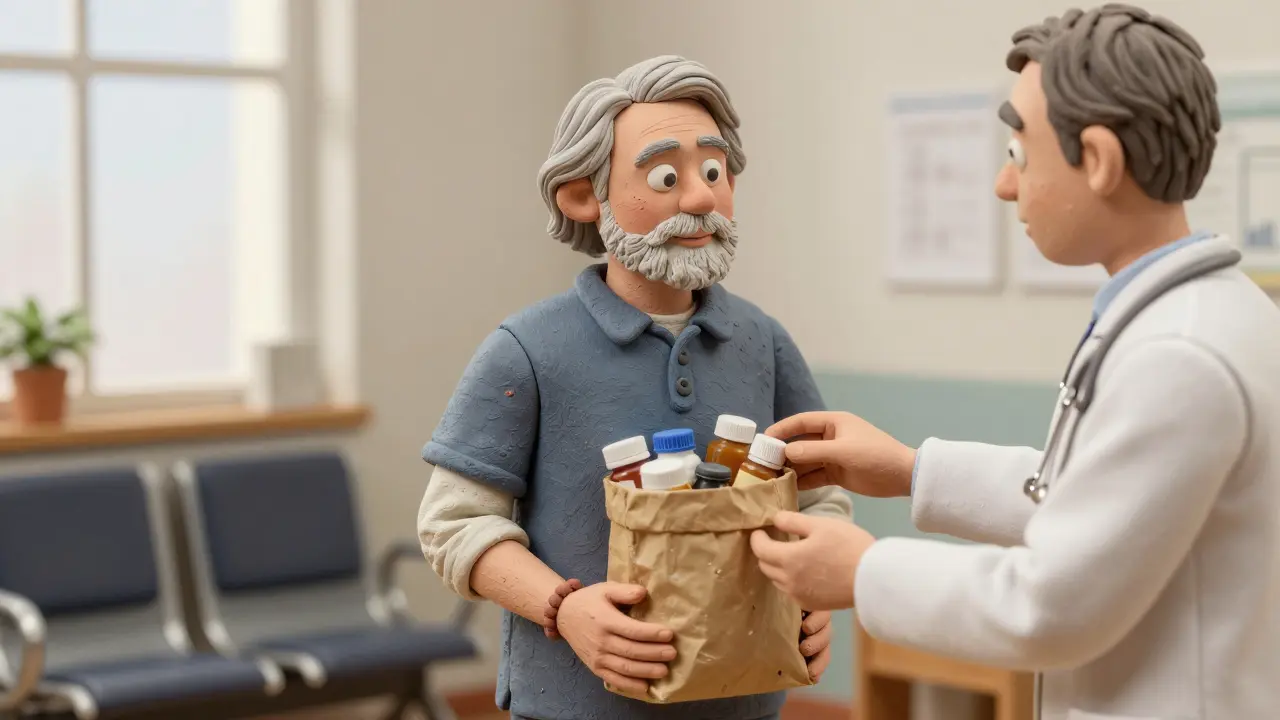
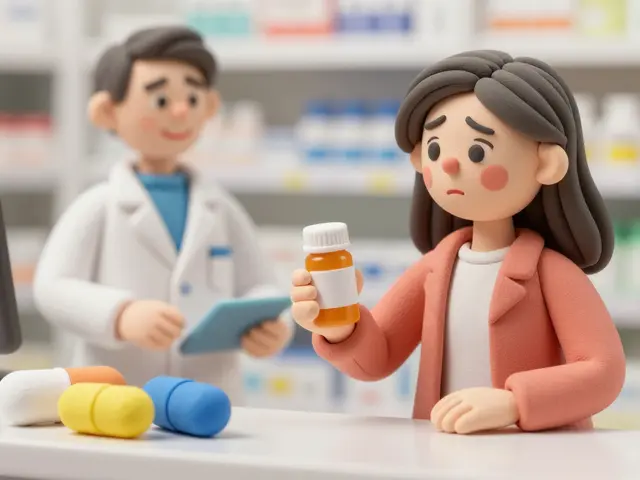
When you walk into a doctor’s office, urgent care, or hospital, one of the most important things you can do isn’t something they ask you to do-it’s something you need to remember to do. Bring your meds. All of them. Not just the ones you think matter. Not just the ones you’re taking right now. All of them. Because the difference between a safe prescription and a dangerous mistake often comes down to whether someone knew you were taking that old blood pressure pill from last year, or that herbal supplement your cousin swore by, or the over-the-counter painkiller you’ve been popping every night for months.
Medication errors are not rare. They’re common. And they’re preventable. In the U.S., about 7,000 to 9,000 people die every year because of mistakes linked to medications. That’s not because doctors are careless. It’s because the system is broken-unless you help fix it. Your medical history isn’t just a list. It’s your safety net.
Why Your Medication List Matters More Than You Think
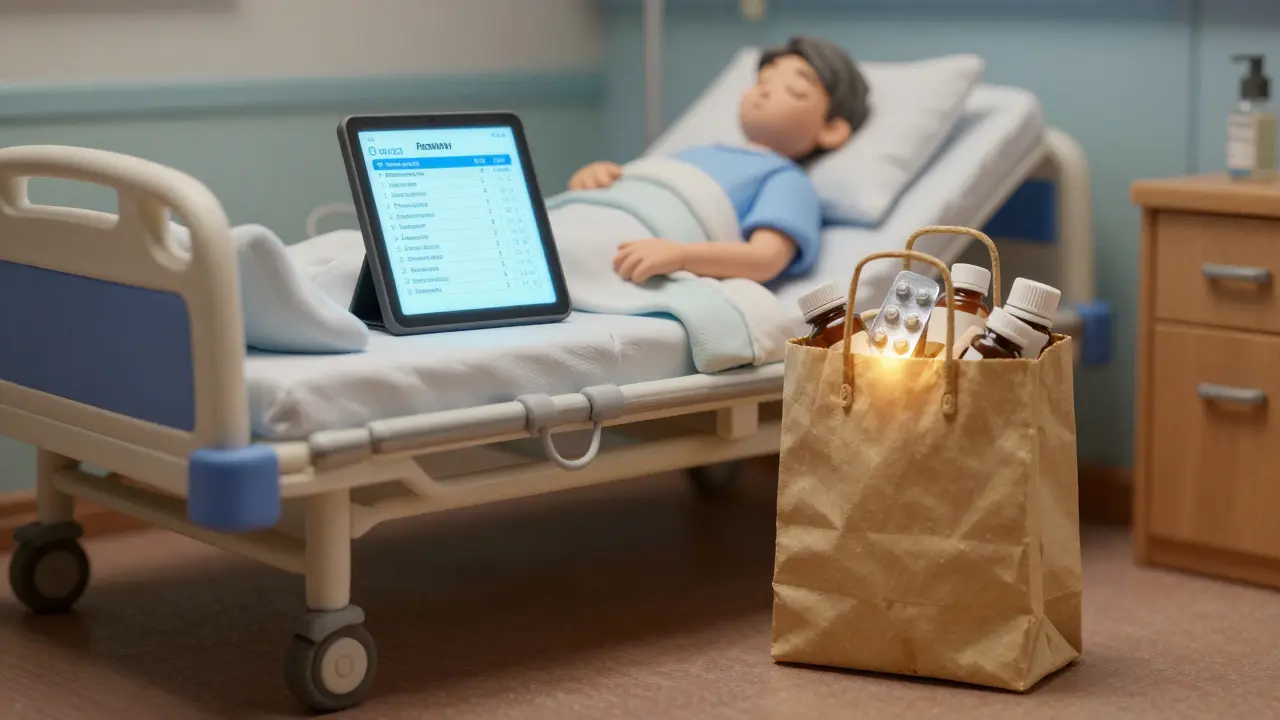
Think of your medications like a puzzle. Every pill, patch, liquid, or supplement is a piece. If even one piece is missing, the whole picture changes. When you’re admitted to the hospital, staff are supposed to create an accurate list of everything you’re taking. This is called medication reconciliation. It’s not optional. It’s a national safety standard, required at every transition-admission, transfer, discharge.
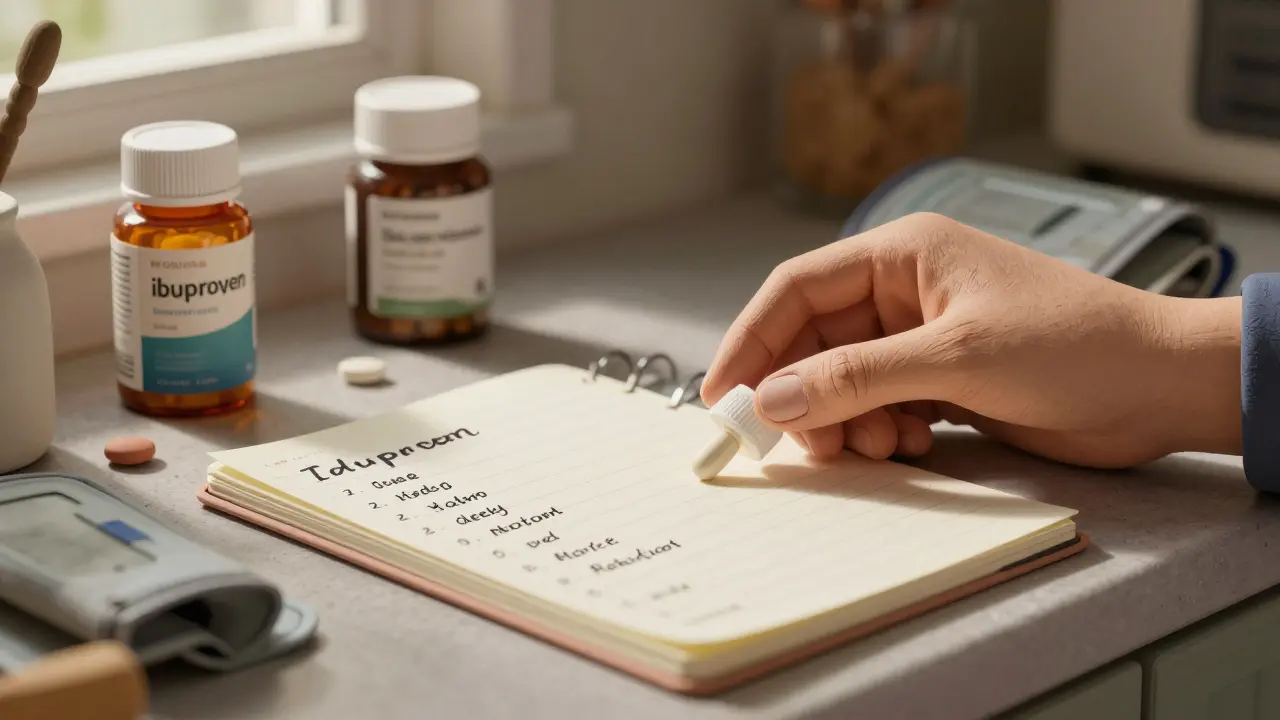
But here’s the problem: manual lists, the kind based on memory or paper notes, miss about 25% of medications. That’s one in four drugs. And when you’re on five or more medications-common for people over 65-that risk jumps to 88%. You might not realize it, but taking a blood thinner and an NSAID like ibuprofen together can cause internal bleeding. Or mixing a sedative with an allergy pill might slow your breathing. These aren’t rare side effects. They’re predictable. And they’re avoidable.
Electronic systems help. Services like Surescripts pull data from over 98% of U.S. pharmacies and 100% of major pharmacy benefit managers. In 2024 alone, they delivered 3.31 billion medication histories. That sounds impressive. But even these systems miss things. Cash-pay prescriptions. Supplements. Over-the-counter drugs. Herbal teas you think are harmless. If you don’t say it, they won’t know.
What You Need to Track (And How)
You don’t need a fancy app. You don’t need to be tech-savvy. You just need a list-and to keep it updated.
Here’s what to include:
- All prescription drugs (even ones you don’t take every day)
- All over-the-counter medicines (painkillers, antacids, sleep aids, cold meds)
- Vitamins, minerals, and supplements (even if you take them “just once a week”)
- Herbal remedies and teas (ginkgo, St. John’s wort, turmeric-yes, even these)
- Any injections, patches, or inhalers
- How often and why you take each one
The best way to do this? The brown bag method. Every time you go to a doctor or pharmacy, bring all your medications in a brown paper bag. Not a list. Not a photo. The actual bottles. This cuts discrepancies by 40% compared to just telling someone what you take. Why? Because pills look different than you remember. Doses change. Names get confusing. And sometimes, you forget you took something because it was given to you in the ER six months ago.
Update this list after every visit. If your doctor changes a dose, crosses something out, or adds a new drug-write it down right there. Don’t wait until next week.
What Providers Are Doing (And Where They’re Falling Short)
Hospitals and clinics use electronic health records (EHRs) to track medications. Many integrate with pharmacy databases. Some use AI tools to flag possible interactions. In 2023, 85% of U.S. hospitals could exchange medication data bidirectionally with pharmacies using FHIR standards. That’s progress.
But here’s the catch: 49% of medication interaction alerts are ignored by clinicians because they’re too noisy. Too many false alarms. Too many pop-ups. Doctors start tuning them out. That’s called alert fatigue. And it’s dangerous.
Also, 67% of patients don’t accurately report OTC meds. Why? They don’t think it counts. Or they forget. Or they’re embarrassed. One patient told me, “I didn’t say I was taking melatonin because my doctor never asked.” Another said, “I thought ‘as needed’ meant I didn’t have to tell them.”
And allergies? They’re often incomplete. One study found that only 61% of allergy records matched what patients actually experienced. If you’re allergic to penicillin, but your chart says “no known allergies,” you might get prescribed it anyway. That’s not a mistake-it’s a risk.
How You Can Make It Work
You are the most important part of this system. No technology replaces you. Here’s how to own it:
- Keep a current, written list. Update it after every appointment.
- Bring your brown bag to every visit-even if it’s just a follow-up.
- Ask: “Is this new medication safe with everything else I take?” Don’t wait for them to ask you.
- If you’re on blood thinners, insulin, or heart meds, carry a card with your meds and doses. Keep it in your wallet.
- Teach someone close to you-your partner, child, caregiver-how to read your list. In an emergency, they might be the one speaking for you.
One nurse practitioner in Birmingham told me about a patient who came in after fainting. She thought it was just low blood sugar. But when they pulled up her brown bag, they found she’d been taking a new herbal supplement for “energy” that interacted with her beta-blocker. She stopped it. Her dizziness went away. No hospital stay. No tests. Just a bag of pills and a honest conversation.
What’s Changing-and What’s Coming
Things are improving. The FDA’s 2024 Medication Error Reduction Initiative is pushing for clearer labeling on high-risk drugs like insulin and anticoagulants. Google Health’s AI prototype cut medication discrepancy time by 63% in trials. Patient portals now let you view your medication list online-76% of patients can access theirs.
But here’s the reality: technology can’t fix what people don’t say. A machine can’t tell if you’re hiding a pill because you can’t afford it. Or if you stopped taking a drug because it made you dizzy. Or if you’re taking a friend’s leftover antibiotics because you didn’t want to go to the clinic.
That’s why your voice matters. That’s why honesty matters. That’s why bringing your brown bag isn’t a chore-it’s your power.
What Happens When You Don’t Share
One Reddit user, u/MedSafetyAdvocate, shared their story: “I had 12 medications. The hospital recorded only 7. I ended up with a dangerous interaction that sent me to ICU.”
Another: “My mom took her pills every day. But she didn’t tell the doctor she’d started CBD oil. They gave her a new antidepressant. She had a seizure.”
These aren’t outliers. They’re examples of what happens when communication breaks down. And the cost? Not just money. Not just time. Sometimes, it’s your life.
Medication safety isn’t just about doctors and systems. It’s about you. You’re the only person who knows every pill you’ve ever taken. You’re the only one who knows what side effects you felt. You’re the only one who can say, “Wait-I didn’t take that one in three weeks.”
So do it. Bring the bag. Speak up. Ask the question. Make it part of your routine. Because when it comes to your health, silence isn’t peaceful. It’s dangerous.




Kal Lambert
Bring the brown bag. Seriously. It's that simple. No app needed. No fancy tech. Just the actual pills in a bag. I've seen it save lives. Do it.
Melissa Starks
I used to think my vitamins didn't count. Then my dad ended up in the ER because the doc didn't know he was taking turmeric with his blood thinner. Turns out 'natural' doesn't mean 'harmless.' I carry my brown bag now. Every time. Even to the dermatologist. I don't care how weird it looks. I'd rather look weird than dead.
Laura Gabel
This is why America's healthcare is a joke. You're telling me we can't build a system that auto-syncs your meds from pharmacies? We have apps that track your cat's poop but not your blood pressure pills? Pathetic.
Emily Hager
I must insist that the notion of relying on a brown paper bag as a primary clinical tool is not only antiquated but fundamentally incompatible with modern medical informatics standards. The absence of interoperable, encrypted, blockchain-verified pharmacovigilance infrastructure represents a systemic failure of national policy.
Jeremy Van Veelen
Oh wow. Another one of these 'just bring your pills' pep talks. Like, did you hear? The system is broken, so now we're gonna make patients into pharmacy clerks? I'm tired of being told I'm responsible for fixing a broken machine because I don't have a trust fund. This isn't empowerment. It's blame.
Ayan Khan
In many cultures, especially in South Asia, elders are reluctant to speak up about medications because they fear being seen as burdensome. I've seen grandmothers hide their insulin because they thought it was 'too much' for the doctor to handle. The brown bag isn't just a tool - it's a quiet act of resistance against silence. It says: I am here. I matter. I am not a problem.
jerome Reverdy
Alert fatigue is real. I'm a pharmacist. We get 15-20 interaction alerts per prescription on average. Most are low-risk noise. Clinicians start ignoring them. The system's not designed for humans. We need smarter algorithms - not more paperwork. The brown bag helps, sure, but it's a Band-Aid on a hemorrhage.
MALYN RICABLANCA
I had a client who was on 14 meds - 7 prescriptions, 3 OTCs, 2 supplements, 1 herbal tea, and a daily CBD gummy she called 'my happy pill.' She didn't tell anyone because 'it wasn't medicine.' Then she got prescribed a new SSRI. Three days later? She was in a psych ward, hallucinating, convinced her toaster was whispering to her. Turns out, CBD + SSRI + St. John’s Wort = serotonin tsunami. I cried. Not for her. For the system. We're all just one poorly documented gummy away from a nightmare.
Andrew Mamone
I update my med list every Sunday night. 📋💊 I use Google Keep. I take a photo of my brown bag. I share it with my sister. I ask my doc: 'Is this safe with everything else?' 🙏 I'm not perfect. But I'm trying. And if you're not, you're gambling with your life. 🚨
Melissa Stansbury
I'm so glad this post exists. My mom didn't tell her cardiologist she was taking garlic pills for 'heart health.' He prescribed her a beta-blocker. She went into a coma. We found the pills in her nightstand. She's fine now. But I'll never forget how scared I was. I carry my own bag. I make my kids carry theirs. I even made a laminated card. I don't care if it's weird. I care if I'm alive.
Laura Gabel
You're telling me the hospital doesn't have access to pharmacy records? That's a federal crime. I'm calling my congressman. This isn't negligence. It's malpractice.