

Immunosuppression Infection Risk Calculator
This tool estimates your risk of developing unusual infections based on your immunosuppressant therapy and symptoms. Based on data from the article, immunosuppressed patients may develop infections without typical symptoms.
Low Risk
Continue monitoring with regular check-ups. Consider routine screening if symptoms develop.
Moderate Risk
Discuss these recommended tests with your doctor: Stool tests for parasites (e.g., Giardia), chest imaging if respiratory symptoms present, and CMV blood tests.
High Risk
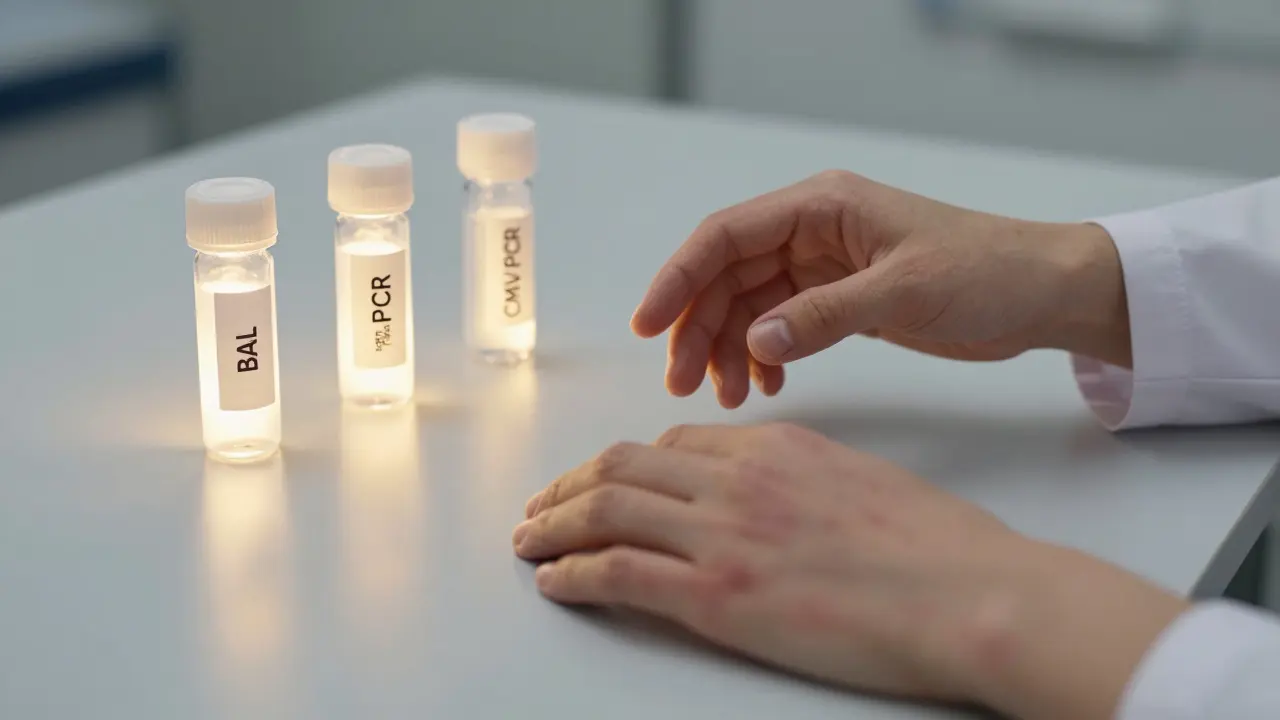
Immediate medical evaluation required. Request: Bronchoalveolar lavage (BAL) for lung assessment, blood PCR for viral infections (CMV, EBV), and comprehensive blood work. Do not delay seeking care.
When you're on steroids or other immunosuppressants, your body is doing its best to calm down an overactive immune system-whether that's for lupus, a transplant, or severe rheumatoid arthritis. But here's the hidden cost: your defenses against germs are turned down too. And that means you're not just at risk for the usual colds or flu. You're facing infections most people never even hear of-organisms that barely touch healthy people but can turn deadly in you.
Why Your Body Can't Fight Back Like It Used To
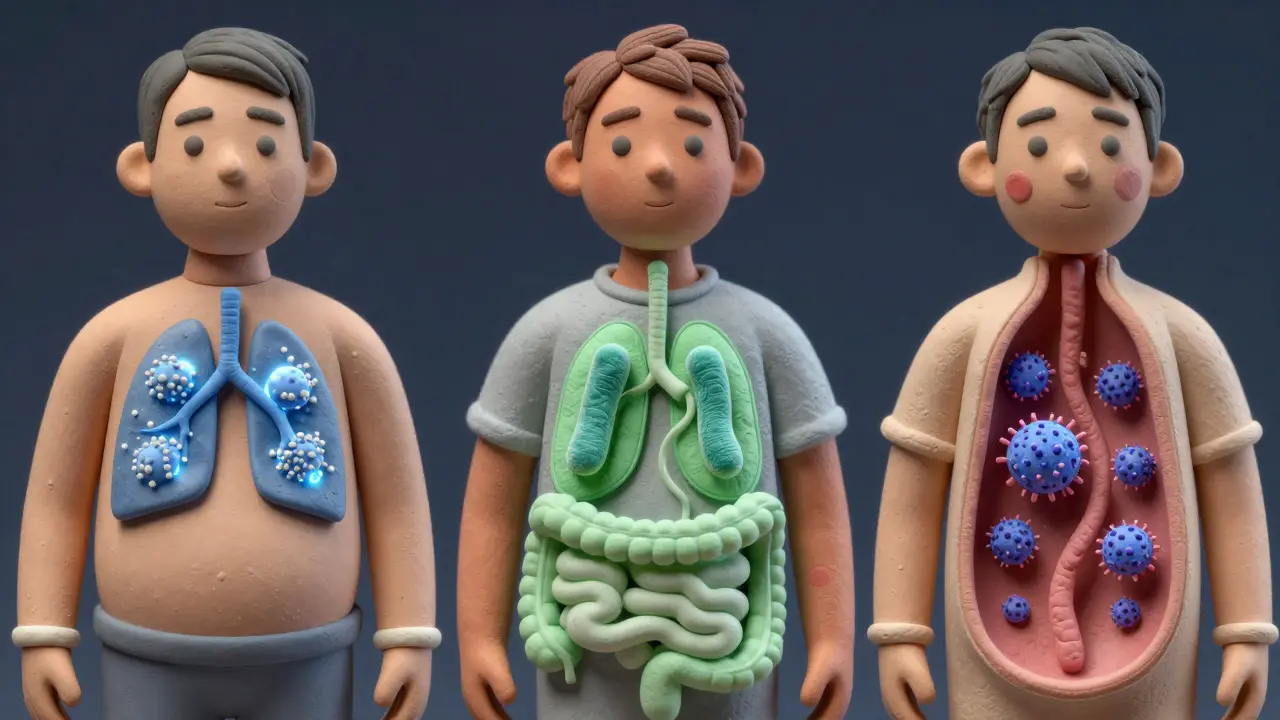
Your immune system isn't just one thing. It's a team. There are T-cells that hunt viruses, B-cells that make antibodies, and phagocytes that swallow up bacteria. When you take immunosuppressants, you're not turning off one part-you're weakening the whole team. And different drugs hit different parts. That's why one person on azathioprine might get a fungal lung infection, while another on rituximab ends up with a stubborn gut parasite.Think about it this way: if your body was a castle, immunosuppressants aren't just lowering the drawbridge. They're removing the guards, silencing the alarm bells, and patching up the walls with cardboard. Germs that normally get stopped at the gate? They walk right in.
The Unusual Suspects: Pathogens That Don't Belong
Most people never see Pneumocystis jirovecii-but in someone with low T-cells, it's one of the top causes of pneumonia. You won't cough up green phlegm. You might just feel a little tired, with a low-grade fever that won't go away. By the time you're wheezing, it's already advanced. In fact, studies show that nearly a quarter of immunosuppressed kids with this infection had zero symptoms when tested. No fever. No cough. Just a positive lab result.Then there's Giardia intestinalis. A tiny parasite. In healthy people, it causes a few days of stomach cramps and loose stool. In someone with low antibody levels-like those with X-linked agammaglobulinemia-it becomes chronic. Foul-smelling gas. Bloating. Weight loss. Eighty-seven percent of affected children show these signs. And standard treatment? Often fails. They need higher doses, longer courses, or combo therapy because their bodies can't clear it alone.
And don't forget fungi. Aspergillus is a mold you breathe in every day. In a healthy person, it's ignored. In a neutropenic patient? It invades the lungs, spreads to the brain, and kills over half the time-even with the best antifungals. Compare that to a 15% death rate in someone with a normal immune system. That's not a coincidence. That's a direct result of missing immune cells.
Even bacteria act differently. Staphylococcus aureus is common, sure-but in patients with phagocyte defects, it doesn't just cause a boil. It burrows into bones, forms abscesses in the liver and spleen, and hides inside cells where antibiotics can't reach. And then there are the weird ones: Flexispira and Helicobacter species, found in just two cases of antibody deficiency. These aren't textbook bugs. They're ghosts of the microbiome, only visible when immunity collapses.
Why Symptoms Are Missing-and Why That's Dangerous
Fever? Not always. Redness? Sometimes barely there. Pus? Rare. In a healthy person, your body screams when something's wrong. In an immunosuppressed patient? It whispers. Or worse-stays silent.This isn't just inconvenient. It's deadly. A study of 69 kids before stem cell transplant found that 23% of those with confirmed infections showed no symptoms at all. One child had a positive lung fluid test for Pneumocystis but was running around, eating normally, no cough. Another had a skin infection that looked like a rash-until it turned into necrotizing tissue. The doctors didn't catch it because they were looking for classic signs.
That's why routine screening matters. Bronchoalveolar lavage (BAL) isn't just for sick people. It's for anyone on long-term immunosuppression with even a hint of respiratory change. The test catches Pneumocystis with 92% accuracy-far better than sputum tests. Stool samples with fluorescent antibodies? That's how you find Giardia in 98% of cases. You don't wait for symptoms. You test before they appear.
How Treatment Changes When Your Immunity Is Down
You can't treat these infections like you would in a healthy person. Metronidazole works for Giardia in most people. But in someone on immunosuppressants? Failure rates jump from 5-10% to 30-40%. Why? Because their body can't help the drug finish the job. They need tinidazole or nitazoxanide-stronger, longer, sometimes both.Antifungals? They're harsher. Amphotericin B can wreck your kidneys. Voriconazole messes with your liver. And in transplant patients? Drug interactions with cyclosporine or tacrolimus can turn a life-saving treatment into a poison. Dosing isn't just about weight or age. It's about what else you're taking.
And then there's CMV. Cytomegalovirus. In healthy people? It's a quiet passenger. In someone with low T-cells? It can cause pneumonia, colitis, retinitis. Without prophylaxis, up to 40% of transplant patients get it. And it doesn't just come once. It reactivates. Again. And again. That's why preemptive therapy-testing weekly and treating at the first sign of virus in the blood-is now standard.
The New Threats: Viruses That Won't Go Away
The pandemic didn't just change how we think about COVID. It changed how we think about all viruses in immunosuppressed people. One patient in a 2021 NIH study shed SARS-CoV-2 for over 120 days. That's more than three months of being contagious, with no symptoms. Meanwhile, healthy people clear it in under two weeks.And it's not just SARS-CoV-2. Coronaviruses NL63 and HKU1-which usually cause mild colds-are now showing up in 8.5% of respiratory infections in leukemia patients. They're not rare anymore. They're routine. Same with human herpesvirus-6. It can cause encephalitis in transplant patients, even when the person feels fine.
And here's the most hopeful part: we're starting to fight back. T-cell therapies-giving patients their own virus-fighting immune cells back-are working. In trials, 70% of patients with stubborn CMV or adenovirus infections responded. It's not magic. It's precision. You don't just pump in more drugs. You rebuild the missing soldiers.
What You Need to Do Now
If you're on long-term steroids or immunosuppressants:- Don't wait for fever. If you feel off-even slightly-get checked.
- Ask about routine screenings: stool tests for parasites, blood tests for CMV, chest imaging if you're short of breath.
- Know your drug interactions. Your pharmacist needs to know every pill you take.
- Get all recommended vaccines-flu, pneumococcal, COVID-but avoid live vaccines (like MMR or varicella) unless cleared by your specialist.
- Report skin changes immediately. A rash that won't heal? A sore that looks like a bruise? It could be histoplasmosis, not acne.
There's no magic shield. But there is awareness. And early action. The difference between catching an infection before it spreads and waiting until you're on a ventilator? That's everything.
Can immunosuppressants cause infections directly?
No, the drugs themselves don't cause infections. But they weaken your immune system's ability to fight off germs. This lets organisms that normally don't harm healthy people-like Pneumocystis jirovecii or Giardia-to take over. The infection comes from the environment or your own body's microbes, not the medication.
Are all immunosuppressed patients at the same risk?
No. Risk depends on what part of the immune system is affected. Low T-cells? You're at high risk for viruses like CMV and fungi like Aspergillus. Low antibodies? You're more likely to get bacterial or parasitic infections like Giardia. Phagocyte defects? You're prone to staph and gram-negative bacteria. Your specific drug and condition shape your unique threat profile.
Why do some infections not respond to standard treatment?
Because your immune system isn't helping. Antibiotics and antifungals work better when your body joins the fight-by sending white blood cells, creating inflammation, and clearing debris. Without that, drugs alone often fail. That's why treatment for Giardia in immunosuppressed patients often needs longer courses or combo therapy, and why fungal infections may require higher doses or longer durations.
Should I avoid travel or crowds if I'm on immunosuppressants?
You don't need to isolate, but you should be cautious. Avoid large crowds during flu season or outbreaks. Wash hands often. Wear a mask in high-risk settings like hospitals or public transit if you're recently transplanted or on high-dose therapy. Talk to your doctor about your specific risk level-some patients can travel safely with precautions, while others need stricter limits.
Is there a way to test if I'm at risk for unusual infections before they happen?
Yes. Regular monitoring is key. Blood tests for CMV, EBV, or adenovirus can catch reactivation early. Stool samples for parasites like Giardia. Chest CT scans and BAL for respiratory symptoms-even mild ones. Some centers do monthly blood PCR tests for high-risk patients. It's not about waiting to feel sick. It's about catching the infection before it finds you.



Brandon Osborne
Let me tell you something no one else will: if you're on immunosuppressants and you think you're safe because you 'don't feel sick,' you're one sneeze away from a coffin. I've seen it. My cousin was on prednisone for lupus, thought she was fine, got a 'minor' cough, and by the time they diagnosed Pneumocystis, her lungs were basically Swiss cheese. They intubated her on day three. She didn't make it. This isn't hypothetical. This is your life. Stop being lazy and get tested. Now.
Tatiana Barbosa
Just wanted to say this post is fire 🔥 Seriously, the way you broke down the immune system as a castle with cardboard walls? Genius. And the part about Giardia in antibody-deficient kids? 87% with chronic symptoms? That’s wild. I work in pediatrics and we see this all the time but never connect it to the underlying immune defect. We need more docs thinking like this. Also-yes to routine BALs. Stop waiting for fever. Your body doesn’t scream anymore. It whispers. Listen.
Ken Cooper
ok so like… i had no idea that aspergillus was just… floating in the air all the time?? like i thought it was like mold in basements or something. but nooo, its in the dirt, the leaves, the air conditioning vents?? and for normal people?? it's like ignoring a fly. but for someone with low neutrophils?? it's like a whole damn invasion fleet. also, i just learned that staph can burrow into bones?? like… why does my body even let that happen??
MANI V
People on immunosuppressants are just asking for trouble. You chose this life. You knew the risks. Why should society bear the cost of your poor decisions? You think you're entitled to live like a normal person while your immune system is on vacation? You're not. You're a walking biohazard. Stop pretending you're a victim. This is karma.
Susan Kwan
Oh wow. So the solution to ‘your body can’t fight back’ is… more tests? More drugs? More invasive procedures? Yeah. Because clearly what we need is more medical bureaucracy to tell us we’re not dying fast enough. I’m sure the 23% of kids with zero symptoms just loved getting a bronchoscopy before school. #Blessed
Random Guy
so like… if your body is a castle and the guards are gone… then what’s the point of even having walls?? like… why not just build a tent? i’m just saying. maybe we should all just live in hazmat suits. i’d wear one to the grocery store. no cap.
Ryan Vargas
Consider this: immunosuppressants aren’t just drugs. They’re metaphysical compromises. You trade autonomy for survival, but in doing so, you surrender not just immunity, but the very narrative of bodily integrity. The body as a sovereign nation? No. Now it’s a colony under occupation-by pharmaceuticals, by institutional protocols, by the silent, invisible colonization of pathogens that once would’ve been mere background noise. We’ve entered an era where health is not the absence of disease, but the perpetual negotiation with entropy. And we call this progress?
John McDonald
Big fan of the castle analogy. Honestly, this is the clearest explanation I’ve seen. I’m a transplant recipient and I’ve had two rounds of CMV reactivation. The preemptive therapy saved me-weekly blood tests, started antivirals at first sign of viral load. No symptoms. Just numbers. That’s the new normal. Also, yes to the vaccines. I got the pneumococcal one last year. No big deal. Avoid live ones? Absolutely. My doc said if I get MMR, I might as well sign a DNR. Not joking.
Andy Cortez
you know what’s wild? they say 'don't wait for fever' but then they tell you to get a bronchoalveolar lavage?? like… that’s not a test. that’s a torture device. they stick a tube down your throat and suck out your lungs?? and you’re supposed to be chill about it?? i’d rather just die. also-why do we even have hospitals? why not just let nature take its course? i’m just sayin’.
Joseph Charles Colin
Important correction: Pneumocystis jirovecii is now classified as a fungus, not a protozoan, and the term 'PJP' (Pneumocystis jirovecii pneumonia) has replaced 'PCP' in clinical literature. Also, for Giardia in antibody-deficient patients, nitazoxanide has shown 89% efficacy in refractory cases versus 58% for metronidazole. And yes-T-cell therapy for CMV is game-changing. A 2023 NEJM study showed 72% sustained response in transplant recipients with refractory CMV viremia using donor-derived virus-specific T cells. This isn't experimental anymore-it's standard of care in major centers. If your center isn't offering it, ask why.
Joshua Smith
Thanks for writing this. I’ve been on rituximab for 5 years and never realized how much my body was just… quietly failing to fight things. I thought my occasional sinus infections were just allergies. Turns out, it was Giardia. Found it in a stool test after I got really tired one day. Took 3 rounds of treatment. But now I get screened every 6 months. It’s not scary. It’s just smart. Also-my pharmacist knows every pill I take. We have a spreadsheet. We’re like a team.