
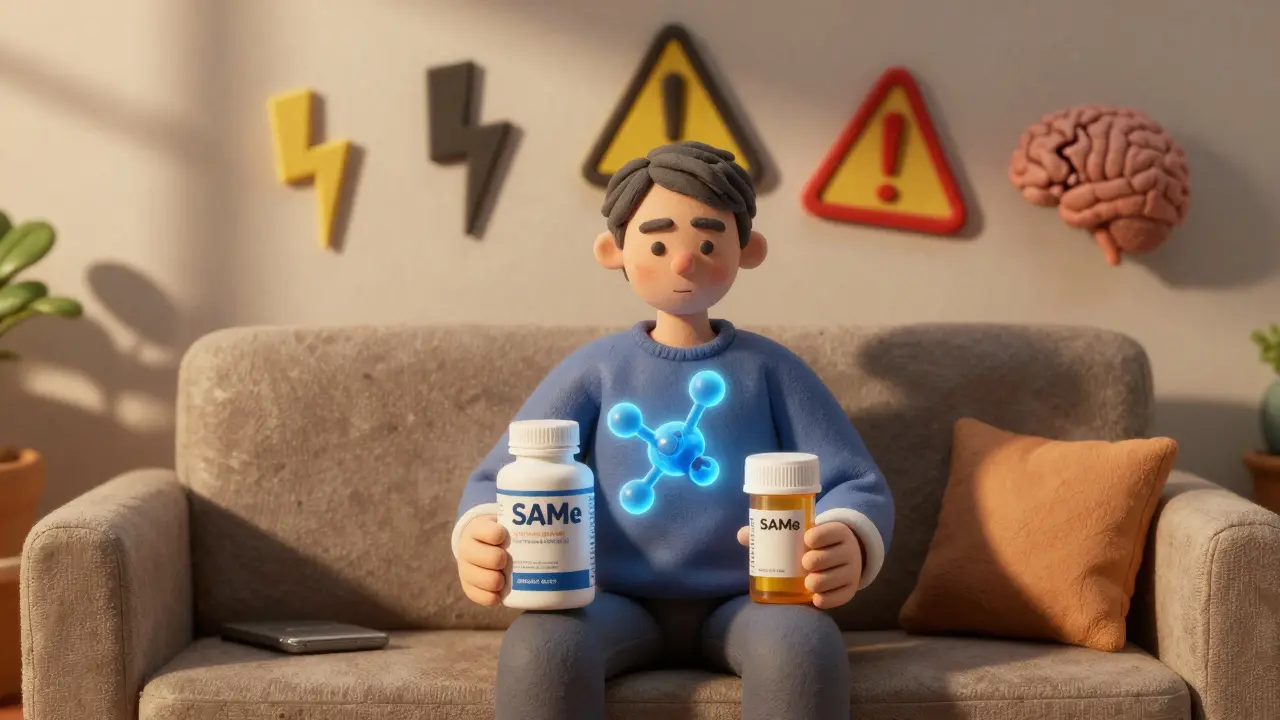
SAMe-Antidepressant Interaction Risk Calculator
This tool helps you understand the potential risks of combining SAMe with your antidepressant medication. Never combine these without medical supervision.
Serotonin syndrome is a medical emergency. Symptoms include racing heart, muscle stiffness, high fever, confusion, and tremors. Consult your doctor before taking SAMe with any antidepressant.
Supplement Quality Check
When people struggle with depression and don’t get enough relief from antidepressants, they often look for help elsewhere. One supplement that keeps coming up is SAMe-S-adenosylmethionine. It’s not a drug. It’s not even approved by the FDA for treating depression. But millions of people in the U.S. take it anyway, often alongside their prescription meds. And that’s where things get risky.
What SAMe Actually Does
SAMe is a compound your body makes naturally. It’s involved in over 200 chemical reactions, mostly helping move methyl groups around. Think of it like a molecular delivery truck. It delivers methyl groups to make neurotransmitters-serotonin, dopamine, norepinephrine-that affect your mood. That’s why it’s been studied for depression since the 1970s.
Studies show SAMe can help lift mood in mild to moderate depression. One 2017 analysis found people taking SAMe saw about a 12-point drop on the Hamilton Depression Scale, compared to 16 points with escitalopram. Not as strong, but still meaningful. And unlike SSRIs, which take weeks to work, SAMe can start showing effects in just 7 to 10 days. That’s fast.
But here’s the catch: SAMe doesn’t work for everyone. In severe depression, especially with symptoms like intense sadness, sleep loss, or lack of energy, it fails more often than drugs like venlafaxine. Remission rates? Only 18% with SAMe versus 42% with standard meds. It also doesn’t help much if you have melancholic depression-the kind that feels like a heavy blanket you can’t shake off.
How SAMe Interacts with Antidepressants
The real danger isn’t SAMe alone. It’s what happens when you mix it with antidepressants.
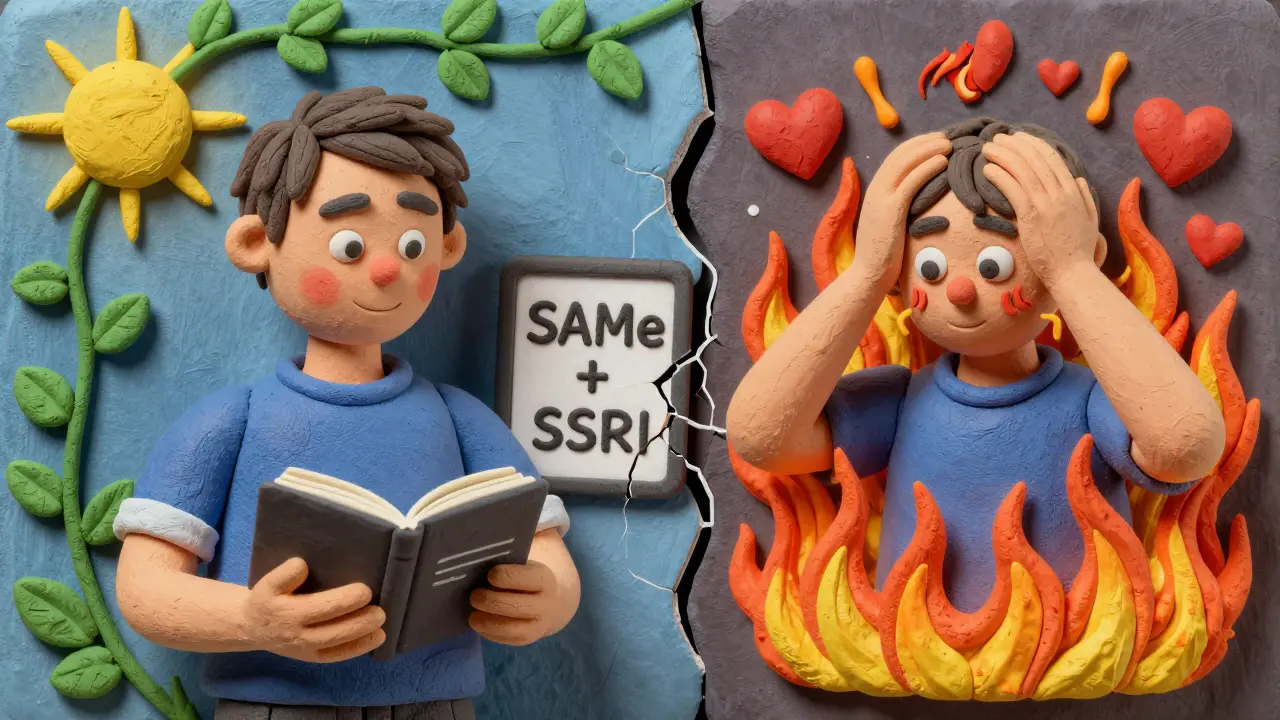
SSRIs like Prozac, Zoloft, or Lexapro work by blocking the reabsorption of serotonin. SAMe does something different-it pushes your body to make more serotonin and may also slightly block its breakdown. Put them together, and serotonin levels can spike dangerously high. That’s called serotonin syndrome.
Serotonin syndrome isn’t just feeling a little jittery. It’s a medical emergency. Symptoms include:
- Racing heart
- Muscle stiffness or twitching
- High body temperature
- Confusion or agitation
- Sweating, shivering, or tremors
The Hunter Criteria-used by doctors to diagnose it-says you need at least one of these: spontaneous clonus, inducible clonus with agitation, ocular clonus with agitation, or tremor plus hyperreflexia plus fever over 38°C.
Between 2000 and 2022, only about 12 published cases linked SAMe and antidepressants to serotonin syndrome. But the FDA’s own reporting system recorded 32 adverse events involving this combo from 2018 to 2022, with 9 classified as serious. One Reddit user, u/DepressionWarrior2020, described ending up in the ER after taking 400mg of SAMe with 20mg of Prozac. He had muscle rigidity and confusion within three days.
Who Should Avoid This Mix
Not everyone who takes SAMe with antidepressants has problems. Some people report real improvement. SarahJ on Healthline’s forum said adding 800mg of SAMe to her Zoloft helped her PHQ-9 score drop from 16 to 7 over eight months-no side effects.
But those are exceptions. The majority of cases show risk outweighs reward. The Mayo Clinic, Natural Medicines Database, and the European College of Neuropsychopharmacology all warn against combining SAMe with antidepressants. The interaction is rated as “Major-Use Caution” with a severity score of 7.3 out of 10.
If you’re already on an SSRI, SNRI, MAOI, or even tramadol or certain migraine meds, you should not add SAMe without your doctor’s supervision. Even then, it’s not recommended outside of research settings. The American Psychiatric Association doesn’t include SAMe in its 2023 guidelines for depression treatment because the evidence is too inconsistent.
The Quality Problem
Even if you’re careful about interactions, there’s another issue: you don’t know what you’re actually getting.
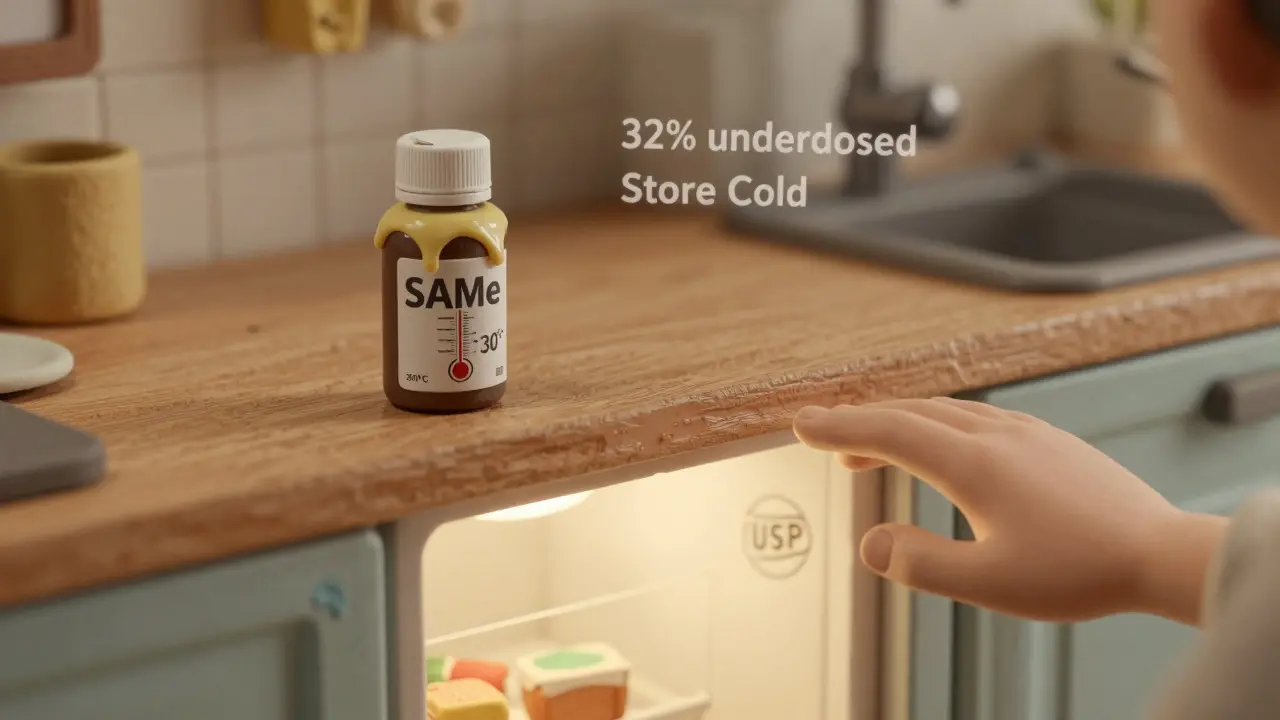
ConsumerLab.com tested 20 different SAMe supplements in 2022. Thirty-two percent contained 15-25% less active ingredient than labeled. That means you could be taking 400mg on the bottle but only getting 300mg-or even less. And because SAMe breaks down easily, if it’s not stored cold (between 2-8°C), it loses potency fast. Most people keep it on their kitchen counter. That’s a problem.
Amazon reviews for SAMe products show 42% of negative feedback says “ineffective for depression.” Another 28% mention stomach upset, nausea, or insomnia. And only 37% of products include clear warnings about drug interactions. That’s not just negligence-it’s dangerous.
What to Do If You’re Considering SAMe
If you’re thinking about trying SAMe, here’s what you need to do:
- Stop self-prescribing. Don’t add it to your regimen without talking to a psychiatrist or pharmacist who knows your full medication list.
- Start low. If your doctor agrees, begin with 200mg twice daily. Never jump to 800mg or 1600mg right away.
- Monitor closely. Watch for signs of serotonin syndrome, especially in the first two to four weeks. That’s when 85% of adverse events happen.
- Take with food. This cuts stomach upset by 65%, according to Mayo Clinic data.
- Store it right. Keep it in the fridge. Check the expiration date. Buy from brands with third-party testing (like USP or ConsumerLab verified).
And if you’re already on SAMe and antidepressants? Don’t quit cold turkey. Stopping SAMe suddenly can cause withdrawal-like symptoms-mood dips, fatigue, irritability. Talk to your provider about tapering.
Why This Matters Now
The global market for depression treatments hit $14.7 billion in 2022. SAMe makes up just 2.3% of that, but its popularity is growing. In 2022, 4.7 million Americans used it for depression. Nearly 7 out of 10 combined it with prescription meds.
Meanwhile, the FDA sent warning letters to three SAMe manufacturers in early 2023 for claiming their products treat depression-a claim they’re not legally allowed to make. A major NIH-funded trial (NCT04821234) is currently studying SAMe with escitalopram, with results expected in mid-2024. Until then, we’re flying blind.
The future might hold better versions-like SAMe-PEG or phospholipid complexes designed to reduce interaction risks. But right now, the evidence says: proceed with extreme caution.
For most people, SAMe isn’t worth the risk. If your antidepressant isn’t working, there are safer, better-studied options: switching meds, adding therapy, trying TMS, or adjusting your dose. Don’t gamble with your brain chemistry on a supplement that’s poorly regulated, inconsistently dosed, and potentially deadly when mixed.
Can I take SAMe with SSRIs like Prozac or Zoloft?
The combination of SAMe and SSRIs carries a significant risk of serotonin syndrome, a potentially life-threatening condition. While some people report benefits, major health organizations-including the Mayo Clinic and the European College of Neuropsychopharmacology-advise against this combination outside of controlled clinical trials. If you’re considering it, consult a psychiatrist first. Never combine them without medical supervision.
How fast does SAMe work for depression?
SAMe can start working faster than traditional antidepressants. While SSRIs typically take 4 to 6 weeks to show effects, some people notice mood improvements with SAMe in as little as 7 to 10 days. However, its overall effectiveness is lower than standard medications, especially in moderate to severe depression. It’s not a replacement-it’s a potential add-on, and even then, only under supervision.
Is SAMe FDA-approved for depression?
No. The FDA classifies SAMe as a dietary supplement, not a drug. That means manufacturers don’t have to prove it works before selling it. It’s available over the counter, but its use for depression is off-label and not supported by strong clinical guidelines. The American Psychiatric Association’s 2023 guidelines do not recommend SAMe for routine treatment of depression due to inconsistent evidence.
What are the side effects of SAMe?
Common side effects include nausea, gas, diarrhea, and insomnia. About 22% of users report increased anxiety in the first week, which may improve over time. Taking SAMe with food can reduce stomach upset. Serious side effects are rare but include serotonin syndrome when combined with antidepressants. Always monitor for signs like rapid heartbeat, muscle stiffness, confusion, or high fever.
How do I know if my SAMe supplement is safe?
Look for brands that are third-party tested-USP, ConsumerLab, or NSF certified. Avoid products that don’t list the exact amount of SAMe per capsule. Store it in the refrigerator (2-8°C) to preserve potency. In 2022, ConsumerLab found 32% of tested SAMe products contained significantly less active ingredient than labeled. Amazon reviews show many users report no effect, suggesting quality is unreliable.

John Cena
Been taking SAMe for about 6 months now, mostly because my doc said it’s ‘probably fine’ with my Zoloft. Honestly? I felt a little more… present. Not a miracle, but I stopped hating Mondays. No side effects, no ER trips. Maybe I’m just lucky, or maybe my body handles it well. Either way, I’m not quitting until my psychiatrist says otherwise.
Maddi Barnes
Oh sweet merciful god, another ‘natural cure’ post that ignores the fact that supplements are basically the Wild West of chemistry.
Let’s be real - if you can buy it next to protein powder and CBD gummies on Amazon, it’s not medicine. It’s a gamble with your neurochemistry.
And don’t get me started on the ‘I felt better!’ anecdotes. That’s how people end up in the ER with serotonin syndrome. I’ve seen it. My cousin was in ICU for 72 hours after ‘just adding SAMe’ to her Lexapro. She’s fine now, but her brain didn’t forget the scare.
TL;DR: If it’s not FDA-approved, it’s not a treatment. It’s a vibe. And vibes don’t save lives.
Jonathan Rutter
Everyone’s acting like this is some new revelation, but we’ve known this for decades.
People don’t want to hear that their antidepressants might not be enough. They want a quick fix they can buy without a prescription. So they slap SAMe on top like it’s a multivitamin.
And then they wonder why they’re twitching at 3 a.m. with a heart rate of 140.
The real issue isn’t SAMe - it’s the culture of self-diagnosis and self-medication. You wouldn’t mix random herbs with chemo, so why the hell are you mixing it with SSRIs?
Also, the fact that 32% of supplements are underdosed? That’s not incompetence. That’s fraud. And the FDA lets it slide because they’re underfunded and overworked. Classic.
Jana Eiffel
It is imperative to underscore that the pharmacological profile of S-adenosylmethionine, while endogenous and biochemically elegant, remains insufficiently characterized within the context of polypharmacotherapy for major depressive disorder.
The current evidentiary base, though promising in mild presentations, lacks the methodological rigor required for clinical endorsement. Moreover, the absence of standardized dosing protocols, coupled with profound inter-individual variability in methylation pathways, renders empirical supplementation a hazardous proposition.
Furthermore, the regulatory vacuum surrounding dietary supplements in the United States permits the dissemination of products with demonstrable compositional inaccuracy - a violation of the fundamental tenets of pharmacovigilance.
Until large-scale, double-blind, placebo-controlled trials with pharmacokinetic monitoring are conducted, clinical recommendation remains untenable.
Jayanta Boruah
India has been using SAMe in Ayurvedic formulations for mood balance for centuries. Western medicine just now caught up.
But here’s the thing - we never mixed it with SSRIs. We used it with ashwagandha, brahmi, and lifestyle changes. That’s the real lesson here: synergy matters. Not just dumping pills on top of pills.
Taylor Mead
I took SAMe for a month with my SNRI and honestly? Felt like a robot on a caffeine bender. Jittery, wired, couldn’t sleep. Quit cold turkey. Didn’t even tell my doctor. Now I’m doing therapy and walking 5 miles a day. No supplements. No drama.
Turns out, moving your body and talking to someone works better than anything you can buy online.
Benjamin Fox
AMERICA NEEDS TO STOP TREATING SUPPLEMENTS LIKE MEDICINE
IF YOU WANT TO FIX DEPRESSION - GET A JOB. GET OUTSIDE. STOP SCROLLING. STOP BEING SOFT.
THIS ISN’T A CHEMISTRY PROBLEM - IT’S A LIFESTYLE PROBLEM.
WE’RE ALL JUST TOO LAZY TO WALK OUT THE DOOR
Freddy King
Look, the serotonin syndrome risk is real, but let’s not pretend SSRIs are safe either. We’re talking about drugs that can cause emotional blunting, sexual dysfunction, and withdrawal that lasts months. And yet nobody’s screaming about that.
SAMe’s got a bad rep because it’s natural - and natural = sketchy in the eyes of Big Pharma.
Meanwhile, the real villain? The $14.7B depression industry that profits off lifelong prescriptions. SAMe’s a threat because it’s cheap. And cheap doesn’t scale.
Also - 12 published cases? That’s not a crisis. That’s a footnote. But sure, let’s panic.
Laura B
I’m a therapist and I’ve had 3 clients in the last year who tried SAMe with SSRIs. Two had mild side effects - nausea, insomnia. One had a full-blown serotonin reaction. She’s okay now, but it scared her into therapy.
What I tell everyone: if you’re thinking about adding something, talk to your prescriber BEFORE you buy it. Not after. Not after you feel ‘a little better.’
And if your doctor says ‘it’s probably fine’ - ask them why. Are they reading the literature? Or just being lazy?
You deserve better than guesswork.
Robin bremer
yo i took sam e with zoloft for 3 weeks and i felt like a new person like legit
no jk i had muscle spasms and thought i was having a stroke lmao
went to er they said ‘u dumbass’
now i just do yoga and cry into my dog
Hariom Sharma
My mom took SAMe for 2 years after my dad passed. Said it helped her sleep and stop crying all day. Never mixed it with meds. Just took it alone. She’s 72 now and still smiling.
Maybe it’s not for everyone. But for some? It’s a quiet gift. Don’t ruin it by turning it into a war between science and superstition.