
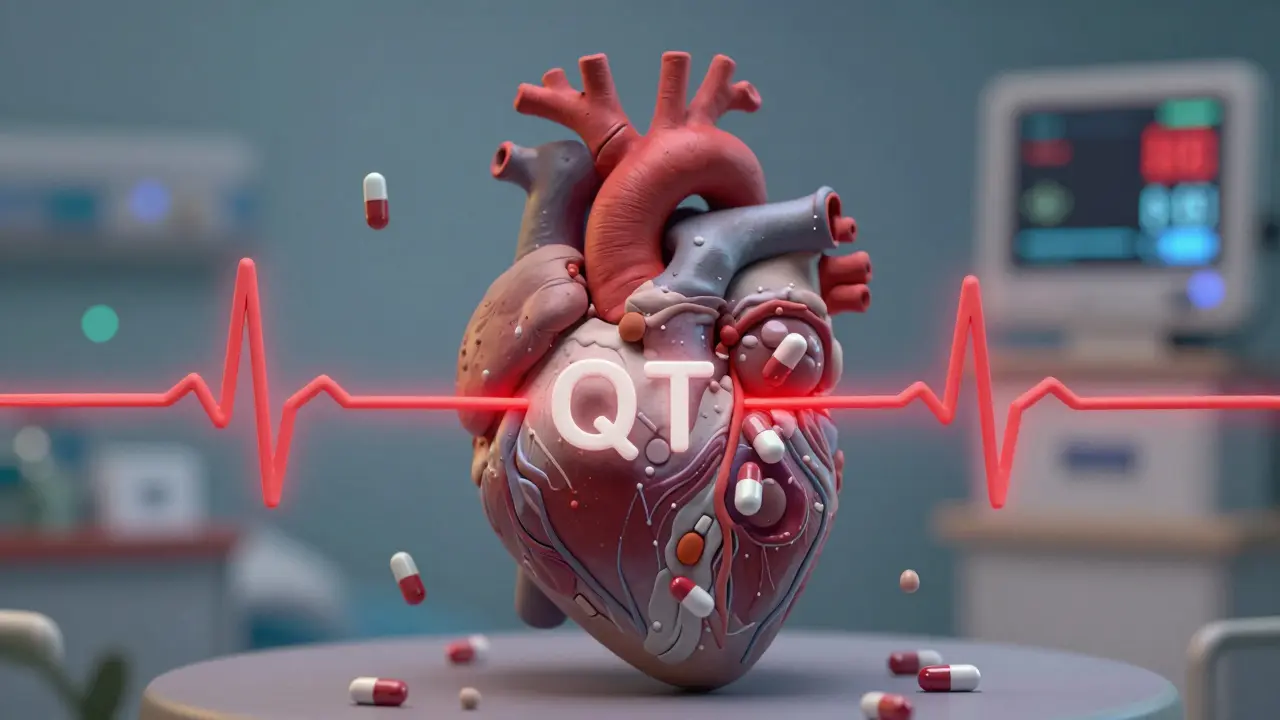
Ondansetron QT Prolongation Risk Calculator
Patient Risk Assessment
This tool estimates the potential QT prolongation risk from ondansetron based on clinical data. Results are for educational purposes only and should not replace professional medical advice.
Results will appear here
When you’re feeling sick to your stomach after chemo or surgery, ondansetron can feel like a lifesaver. It works fast, it’s widely available, and for years, doctors reached for it without a second thought. But here’s the quiet truth: ondansetron can mess with your heart’s rhythm - and in some cases, that’s deadly. It’s not just about nausea anymore. It’s about how your heart beats after the pill or IV goes in.
What QT Prolongation Actually Means
Your heart doesn’t just pump blood. It does it with electrical signals. Each beat starts with a spark in the upper chambers, then travels down, making the lower chambers contract. After that, the heart needs time to reset - that’s repolarization. The QT interval on an ECG measures how long that reset takes. If it’s too long, your heart’s electrical system gets unstable. That’s QT prolongation.Long QT doesn’t always cause symptoms. But when it does, it can trigger a dangerous rhythm called torsades de pointes - a wild, chaotic heartbeat that can turn into cardiac arrest. It’s rare, but it’s real. And ondansetron is one of the most common drugs linked to it.
How Ondansetron Slows Down Your Heart’s Reset
Ondansetron blocks serotonin receptors to stop nausea. But it also blocks something else: the hERG potassium channels in heart cells. These channels let potassium flow out after each beat, helping the heart recharge. When ondansetron blocks them, potassium stays trapped inside. That delays repolarization. The result? A longer QT interval.Studies show IV ondansetron can stretch the QTc interval - the heart-rate-corrected version - by 20 milliseconds or more. That’s not a small blip. A 10-millisecond increase in QTc raises arrhythmia risk by 5-7%. At 32 mg IV, the increase hits 20 ms. That’s why the FDA banned that dose in 2012. But even 8 mg IV can push a borderline QTc into danger zone, especially in older adults or those with heart problems.
Not All Antiemetics Are Created Equal
Ondansetron isn’t alone. But it’s not the worst, either. Here’s how the main players stack up:| Antiemetic | Class | Max QTc Increase (ms) | Risk Level |
|---|---|---|---|
| Dolasetron | 5-HT3 antagonist | 25-35 | High |
| Ondansetron (IV 32 mg) | 5-HT3 antagonist | 20 | High |
| Ondansetron (IV 8 mg) | 5-HT3 antagonist | 6-12 | Moderate |
| Granisetron (transdermal) | 5-HT3 antagonist | <5 | Low |
| Palonosetron | 5-HT3 antagonist | 9.2 | Moderate |
| Droperidol | Butyrophenone | 15-20 | High |
| Prochlorperazine | Phenothiazine | 10-15 | Moderate |
| Dexamethasone | Corticosteroid | 0-2 | Very Low |
Palonosetron and transdermal granisetron are safer bets for patients with heart issues. Dexamethasone? It doesn’t touch QT at all. And it’s just as good for nausea in many cases. So why keep reaching for ondansetron? Habit. Convenience. But the data doesn’t lie - safer options exist.
Who’s at Real Risk?
Not everyone who gets ondansetron will have a problem. But some people are walking into a minefield without knowing it:- People with congenital long QT syndrome
- Those with heart failure or slow heart rhythms
- Patients with low potassium or magnesium
- Older adults - especially over 75
- People taking other QT-prolonging drugs (antibiotics like azithromycin, antidepressants like citalopram, or antifungals like fluconazole)
- Those with liver disease - ondansetron is broken down by the liver, so buildup happens faster
- CYP2D6 poor metabolizers - a genetic group that processes ondansetron slowly, leading to higher blood levels
A 2019 Johns Hopkins case series found three out of 15 elderly patients with heart conditions developed QTc over 500 ms after just 8 mg IV ondansetron. That’s not a fluke. That’s a pattern.
What Doctors Are Doing Differently Now
Since the FDA warning in 2012, things have changed - slowly, but they’ve changed.Most hospitals now:
- Check baseline ECG before giving IV ondansetron to high-risk patients
- Cap IV doses at 8 mg for anyone with heart disease, kidney issues, or electrolyte imbalances
- Fix low potassium or magnesium before giving the drug
- Monitor ECG for 4 hours after IV administration if QTc is above 440 ms
- Use dexamethasone or palonosetron instead for patients with known cardiac risks
A 2020 survey of 256 anesthesiologists found 78% lowered their ondansetron doses after the FDA alert. That’s progress. But 22% still use 16 mg - and that’s dangerous.
Emergency departments and oncology units are also starting to require pharmacist review of QTc calculations before high-dose ondansetron is given. That’s a safety net. And it’s working.

What You Can Do - Patient and Caregiver Guide
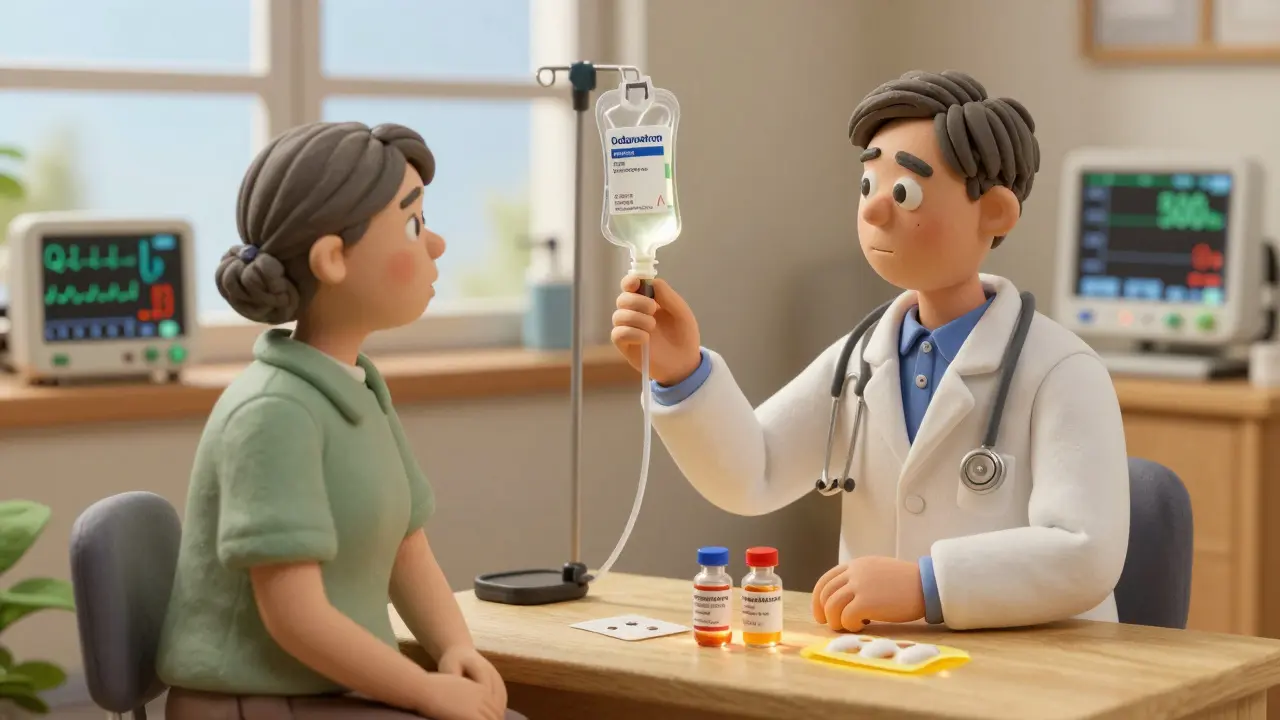
If you or someone you care for is about to get ondansetron:- Ask: “Is this IV or oral?” - Oral is safer. Much safer.
- Ask: “Do I have a history of heart rhythm problems?” - If yes, push for an ECG before the drug.
- Ask: “Can we use dexamethasone or granisetron instead?” - These are equally effective and much safer for the heart.
- Ask: “Have my potassium and magnesium been checked?” - Low levels make QT prolongation worse.
- Watch for dizziness, fainting, or fluttering in your chest after the dose - report it immediately.
Don’t assume the doctor knows. Don’t assume it’s safe. Ask. Push. It’s your heart.
The Bigger Picture: Why This Matters Beyond One Drug
Ondansetron is just one example of a bigger problem: we give drugs based on how well they stop nausea - not how safely they affect the heart. The same pattern shows up with antibiotics, antipsychotics, and even some allergy meds.The solution isn’t to ban ondansetron. It’s to use it smarter. The American Society of Clinical Oncology now recommends palonosetron over ondansetron for patients with cardiac risk. That’s a major shift. And it’s based on real data - not guesswork.
Meanwhile, research is moving toward personalized dosing. The NIH-funded QT-EMETIC trial is testing whether genetic testing can predict who’s at highest risk. If you’re a poor metabolizer of CYP2D6, you might need half the dose. That’s the future.
For now, the message is clear: ondansetron is not a harmless drug. It’s a tool. And like any tool, it’s dangerous in the wrong hands - or the wrong body.
Can I still take ondansetron if I have a heart condition?
It depends. If you have a history of long QT syndrome, heart failure, or slow heart rhythms, you should avoid IV ondansetron entirely. Oral ondansetron at low doses (up to 8 mg) may be safe in some cases, but only after checking your ECG and electrolytes. Always talk to your doctor - and ask for alternatives like dexamethasone or palonosetron.
Is oral ondansetron safer than IV?
Yes, significantly. IV ondansetron hits your bloodstream fast and hard, causing a sharp spike in drug levels. Oral doses are absorbed slowly, so the effect on your heart is much weaker. The FDA says single oral doses up to 24 mg are safe for most people - no dose adjustment needed. That’s why many hospitals now switch to oral after the first dose.
What’s the maximum safe dose of IV ondansetron?
The FDA recommends no more than 16 mg IV in a single dose. But for patients with heart disease, liver problems, or low potassium, even 8 mg can be too much. Many hospitals now cap IV doses at 4-8 mg for high-risk patients. Always follow your provider’s guidance - don’t assume the standard dose is safe for you.
Can low potassium make ondansetron more dangerous?
Absolutely. Low potassium (below 3.5 mEq/L) and low magnesium (below 1.8 mg/dL) make your heart more sensitive to QT prolongation. Before giving ondansetron, many hospitals now check and correct these levels. If you’re on diuretics or have vomiting from chemo, your levels may already be low. Ask for a blood test.
Are there better alternatives to ondansetron?
Yes. For patients with heart risks, palonosetron causes less QT prolongation than ondansetron. Transdermal granisetron is even safer. Dexamethasone is non-cardiac and just as effective for many types of nausea. In fact, combining dexamethasone with a low-dose antiemetic is now standard in many cancer centers. Ask your doctor if you’re a candidate.





Kipper Pickens
Let’s be real - ondansetron’s QT risk is textbook pharmacokinetic liability. Blocking hERG channels isn’t some accidental side effect; it’s a direct off-target binding event. The 20ms QTc prolongation at 32mg IV? That’s not a blip, it’s a red flag waving in a hurricane. And yet, we still see it pushed in EDs like it’s aspirin. The real issue isn’t the drug - it’s the institutional inertia. We’ve got better alternatives like palonosetron with half the hERG affinity and longer half-life. Why are we still using a 2008 protocol in 2025? It’s not laziness - it’s cognitive dissonance wrapped in clinical habit.
Also, CYP2D6 poor metabolizers? That’s a pharmacogenomic blind spot we’ve ignored for too long. We genotype for warfarin and clopidogrel, but still hand out 8mg IV ondansetron like it’s candy. The NIH’s QT-EMETIC trial is long overdue - and frankly, it should’ve been mandatory a decade ago.
Aurelie L.
My uncle died after a 4mg IV dose.
They didn’t check his ECG. Didn’t check his K+. He was 78. Had heart failure. They said ‘it’s just for nausea.’
Sally Dalton
OMG this is so important!! I had no idea ondansetron could do this 😭 My mom got it after chemo and she got super dizzy and said her heart felt ‘weird’ - I didn’t think anything of it till now. Thank you for writing this!! I’m going to print this out and take it to her oncologist next week. Also, I just looked up dexamethasone and it’s like… a steroid? But it works for nausea?? That’s wild. I’m so glad I read this before something bad happens. We need more posts like this!! 🙏❤️
Also, can someone explain what ‘QTc’ even means again? I’m not a doctor but I wanna understand 😅
Allie Lehto
You people are so naive. You think this is about ‘safety’? Nah. It’s about control. Pharma doesn’t want you to know that dexamethasone - a cheap, generic steroid - works just as well. They make billions off ondansetron. The FDA didn’t ban 32mg because it’s dangerous - they banned it because the lawsuits were piling up. And now? They’re pushing ‘safer’ alternatives that are still patented and 10x more expensive. This isn’t medicine. It’s capitalism with a stethoscope.
Also, ‘CYP2D6 poor metabolizers’? That’s just a fancy way of saying ‘your genes make you a liability.’ So now we’re genetically profiling people before we give them nausea meds? Next they’ll be testing your DNA before you get a Band-Aid. Wake up.
And yes, I know what I’m talking about. I read a blog once. 🤓
Henry Jenkins
There’s a lot here that’s valid, but I think we’re missing the forest for the trees. Yes, ondansetron prolongs QT - no argument. But let’s look at the actual incidence of torsades de pointes. It’s extremely rare - like, 1 in 100,000 doses rare. Meanwhile, uncontrolled nausea leads to dehydration, aspiration, non-compliance with chemo, hospital readmissions, and even death from malnutrition. The risk-benefit ratio isn’t even close. The problem isn’t ondansetron - it’s the lack of standardized risk stratification. We need protocols, not fear.
For example: if a patient has a QTc < 450, normal K+/Mg++, no polypharmacy, and no structural heart disease - 8mg IV is fine. But if they’re 82 with CHF and on amiodarone? Then sure, use dexamethasone. But blanket avoidance? That’s not evidence-based - it’s overcorrection.
Also, oral vs IV? Totally agree. Oral bioavailability is ~60%, and peak concentration is way lower. I’ve seen patients on 24mg oral daily for days with zero ECG changes. The real villain here is IV bolus dosing in high-risk populations. Not the drug itself.
And yes, palonosetron is better for long-term use, but it’s 5x the cost. In resource-limited settings, that’s not just a clinical decision - it’s an ethical one. We need nuance, not dogma.
Dan Nichols
Stop panicking. Ondansetron is fine. People die from chemo not from nausea meds. You want to blame a drug? Blame the doctors who don’t check electrolytes. Blame the hospitals that don’t monitor. Blame the nurses who don’t read the ECG. This isn’t about ondansetron. This is about lazy medicine. And now you’re turning a manageable risk into a moral panic. The FDA didn’t ban it. They capped the dose. That’s it. You’re all acting like it’s fentanyl. It’s not. Use it wisely. Stop making patients feel guilty for getting relief. And for god’s sake stop saying ‘ask your doctor’ like that’s some magic wand. Most doctors don’t even know what hERG is.
Also dexamethasone causes insomnia and hyperglycemia. Good luck telling a diabetic they can’t have ondansetron because their sugar’s high. This is why medicine is broken.
Renia Pyles
So let me get this straight - you’re telling me the same drug that helped me stop vomiting after surgery is now a silent killer? And you expect me to believe that doctors didn’t know this? That they’ve been poisoning people for decades? And now they’re just ‘starting to change’? Like they just woke up? No. They knew. They just didn’t care. Because it’s cheaper. Because it’s faster. Because they don’t want to deal with the paperwork. I’ve seen it. My sister got it after her transplant. She had a near-cardiac arrest. They didn’t even pause. They just gave her more. And now you want me to be grateful they ‘capped’ the dose? That’s not progress. That’s damage control. And you know what? I’m not sorry for being angry. You don’t get to tell me to ‘ask my doctor’ when the doctor is the one who almost killed her.
And dexamethasone? Yeah right. Try telling a cancer patient they can’t sleep for a week because their meds are ‘safer.’
Rakesh Kakkad
Respected colleagues, I must express profound appreciation for this meticulously structured exposition on the pharmacodynamic implications of 5-HT3 antagonists. In the Indian context, where polypharmacy is rampant and cardiac monitoring infrastructure remains inconsistent, this data is not merely academic - it is a lifeline. I have personally observed elderly patients receiving IV ondansetron without baseline ECG or electrolyte assessment. The institutional inertia you describe is palpable here as well. I propose a collaborative initiative between oncology, cardiology, and pharmacy departments to implement mandatory pre-dose QTc screening protocols, especially in tertiary care centers. Furthermore, the integration of pharmacogenomic screening for CYP2D6 status, though logistically challenging, represents the future of precision antiemetic therapy. Let us not mistake caution for conservatism - let us embrace evidence as our only compass. 🙏