
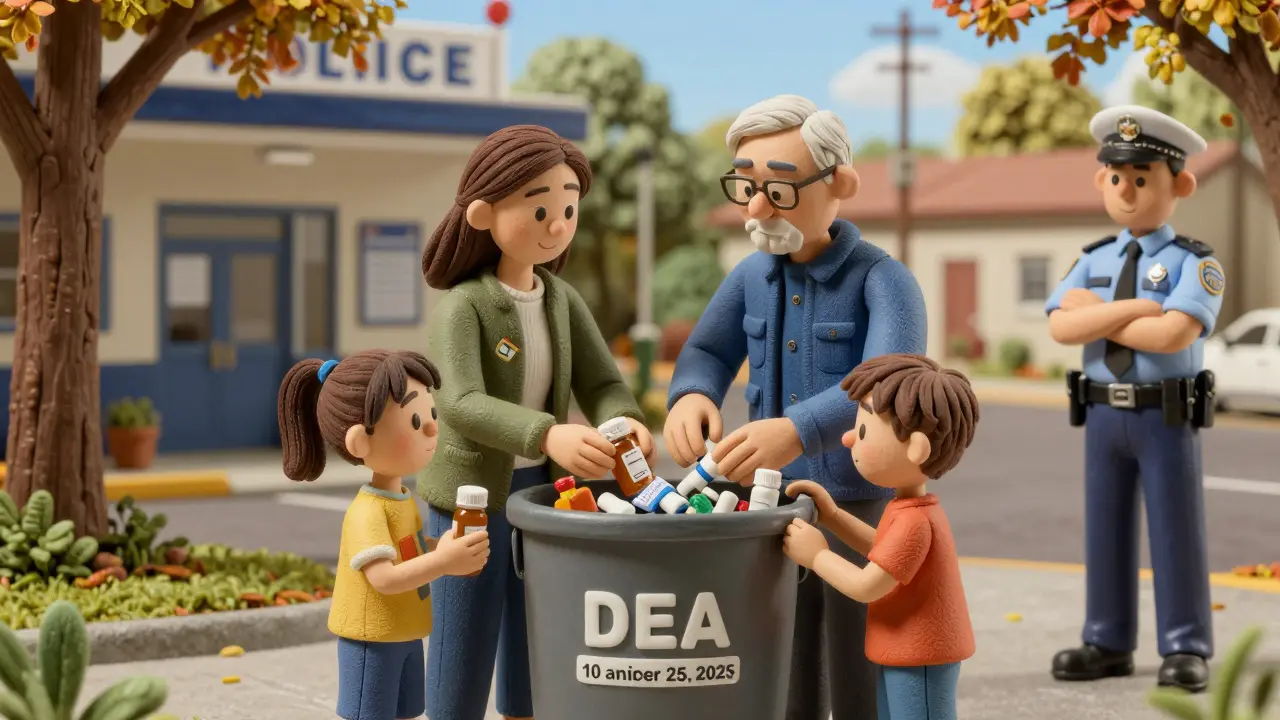
Every year, millions of unused prescription pills sit in bathroom cabinets, kitchen drawers, and medicine chests across the U.S. Some are old antibiotics. Others are leftover painkillers from surgery or injury. A few might even be from a loved one who passed away. And most of them? They never get properly thrown away.
That’s where National Prescription Drug Take-Back Days come in. These events, run by the U.S. Drug Enforcement Administration (DEA), give you a simple, safe, and free way to get rid of medications you no longer need-without risking them falling into the wrong hands or polluting the environment.
If you’ve ever wondered what happens when you drop off those old pills at the police station or pharmacy, or if you’re thinking about going this year, here’s exactly what to expect-no fluff, no jargon, just what you need to know.
When and Where Do These Events Happen?
National Prescription Drug Take-Back Days happen twice a year: once in April and once in October. The next one is scheduled for October 25, 2025, from 10 a.m. to 2 p.m. local time. That’s it-just four hours. No extensions. No weekend extra days. If you miss it, you’ll have to wait until spring.
There are over 4,500 collection sites across the country. You’ll find them at local police stations, fire departments, hospitals, pharmacies like CVS and Walgreens, and even some community centers. The DEA keeps a live map on their website, takebackday.dea.gov, where you can search by zip code. You can also use the Dispose My Meds app, used by over 340,000 people, to find the closest spot.
Don’t assume your local pharmacy has a drop-off box year-round. While some do, the Take-Back Day is the only time you’re guaranteed a DEA-authorized, law enforcement-supervised collection point. And yes, they’ll take your meds even if you don’t have a receipt, ID, or explanation.
What Can You Drop Off?
They’ll take almost any prescription medication you have at home:
- Pills and capsules
- Transdermal patches (like fentanyl or nicotine patches)
- Liquid medications, as long as they’re sealed in their original bottles
- Vials and blister packs
- Over-the-counter drugs if they were prescribed to you (like high-dose ibuprofen)
But here’s what they won’t take:
- Sharps (needles, syringes, lancets)
- Illicit drugs (cocaine, heroin, marijuana)
- Thermometers or medical devices
- Chemotherapy drugs
- Alcohol or inhalers
If you have needles, your local pharmacy or health department can point you to a sharps disposal program. For inhalers, check with your pharmacy-they often have special recycling bins. And if you’re unsure about a medication, just bring it anyway. The staff will sort it out.
How Does the Process Work?
It’s quick. Really quick.
Arrive at your chosen site between 10 a.m. and 2 p.m. You’ll see a table or bin marked with a DEA logo. No lines. No forms. No questions asked. Just drop your medications into the box. That’s it.
Some sites have volunteers handing out flyers or offering educational materials about safe storage and overdose prevention. Others are just a quiet drop-off point. Either way, your identity stays private. No one asks your name. No one tracks what you brought. You don’t even have to say a word.
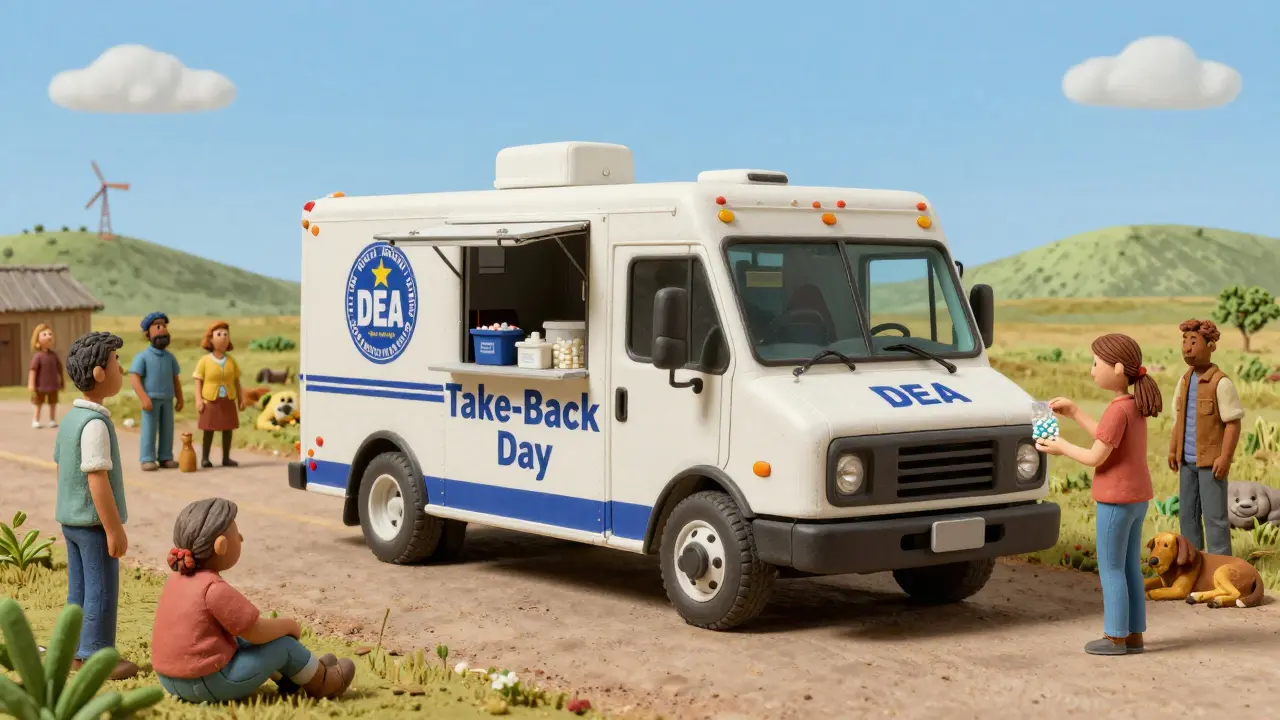
Law enforcement officers are always present. They’re not there to investigate you-they’re there to make sure the process is secure. Once collected, the drugs are stored in locked containers and later incinerated under federal environmental regulations. Nothing gets reused. Nothing gets recycled. Nothing gets dumped in landfills or flushed down the toilet.
Why Does This Matter?
It’s not just about cleaning out your medicine cabinet. It’s about saving lives.
In 2024, over 8 million Americans aged 12 and older misused prescription pain relievers-and nearly half of them got those drugs from a friend or family member’s medicine cabinet, according to the National Survey on Drug Use and Health. That’s not a small number. That’s your neighbor, your kid’s classmate, your cousin.
Every year, the DEA collects over 600,000 pounds of unused medication during these events. Since 2010, that’s nearly 10 million pounds total. That’s the weight of over 700 full-size school buses filled with drugs that won’t end up in the wrong hands.
And it’s not just about preventing addiction. Improper disposal pollutes waterways. Flushing pills or tossing them in the trash leads to traces of medication showing up in rivers and drinking water. The EPA and CDC both warn about this. Take-Back Days help stop that.
What If You Can’t Make It?
If you miss the event, you’re not out of options. There are over 14,250 permanent DEA-authorized collection sites across the country-mostly at pharmacies and hospitals. Many of these are open year-round, with drop-off boxes in the lobby. Walgreens and CVS have installed permanent kiosks in over 1,200 locations as of August 2025.
But here’s the catch: not every pharmacy has one. And even if they do, they might not accept all types of meds. Always call ahead. Ask if they’re DEA-authorized. Ask if they take liquids or patches.
If you can’t find a drop-off site, the FDA recommends mixing pills with an unappealing substance-like cat litter, coffee grounds, or dirt-putting them in a sealed plastic bag, and throwing them in the trash. Never flush them unless the label says to. And never leave them unsecured in a drawer where kids or visitors can find them.
What’s New in 2025-2026?
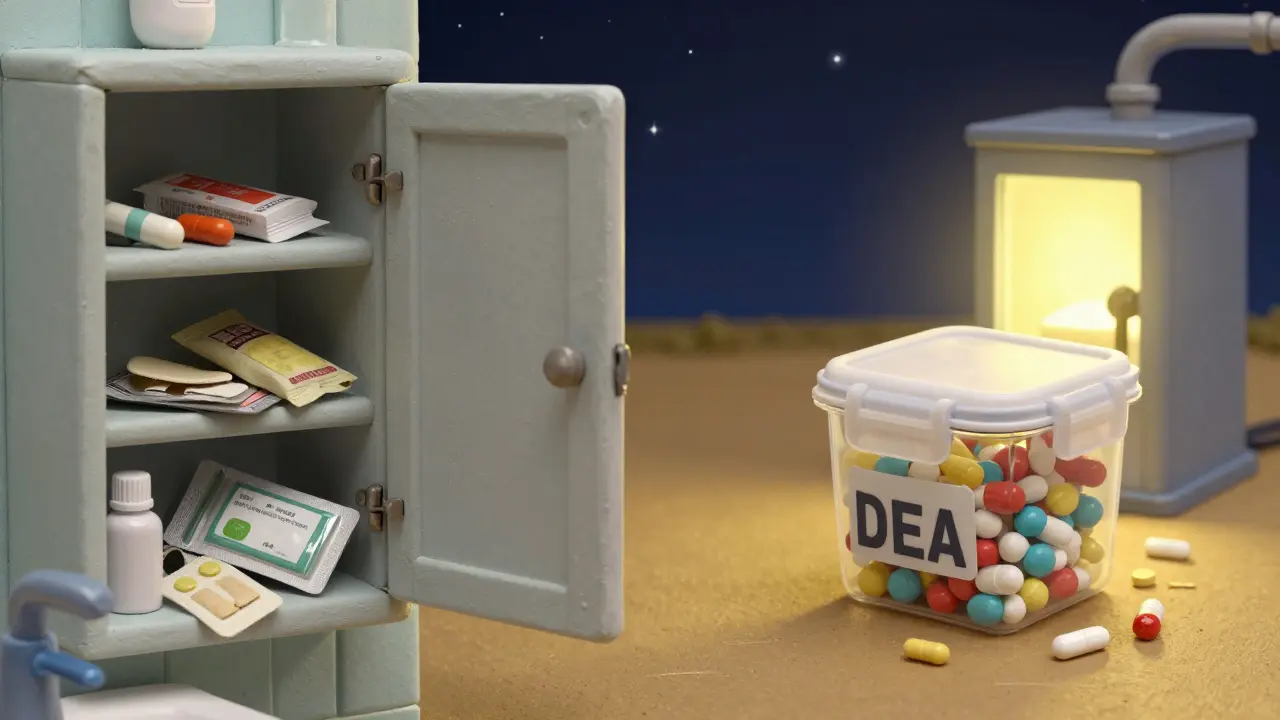
This year, the DEA is rolling out mobile collection units-trucks that travel to rural areas where sites are scarce. There are 120 of them now, targeting communities more than 25 miles from the nearest drop-off point. Early results show an 18% increase in participation in pilot areas.
They’re also testing a new feature: when you fill a prescription at a hospital using Epic’s electronic records system, you’ll start seeing a pop-up reminder: “Did you know you can safely dispose of unused meds? Visit takebackday.dea.gov.” This pilot is running in 12 hospital networks and could expand nationwide.
There’s also growing pressure to make these events year-round. The DEA has received bipartisan support to keep funding at $2.4 million annually. But until permanent kiosks are everywhere, the biannual events remain the most reliable way to dispose of meds safely and anonymously.
What People Are Saying
On Reddit’s r/addiction community, users shared their experiences:
“Dropped off my mom’s unused opioids at the police station-no questions asked, took 2 minutes, and I know they won’t end up in a teen’s hands.” - u/MedSafetyAdvocate, April 2025
Most people praise the simplicity and privacy. But common complaints? Limited hours and lack of awareness. Nearly half of those who missed the event said they didn’t know it was happening. A third said the nearest site was too far.
Places that pair the drop-off with a short educational talk-like University Hospitals in Ohio-see 37% more participation. It’s not just about collecting pills. It’s about changing behavior.
Final Thoughts
National Prescription Drug Take-Back Days aren’t glamorous. They don’t make headlines. But they’re one of the most effective public health tools we have.
You don’t need to be a doctor, a parent, or someone struggling with addiction to care. You just need to know that the pills in your drawer could hurt someone else. And that you have a simple, legal, and anonymous way to stop that from happening.
Mark October 25, 2025 on your calendar. Gather your old meds. Drive to the nearest site. Drop them off. And do it again in April next year. It takes two minutes. It saves lives.
Can I drop off expired over-the-counter medications at Take-Back Days?
Yes, you can. If the over-the-counter medicine was originally prescribed to you-like high-dose ibuprofen or sleep aids-it’s accepted. Even if it’s just a regular bottle of pain relievers, most sites will take them. When in doubt, bring it. The staff will sort it out.
Do I need to remove labels from pill bottles before dropping them off?
No. You don’t need to remove labels or empty the bottles. Just bring them as-is. The DEA and law enforcement handle all personal information securely. In fact, keeping the labels helps them identify what’s being collected and ensures nothing gets mixed up during disposal.
What if I have a lot of medication? Can I bring multiple bags?
Absolutely. There’s no limit on how much you can bring. Whether it’s one bottle or five bags, they’ll take it all. Some people drop off medications from deceased relatives, others from long-term prescriptions. No judgment. No limits.
Are these events only for opioids or painkillers?
No. They accept all types of prescription drugs-antibiotics, antidepressants, blood pressure pills, thyroid meds, diabetes medications, and more. The goal is to remove all unused medications from homes, not just the ones that are addictive.
What happens to the drugs after I drop them off?
They’re stored securely in locked containers at the collection site until they’re transported to a licensed incineration facility. The DEA ensures all drugs are destroyed under federal environmental regulations. Nothing is recycled, reused, or dumped. It’s a one-way process: from your cabinet, to the bin, to the furnace.
Can I drop off medications for someone else, like my elderly parent?
Yes, you can. Many people bring medications from aging parents, relatives who passed away, or even friends. You don’t need permission or documentation. Just bring the meds and drop them off. It’s anonymous, and it’s legal.
Is there a fee to participate in Take-Back Days?
No. Participation is completely free. There are no charges, no donations requested, and no hidden fees. The DEA funds the program through federal appropriations, and local law enforcement volunteers their time. It’s a public service-no strings attached.
What if I live in a rural area with no nearby collection site?
The DEA has launched 120 mobile collection units specifically for rural communities more than 25 miles from a fixed site. Check takebackday.dea.gov for updates on mobile unit schedules in your county. If none are listed, contact your local sheriff’s office-they may coordinate a special drop-off day or connect you with a nearby permanent kiosk.
If you’re still unsure about what to do with old meds, remember: the safest choice is always to use a DEA-authorized drop-off. Whether it’s during a Take-Back Day or at a permanent kiosk, you’re helping protect your family, your community, and the environment.

Iona Jane
They're tracking us. Every pill you drop off? Logged. Linked to your zip. Soon they'll know who's hoarding antidepressants and who's got oxy. This isn't cleanup. It's surveillance with a smile.
Jaspreet Kaur Chana
In India we don't have these events but I love the idea so much! We just throw pills in the trash or flush them because no one told us better. Imagine if every village had a drop box like this? No more kids finding grandma's blood pressure pills. This is the kind of public health wisdom we need everywhere. The DEA is doing something beautiful here.
Haley Graves
If you haven't cleaned out your medicine cabinet this year, you're not just being lazy-you're putting your family at risk. This isn't optional. It's basic responsibility. Do it. October 25. Set a reminder. Bring everything. No excuses.
Gloria Montero Puertas
I find it deeply concerning that the DEA has to host biannual events to clean up the mess created by overprescribing, poor patient education, and pharmaceutical greed. And yet, we still don't mandate return programs with every prescription. This is band-aid medicine for a systemic wound. Also, why are we still using plastic bottles? The environmental hypocrisy is staggering.
Tom Doan
Fascinating. The anonymity is brilliant. No ID? No questions? That’s the exact opposite of how most government programs operate. I wonder if this model could be applied to other controlled substances-say, used syringes or even unregistered firearms. The logistics would be nightmarish, but the principle? Elegant.
Sohan Jindal
This is just the government getting us used to handing over our stuff. Next they'll want your vitamins. Then your coffee. Then your toothpaste. They're building the database. They're watching. Don't fall for the feel-good lie.
Arjun Seth
People don't realize how dangerous this is. I saw a kid in my village take his dad's painkillers after a football game. He almost died. If we had a drop box like this in our town, maybe he'd still be here. We need this in every city. Not just the rich ones. Every single place.
Mike Berrange
I appreciate the intent. But the fact that we need a biannual event to fix a problem created by overprescribing, poor labeling, and lack of patient counseling speaks volumes. And yet, no one is holding the pharmaceutical companies accountable. They profit from the pills, then we pay to destroy them. The cycle is grotesque.
Ayush Pareek
I run a senior center and we bring our residents' meds every Take-Back Day. Some of them don't even remember what they're dropping off. But they know it's safe. That’s all that matters. You don't need a PhD to do the right thing. Just a little care.
Nishant Garg
In India, we say 'jugaad'-fixing things with grit and glue. This is the American jugaad: a two-hour window, a police station, and a box. No bureaucracy. No forms. Just human decency in action. I wish we had this. Not just for drugs-for old electronics, for expired oils, for everything we don't know what to do with.
Jan Hess
Just dropped off my dad’s leftover pain meds last year. Took 90 seconds. Felt like I did something real. Do it. Seriously.