
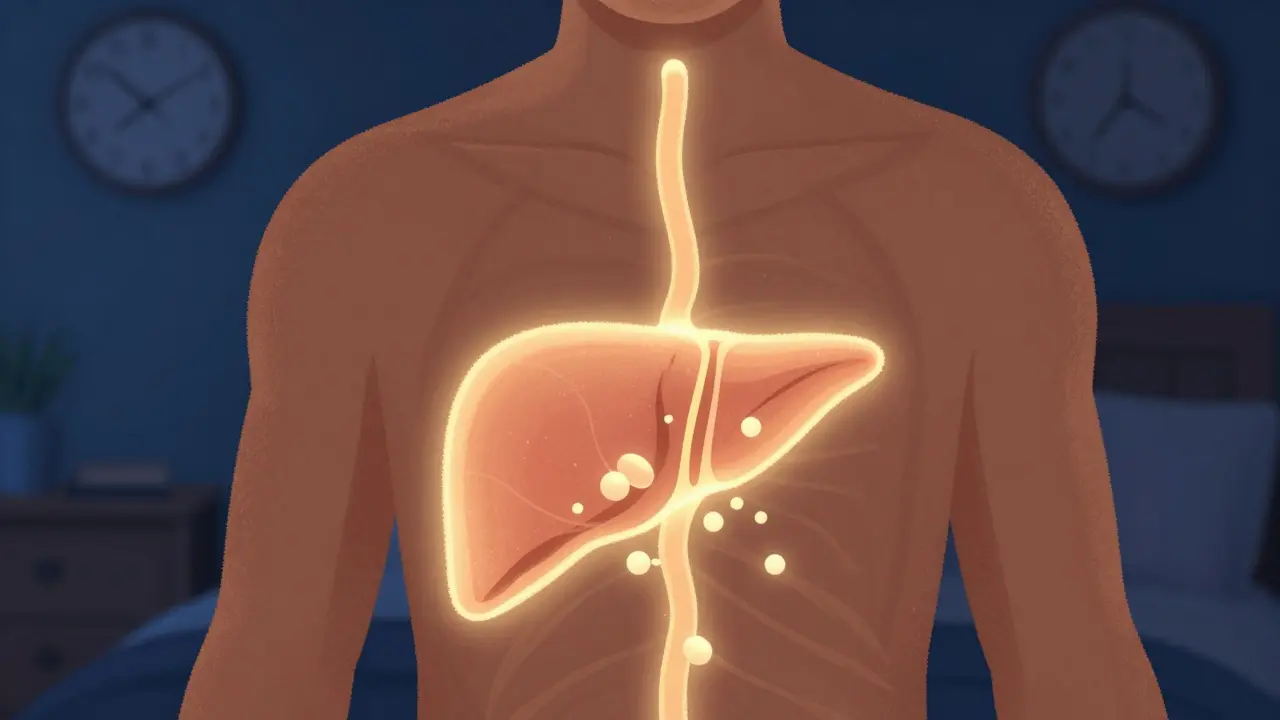
Have you ever wondered why your doctor told you to take your blood pressure pill at night, or your cholesterol medicine before bed? It’s not just a random suggestion. The time you take your medication can make a real difference in how well it works-and how many side effects you feel. This isn’t guesswork. It’s science. And it’s called chronotherapy.
Why Timing Matters More Than You Think
Your body runs on a 24-hour clock. Not just your sleep cycle-your liver, kidneys, stomach, and even your immune system follow daily rhythms. These rhythms affect how your body absorbs, breaks down, and gets rid of drugs. Take a statin in the morning? You might get only half the benefit. Take it at night, when your liver is busiest making cholesterol? You could lower your LDL by 15-20% more. The same goes for blood pressure meds. A major study called MAPEC found that taking ACE inhibitors at bedtime cut cardiovascular events by 29% compared to taking them in the morning. Why? Because blood pressure naturally dips at night. If your medication peaks when your body needs it most, you’re not just treating high blood pressure-you’re protecting your heart while avoiding side effects like dizziness or excessive drops in pressure during the day.High-Risk Medicines Need Tight Schedules
Not all meds are created equal when it comes to timing. Some can be taken within a few hours of the scheduled time without issue. Others? Miss the window by 15 minutes, and things go wrong fast. Insulin is one of them. If you take rapid-acting insulin too early before a meal, you risk a dangerous drop in blood sugar. Wait too long? Your sugar spikes. Studies show mistimed insulin leads to hypoglycemia in 22% of cases. Anticoagulants like warfarin or apixaban are another. Timing errors here can raise bleeding risk by up to 37%. That’s not a small number. Even a 30-minute delay can throw off the balance between clotting and bleeding. Chemotherapy drugs are timed down to the minute in hospitals because cancer cells divide at specific times. Giving chemo when healthy cells are least active-and cancer cells are most vulnerable-can improve results and cut nausea, fatigue, and hair loss.Medications That Work Better at Night
Some drugs actually work better when taken at night-not because they’re stronger, but because your body’s rhythm matches them.- Statins (atorvastatin, simvastatin): Cholesterol production peaks between midnight and 4 a.m. Taking these at night boosts their effect.
- ACE inhibitors and ARBs (lisinopril, losartan): Bedtime dosing improves overnight blood pressure control and reduces morning heart strain.
- Beta-blockers (metoprolol, carvedilol): Nighttime use lowers heart rate during sleep, reducing post-surgery arrhythmias. One ICU unit saw a 40% drop in atrial fibrillation after switching to evening dosing.
- Corticosteroids (prednisone): Taking them in the morning mimics your body’s natural cortisol release, reducing adrenal suppression and sleep disruption.
What Happens When Timing Goes Wrong?
Medication errors aren’t always about giving the wrong pill. Often, it’s about giving the right pill at the wrong time. A 2008 JAMA Internal Medicine study tracked 720 patients and found that every interruption during a medication round increased the chance of an error. With five interruptions, error rates jumped from 39% to 61%. That’s not just a glitch-it’s a safety crisis. In hospitals, IV meds have error rates between 48% and 53%. Oral meds? 8% to 25%. But even at home, 43% of medication discrepancies involve timing mistakes. Patients forget. They’re busy. They don’t know why it matters. A survey of 1,200 people found 68% of those on chronotherapeutic meds didn’t stick to their schedule. Low health literacy was the biggest reason-74% of non-adherent patients didn’t understand the importance of timing.Why Your Pharmacy or Doctor Might Not Talk About This
Chronotherapy isn’t new. Franz Halberg started researching it in the 1970s. But most doctors still treat all meds the same: once a day, take it with food, etc. The system isn’t built for precision. Electronic health records rarely flag which meds need tight timing. Nurses get interrupted every 5 minutes. Patients get a printed sheet with “take once daily” and no explanation. Even worse: only 14% of community hospitals have formal chronotherapy protocols. Academic centers? 42%. That gap means most people are missing out on safer, more effective treatment.
What You Can Do Right Now
You don’t need a fancy app or a hospital protocol to get this right. Start with these steps:- Ask your doctor or pharmacist: “Is there a best time to take this medicine? Does timing affect side effects?” Don’t assume it’s the same for all drugs.
- Check your meds: Statins? Take at night. Blood pressure meds? Try bedtime if your doctor agrees. Diuretics? Take in the morning so you don’t wake up peeing all night.
- Use alarms: Set two phone alarms-one for the time, one 15 minutes later as a backup. Even simple reminders cut timing errors by over 30%.
- Track your symptoms: If you feel dizzy after taking your pill at noon, but fine when you take it at 8 p.m., write it down. That’s data your doctor can use.
- Don’t guess: If you’re unsure, call your pharmacy. They can tell you if your med is timing-sensitive.





Vikrant Sura
Yeah, whatever. I take my pills when I remember. If I feel fine, why bother changing? Doctors don’t even know what they’re talking about half the time.
Also, I’m not setting alarms for medicine. I’m not a robot.
jenny guachamboza
ok but what if the whole 'circadian rhythm' thing is just a Big Pharma lie to sell you more expensive timed-release pills?? 🤔
They don't want you to know that your body can detox ANYTHING if you just drink lemon water and sleep in a pyramid 😈
Also, I took my statin at 3pm once and my dog started barking at me like I was a demon. Coincidence? I THINK NOT.
Also, why do all the studies come from 'academic centers'? 🤔 maybe they're just paid off??
Jim Brown
One is compelled to reflect upon the profound ontological implications of chronotherapy-not merely as a pharmacological optimization, but as a reconciliation between human physiology and the cosmic rhythm of diurnal cycles.
Our ancestors, who rose with the sun and retired with its descent, lived in harmony with these rhythms; modernity, in its frenetic disregard for temporal order, has severed this covenant.
It is not merely a matter of LDL reduction or nocturnal BP control-it is a question of whether we, as biological entities, remain faithful to the architecture of our own being.
When we ignore the temporal signature of our cells, we do not merely risk side effects-we risk alienation from the very essence of our corporeal existence.
One must ask: Is convenience a virtue, or merely the surrender of wisdom to the tyranny of the clock?
Sai Keerthan Reddy Proddatoori
India has been doing this for thousands of years. Ayurveda knew about body clocks before your science even had a name for it.
Now you Westerners read one study and act like you invented it?
Our grandmas told us when to take medicine-morning for digestion, night for blood. No apps needed.
And now you want to patent it? Typical. Take your data, sell it to Pfizer, then charge us for the solution.
Also, why do your hospitals have 48% error rates? Because you don’t respect time. You waste it. We don’t.
Sam Black
I’ve been working in rural clinics for 18 years. The biggest issue isn’t timing-it’s access.
People don’t have phones to set alarms. They don’t have consistent electricity. They’re lucky if they get the pill once a week.
Yes, timing matters. But telling someone to take their BP med at night when they’re sleeping on a concrete floor with no lights and no clock? That’s not advice-that’s privilege.
Maybe we should fix the system before we lecture people on circadian rhythms.
And yes-I’ve seen patients who took their insulin at random times and lived to 87. Biology is messier than your graphs.
Johnnie R. Bailey
Let me add something practical: if you're on warfarin, your INR fluctuates based on vitamin K intake-and that’s tied to meal timing. So yes, taking your anticoagulant at the same time every day matters, but so does eating the same amount of kale every evening.
One patient I worked with in Memphis had perfect INR control after we synced his dose with his nightly spinach salad.
It’s not magic. It’s integration.
And for those who say ‘I forget’-use pill organizers with time slots. They cost $5. Don’t let pride cost you a bleed.
Also, if your doctor doesn’t know this stuff, find one who does. Your life isn’t a suggestion box.
Tony Du bled
My grandma took her pills whenever she felt like it and lived to 96. So maybe the science is just noise.
Also, I take my statin with a beer. Works fine.
Don’t overthink it.
Art Van Gelder
Okay, so let’s go deeper-because this isn’t just about when you take your pills, it’s about how our entire society has been engineered to ignore biological truth.
We wake up at 6 a.m. because the train leaves at 7, even if our natural rhythm says 8:30.
We eat lunch at noon because the office says so, even if our stomach isn’t ready.
We take meds at breakfast because it’s ‘convenient,’ not because it’s optimal.
And then we wonder why we’re tired, anxious, hypertensive, diabetic, and sleeping poorly.
Chronotherapy isn’t a medical hack-it’s a rebellion against a system that treats the human body like a malfunctioning machine that needs to be forced into a schedule it never agreed to.
Imagine if we designed workplaces, schools, and healthcare around circadian biology instead of corporate calendars?
Imagine if your doctor didn’t just say ‘take it once daily’ but asked: ‘When do you naturally wake? When do you feel most alert? When does your body feel like it’s in sync?’
That’s the future. Not apps. Not alarms. Not pills timed to the minute-but a world that finally listens to the rhythm we were born with.
And yeah, I’ve seen people who took their meds at random and lived long lives.
But I’ve also seen the ones who died quietly because their heart couldn’t handle the morning spike from a nighttime dose of lisinopril.
Timing isn’t optional.
It’s the quiet pulse beneath everything we do.