
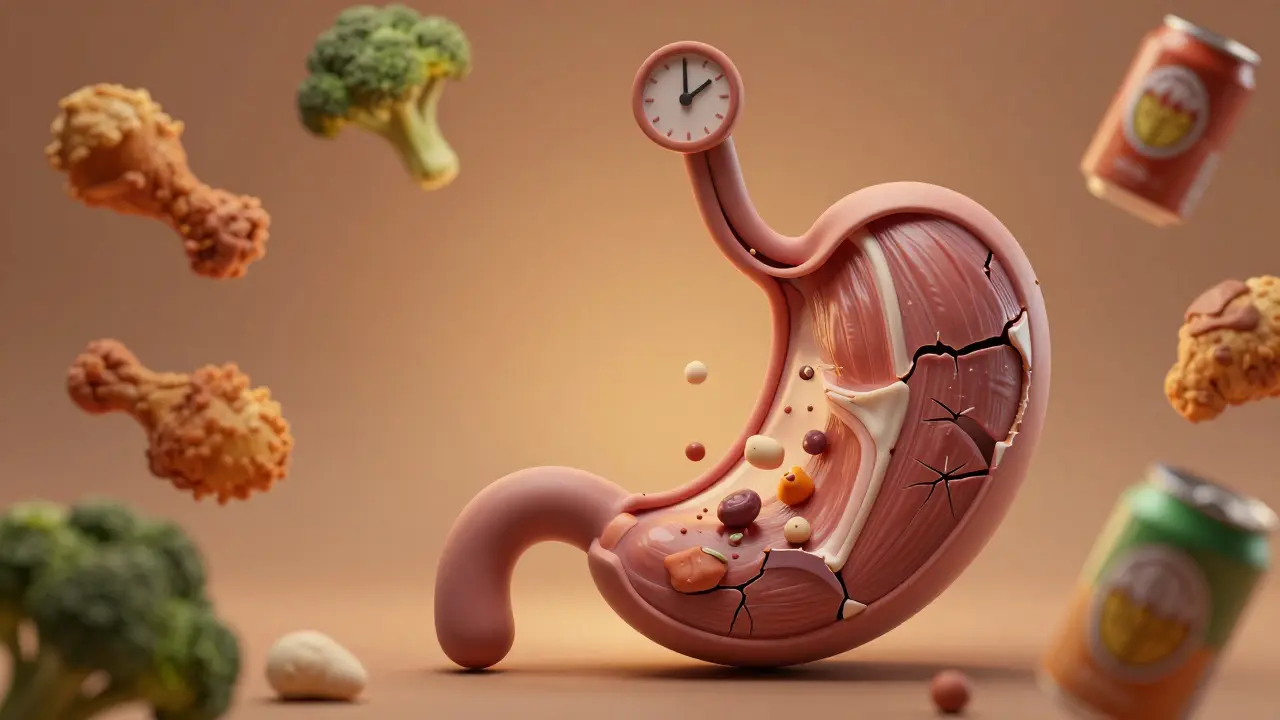
Gastroparesis isn't just a slow stomach. It’s when your stomach can’t move food into your small intestine like it should, even when there’s no blockage. This isn’t a rare oddity-it affects about 4% of people, and for many, it turns meals into a source of fear, pain, and exhaustion. If you’ve ever felt full after just a few bites, thrown up hours after eating, or spent nights with bloating so bad you couldn’t sleep, you’re not alone. The good news? Diet changes alone can cut symptoms in half for most people. No magic pills. No surgery. Just smart, science-backed eating.
What Gastroparesis Really Does to Your Body
Your stomach isn’t just a food bag. It’s a pump. It relaxes to take in food, then contracts to grind it into a thin slurry before sending it onward. In gastroparesis, that pump fails. Nerves-especially the vagus nerve-get damaged. Muscles weaken. Food sits. And that’s when trouble starts.
Think of it like a clogged drain. The water (food) is still there, but it’s not moving. That’s why you feel full so fast. That’s why nausea hits hours after eating. That’s why vomiting isn’t just about bad food-it’s your body trying to clear a system that’s backed up. Studies show 90% of people with gastroparesis have nausea. 85% feel full after just a few bites. And 75% vomit regularly. These aren’t side effects. They’re symptoms of a broken system.
It’s worse for women. Four out of five patients are female. And if you have diabetes-especially type 1-your risk jumps to 50%. That’s because high blood sugar damages nerves over time. But it’s not just diabetes. Surgery, autoimmune diseases like scleroderma, and even unknown causes (called idiopathic) account for most cases. The key takeaway? This isn’t just about digestion. It’s about nerve damage, muscle failure, and a body that can’t keep up.
How Doctors Diagnose It
Many people are misdiagnosed for years. Gastroparesis looks like acid reflux, IBS, or even anxiety. But the real test is simple: measure how fast food leaves your stomach.
The gold standard is a gastric emptying scan. You eat a meal with a tiny bit of radioactive material. Then, a camera tracks it over 4 hours. If less than 40% of the meal is gone after 2 hours, you have gastroparesis. Some clinics use stricter numbers-less than 10% at 60 minutes-but the 40% rule at 120 minutes is widely accepted.
There’s no blood test. No scan that shows nerves. Just this one test. And it’s not always done right. Many doctors skip it, assuming symptoms alone are enough. But symptoms overlap too much. That’s why 30% of cases have no known cause. That doesn’t mean it’s not real. It means we need better tools.
Why Your Diet Is the First Line of Defense
Medications help some. Surgery helps others. But 65% of people get real relief just by changing what and how they eat. That’s not a guess. That’s from UCLA Medical School data. And it’s backed by decades of clinical use.
The core idea? Reduce the workload on your stomach. Make food easier to digest before it even gets there.
Start with size. Eat 5 to 6 tiny meals a day. No more than 1 to 1.5 cups per meal. That’s about half a sandwich or a small bowl of soup. Big meals mean more pressure, more bloating, more vomiting. Small meals mean less strain.
Then, texture. Raw carrots? Forget them. Broccoli? Skip it. Tough chicken? Don’t bother. These foods don’t break down. They sit. And they form bezoars-solid masses of undigested food that can block your stomach. That’s not theoretical. It happens in 6% of cases, and 2% need surgery to remove them.
Instead, blend. Puree. Cook until soft. A study from Mayo Clinic found that 70% of patients improved when their food was blended to a smooth consistency-particles smaller than 2mm. Think baby food texture. You don’t need to eat like a toddler. You need to eat like your stomach is broken.

What to Avoid: The Top 3 Diet Triggers
Not all foods are equal. Some don’t just sit around-they actively slow things down.
1. Fat - High-fat meals delay gastric emptying by 30% to 50%. That’s not a small effect. It’s a major roadblock. Avoid fried food, butter, cream, cheese, fatty meats, and even nuts. Aim for less than 3 grams of fat per meal. That means no heavy sauces. No creamy soups. No avocado toast. Stick to lean proteins and low-fat dairy.
2. Fiber - Too much fiber = too much bulk. Your stomach can’t break it down. Aim for less than 15 grams per meal. That means ditching whole grains, raw veggies, beans, and bran cereals. Choose white bread, white rice, peeled potatoes, and cooked squash instead.
3. Carbonation - Soda, sparkling water, even beer. These add gas to your stomach. That gas expands your stomach, increasing pressure and making nausea worse. A study showed carbonated drinks increase gastric distension by 25%. That’s enough to trigger vomiting in someone already struggling.
And don’t drink with meals. Wait 30 minutes after eating before sipping water. Drinking while eating increases stomach volume by 40%. That’s like trying to fit two full plates into a one-plate system.
What to Eat: A Real-World Meal Plan
Here’s what a day of eating looks like for someone with gastroparesis:
- Breakfast: 1/2 cup oatmeal (made with water, not milk), 1 scrambled egg, 1/2 banana (mashed)
- Mid-morning snack: 1/2 cup applesauce, 1/4 cup low-fat yogurt
- Lunch: 1 cup blended chicken and rice soup (strained, no chunks), 1/2 cup mashed sweet potato
- Afternoon snack: 1/2 cup smoothie (blended banana, almond milk, protein powder)
- Dinner: 1/2 cup pureed fish, 1/2 cup mashed cauliflower, 1/4 cup white rice
- Evening snack: 1/2 cup custard or pudding (low-fat)
Hydration matters too. Sip 1 to 2 ounces of water every 15 minutes. That’s 4 to 6 sips. Not a glass. Not a bottle. Just small, steady sips. Big gulps stretch your stomach. Small sips keep things moving.
When Diet Isn’t Enough
Some people do everything right and still suffer. That’s when you need more.
Medications like metoclopramide can speed up emptying by 20-25%. But they come with risks. Long-term use can cause uncontrollable muscle movements (tardive dyskinesia). That’s why doctors only prescribe them short-term.
For those who don’t respond, there’s gastric electrical stimulation (GES). It’s like a pacemaker for your stomach. A device sends tiny pulses to help it contract. FDA-approved since 2000, it helps 70% of patients reduce vomiting by over half. It’s not a cure, but it’s life-changing for many.
Newer options are coming fast. Per-oral pyloromyotomy (POP) is a minimally invasive procedure that cuts the muscle at the bottom of the stomach. It reduces resistance by 80% and works in 60-70% of cases. And in trials, a new drug called relamorelin improved emptying by 35%. These aren’t science fiction. They’re real, available treatments.
For the most severe cases-where weight loss is extreme and nutrition is failing-tube feeding or IV nutrition might be needed. It’s not the goal. But it’s a safety net.
Why Tracking Food Helps More Than You Think
Not all triggers are the same. What makes one person sick might be fine for another.
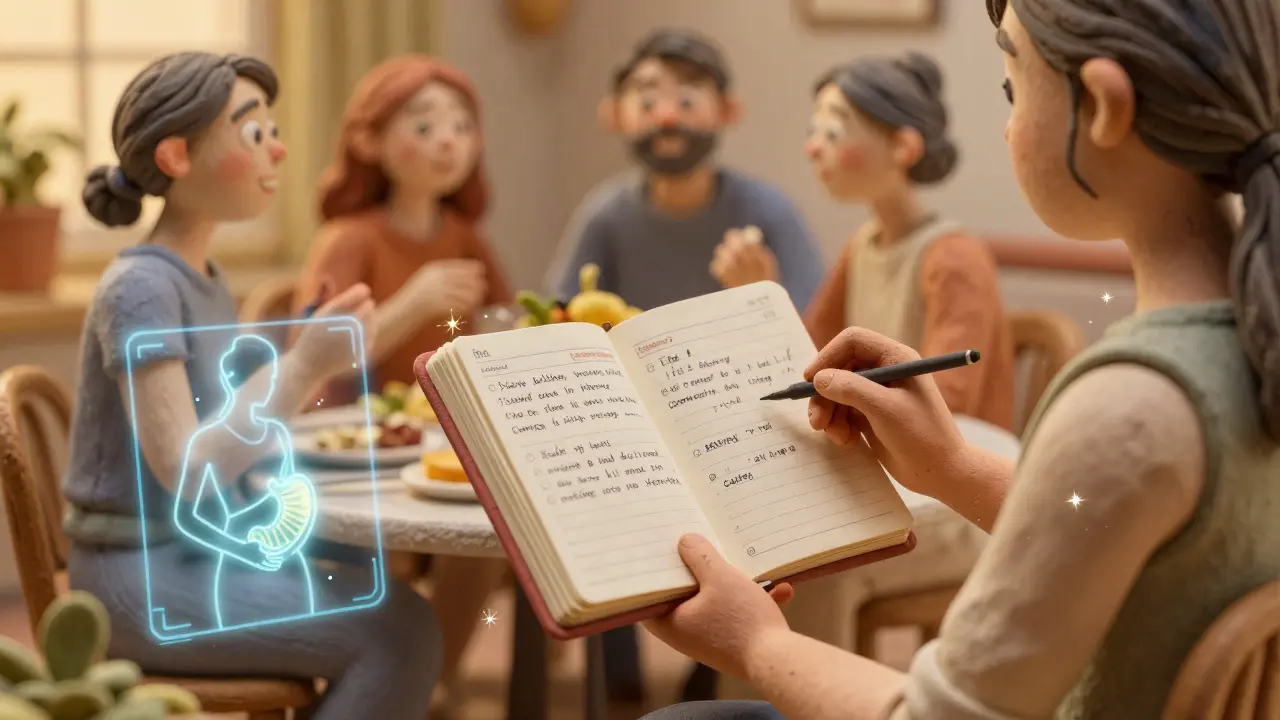
Cleveland Clinic found that 80% of patients identify their personal triggers by keeping a food and symptom diary. Write down everything you eat. Write down how you feel 1 hour, 3 hours, and 6 hours after. After 2 weeks, patterns show up.
One person finds tomatoes trigger vomiting. Another can’t tolerate dairy. Another gets sick after eating anything with seeds. You won’t know unless you track. And working with a registered dietitian who specializes in gastroparesis improves outcomes by 40%. That’s huge.
The Hidden Costs: More Than Just Hunger
This isn’t just about food. It’s about life.
75% of patients say gastroparesis limits daily activities. 40% can’t work full-time. 65% feel anxious before meals. 50% avoid social events because they can’t predict when they’ll feel sick. That’s not just physical. It’s emotional.
And it gets worse for diabetics. Uncontrolled gastroparesis causes wild blood sugar swings. Insulin doses become useless when food doesn’t move. That’s why managing both conditions together is critical.
Malnutrition affects 30-40% of chronic cases. Weight loss over 10% of body weight is common. Dehydration from vomiting hits 25%. These aren’t side notes. They’re emergencies.
What’s Next: The Future of Gastroparesis Care
The field is changing fast. AI is being tested to analyze gastric scans more accurately-potentially improving diagnosis by 25%. Researchers are looking at gut bacteria. Early studies show probiotics can reduce symptoms by 30%. And new drugs are in phase 3 trials, promising faster emptying without dangerous side effects.
But the biggest breakthrough isn’t in a lab. It’s in the kitchen. The most powerful tool you have is still what you put on your plate. And the best advice? Start small. Eat slowly. Blend your food. Avoid fat and fiber. Track what works. And don’t give up. For most people, this isn’t a life sentence. It’s a challenge-and one you can manage.

Elan Ricarte
Let me tell you something - this post is basically the gospel according to gastroparesis. I’ve been living this for 7 years, and nobody ever told me to blend my food like baby food. I was eating kale salads and quinoa bowls like some kind of wellness influencer. Bro, I was literally vomiting chunks of broccoli at 3 a.m. No joke. Once I switched to pureed chicken and mashed sweet potato? Life changed. No meds. No surgery. Just… less rage in my stomach.
Camille Hall
Thank you for this. I’ve been struggling to find clear, practical advice without someone trying to sell me a supplement or a detox tea. The meal plan here? Real. Doable. And honestly? Kind. I’ve been telling my friends with IBS to read this - it’s not just for gastroparesis. A lot of it applies to anyone with a sensitive gut. You don’t need to suffer in silence. This is the roadmap.
Ritteka Goyal
OMG I LUV THIS POST!! I AM FROM INDIA AND WE EAT A LOT OF FIBER AND SPICES BUT AFTER MY DAD GOT GASTROPARESIS I STARTED MAKING SOUPS WITH LITTLE ONIONS AND TURMERIC AND IT WORKED SO WELL!! HE WASNT VOMITING ANYMORE AND EVEN ATE 3 MEALS A DAY!! I THINK THE KEY IS TO COOK EVERYTHING SOFT AND NOT USE TOO MUCH OIL OR MILK!! ALSO DONT DRINK WATER WITH MEALS!! I LEARNED THAT FROM MY AUNTY WHO IS A NURSE!! THANKS FOR SHARING!!
THANGAVEL PARASAKTHI
Man, I never realized how much fiber I was eating until I started tracking. I used to think ‘high fiber = healthy’ but turns out my stomach thinks it’s a brick. Now I eat white rice like it’s a religious ritual. And no more lentils. I miss them but my gut says ‘nope.’ Also, the 30-minute wait before drinking? Genius. I used to chug water after every bite. Now I sip like a vampire at a tea party. Small changes, huge difference.
Chelsea Deflyss
Ugh. I hate when people act like diet is ‘enough.’ What about the ones who do everything right and still can’t keep weight on? You’re making it sound like it’s just a matter of ‘eating right’ like it’s a 30-day cleanse. Some of us are on TPN. Some of us are hospitalized. This post feels like a sugar-coated PSA. Not everyone gets to ‘blend their food’ and call it a day.
Scott Conner
So… is the gastric emptying scan really the only way? I had my test done 4 years ago and they said I was borderline. But my symptoms are way worse now. Do I need to get retested? Or is it just ‘live with it’? Also, what’s the deal with relamorelin? Is that even available yet? I’ve been googling it but it’s all trial stuff. Would love a real answer.
Sam Dickison
As someone who’s worked in GI for 12 years, I’ll say this: the fat/fiber/carbonation triad is 100% spot-on. You don’t need to be a doctor to get this. The science is simple: gastric motility is a pressure game. Less bulk, less resistance, less gas = better emptying. The real win here is the 70% improvement with blending. That’s not anecdotal. That’s from prospective cohort studies. This post is clinically accurate. Rare.
Karianne Jackson
I cried reading this. I’ve been avoiding dinner parties for 5 years because I’m scared I’ll throw up. Last week I tried the pureed fish and mashed cauliflower. I ate it. I didn’t puke. I didn’t even feel bloated. I sat there and just… ate. Like a normal person. I don’t know what to say. Thank you. I feel like I got my life back for one night.
Tom Forwood
From a guy who’s been to 7 different doctors and had 3 misdiagnoses - this is the first thing that made sense. I used to think I was just ‘bad at eating.’ Turns out I was just eating like a normal person. Who knew? I started doing the 6-meal thing and now I can actually sleep without a heating pad on my stomach. Also - the hydration tip? 10/10. I used to chug 32 oz of water before bed. Now I sip 4 oz every 15 mins. I swear, it’s like my stomach finally got a massage.
Jacob den Hollander
I just want to say - this isn’t just about food. It’s about dignity. I used to hide in the bathroom after meals. I’d cancel plans because I didn’t know if I’d be sick. I felt broken. But when I started tracking my food? I found my triggers. Tomato sauce? Vomiting. Garlic bread? Bloating. Now I make my own meals. I cook for myself. And for the first time in years… I feel like I’m in control. This post didn’t just give me a diet. It gave me hope. And that’s worth more than any pill.