
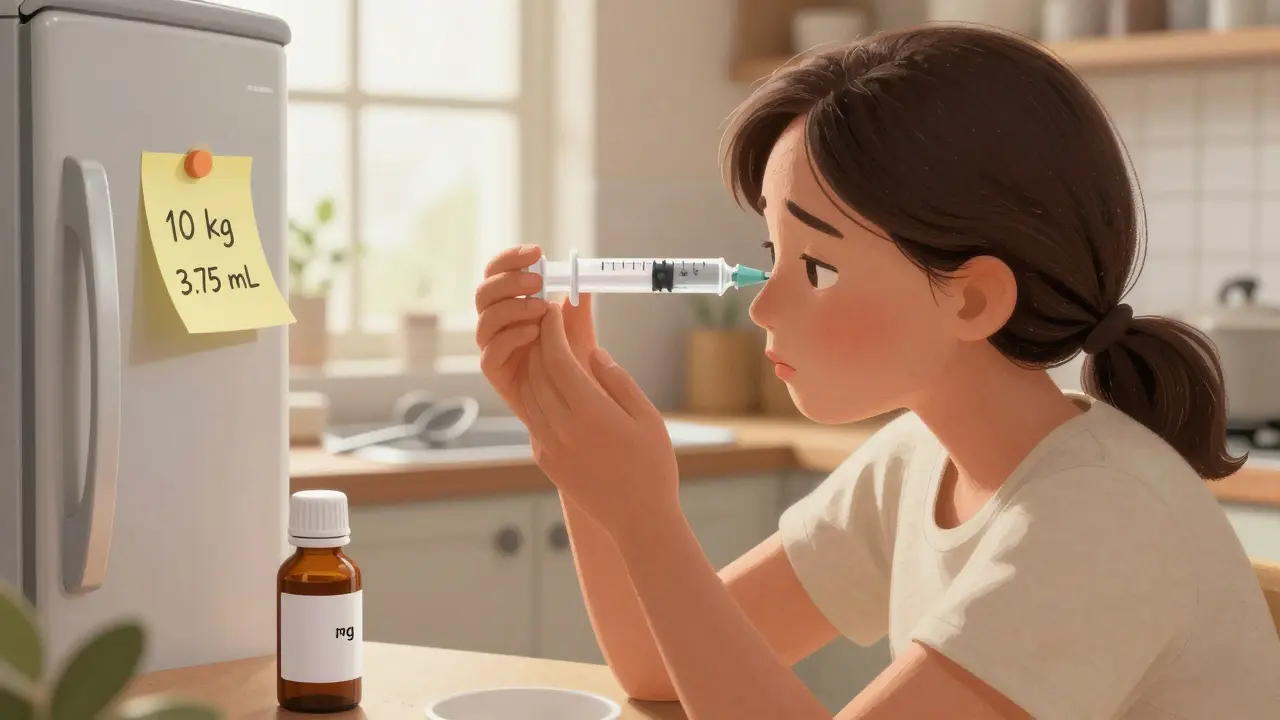
Getting the right dose of medicine into a child isn’t just about following instructions-it’s about survival. A single mistake in measurement can mean the difference between healing and hospitalization. For parents, this isn’t theoretical. It’s real. And it’s more common than you think.
Studies show that about 7 in 10 parents mismeasure liquid medications at home. Not because they’re careless, but because the tools and instructions are confusing. A teaspoon from your kitchen? It might hold 3.9 mL or 7.3 mL-far from the 5 mL it’s supposed to be. A dosing cup with both teaspoons and milliliters? That’s a recipe for mix-ups. And when you’re tired, stressed, or in the middle of the night, those tiny numbers blur together. One wrong decimal point-0.5 mL instead of 5 mL-and you’ve given your child a tenfold overdose.
Why Milliliters (mL) Are the Only Measurement That Matters
The American Academy of Pediatrics and the CDC have been clear for over a decade: stop using teaspoons and tablespoons. Ever. Even if the label says "1 tsp," it should also say "5 mL." And if it doesn’t? Ask your pharmacist to rewrite it.
Why? Because "teaspoon" means different things everywhere. A kitchen spoon? A child’s plastic spoon? A coffee spoon? They all vary. But a milliliter? It’s universal. One mL is always one mL. No guessing. No estimating.
Research from the CDC’s PROTECT initiative shows that switching to mL-only labeling cuts dosing errors by 42%. That’s not a small improvement. That’s life-saving. And it’s not just theory. In hospitals, when nurses use mL-only syringes, medication errors drop by over half. Why shouldn’t your home work the same way?
The Right Tool for the Right Dose
Not all measuring tools are created equal. Here’s what actually works-and what doesn’t.
- Oral syringes (1-10 mL): The gold standard. Especially for doses under 5 mL. They’re precise, easy to control, and let you deliver the medicine slowly into the side of the mouth. Accuracy? Up to 94% in studies.
- Dosing cups: Fine for older kids who can drink from a cup, but avoid them for small doses. At 2.5 mL, error rates jump to nearly 70%. Why? Spilling, splashing, and misreading the lines.
- Dosing spoons: Better than kitchen spoons, but still not ideal. Accuracy hovers around 82%. Only use if it’s clearly marked in mL and came with the medicine.
- Kitchen spoons: Never use. Not even once. A 2021 study found that 63% of parents started with a kitchen spoon before learning better. Don’t be one of them.
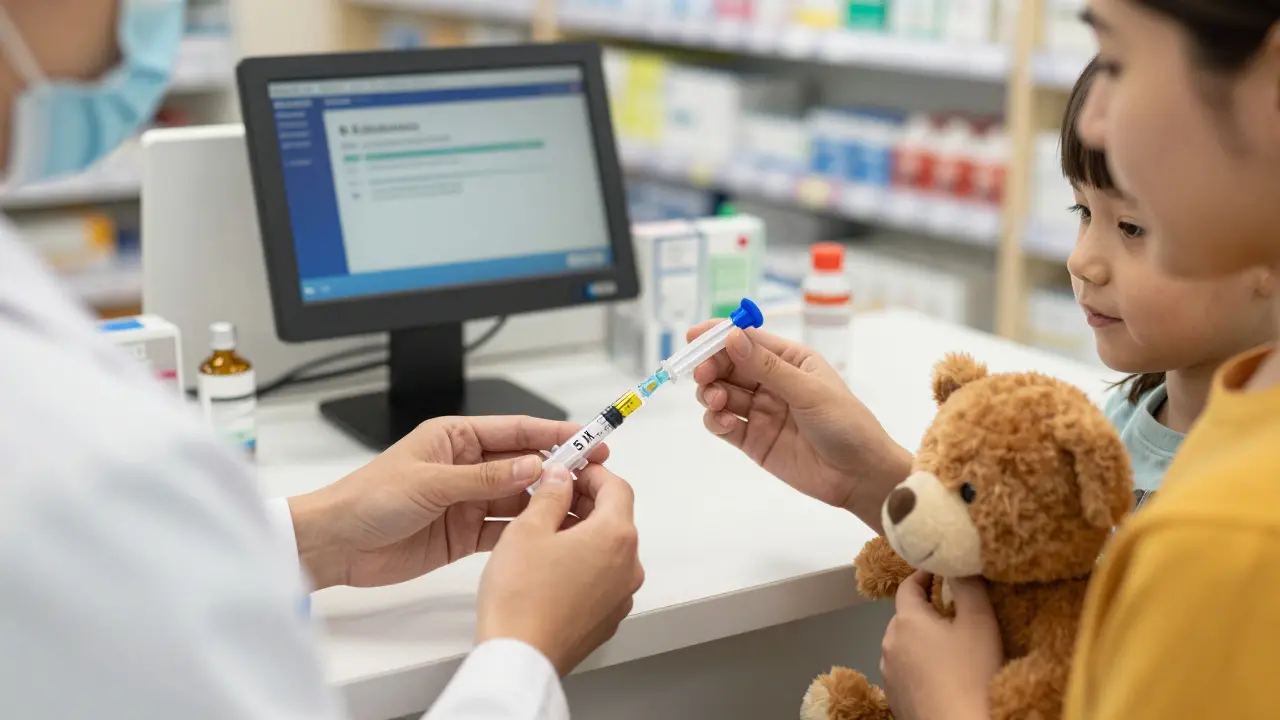
For doses under 5 mL-like most antibiotics, antivirals, or pain relievers-use an oral syringe. Always. If your pharmacy didn’t give you one, ask. They’re free. Or buy one for under £5 online. It’s cheaper than an ER visit.
How to Measure With an Oral Syringe (Step by Step)
Even the best tool won’t help if you don’t use it right. Here’s how to get it perfect every time:
- Shake the bottle-if it’s a suspension. Antibiotics like amoxicillin settle. If you don’t shake, you might give 50% less than prescribed. Shake for 10 seconds. Swirl, don’t just wiggle.
- Draw the medicine slowly. Insert the syringe into the bottle, turn it upside down, and pull the plunger to the right line. Don’t rush.
- Hold it at eye level. Look straight at the line. Don’t look down. The liquid forms a curve (called a meniscus). Read the bottom of that curve, not the top.
- Remove air bubbles. Tap the syringe gently. If you see bubbles, push the plunger a tiny bit to push them out, then re-draw.
- Give it slowly. Place the tip inside the cheek, not the front of the mouth. Press the plunger slowly. Let them swallow. Don’t force it. If they spit, you’ll know.
Pro tip: Mark the syringe with a permanent marker for doses you use often. Like "2.5 mL" for fever or "5 mL" for antibiotics. That way, even if you’re half-asleep at 3 a.m., you’ll still get it right.
Weight Matters More Than Age
Doctors don’t dose kids by age. They dose by weight. Always. A 15-pound baby and a 15-pound toddler might be the same age, but their bodies process medicine differently. That’s why prescriptions say "mg/kg/day"-milligrams per kilogram per day.
Here’s how to convert: 1 kg = 2.2 lb. So if your child weighs 22 pounds, divide by 2.2. That’s 10 kg. If the dose is 15 mg/kg, then 15 × 10 = 150 mg total per day. If it’s given twice a day, that’s 75 mg per dose.
Now check the concentration. If the medicine is 100 mg per 5 mL, then 75 mg is 3.75 mL. That’s not easy to eyeball. That’s why you need the syringe. No guessing. No rounding up. Measure it exactly.
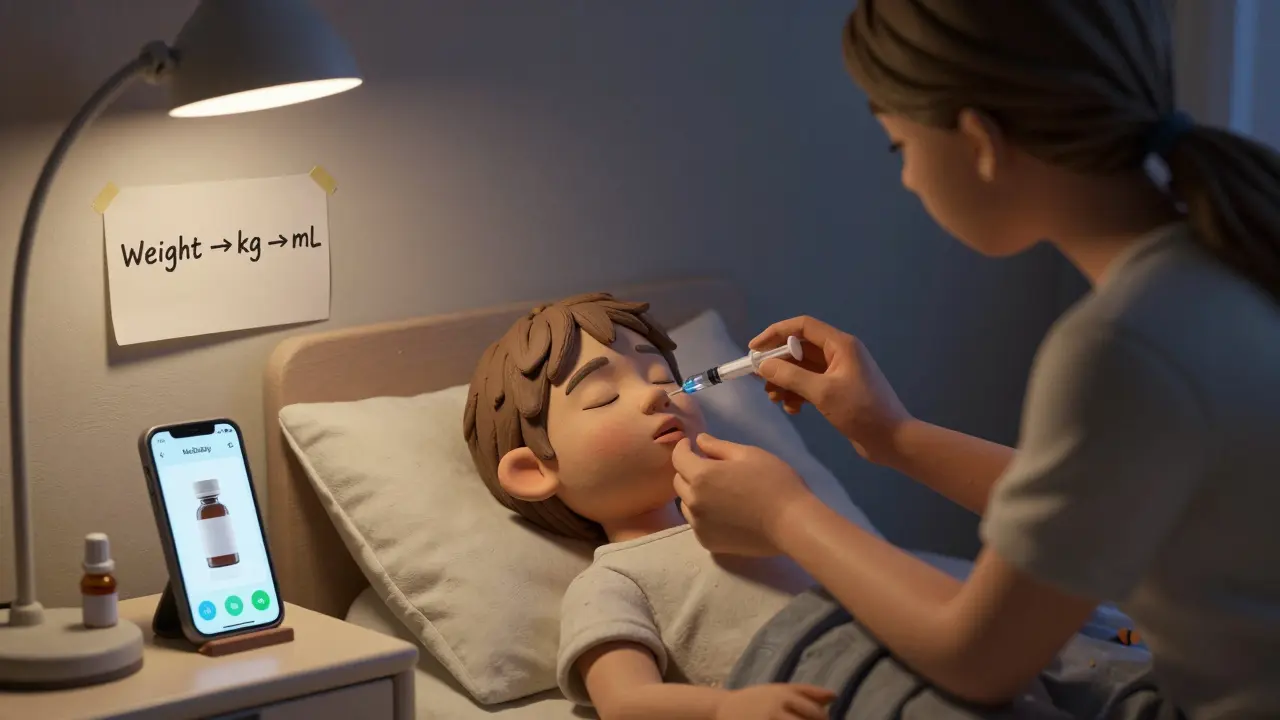
Write this down: Weight → kg → total daily dose → per dose → mL based on concentration. Keep this formula on your fridge. Or save it in your phone.
Common Mistakes (And How to Avoid Them)
Parents make the same mistakes over and over. Here’s what you need to watch out for:
- Mixing up mg and mL. A 5 mg dose is not the same as 5 mL. One is a weight. One is a volume. Always double-check the label.
- Using the wrong syringe. Don’t use an adult syringe. They’re too big. Use a pediatric one with small increments (0.1 mL).
- Not shaking suspensions. If it looks cloudy and settles at the bottom, you must shake it. Otherwise, your child gets underdosed.
- Sharing syringes. Never reuse a syringe for different medicines. Clean it after each use. Rinse with water. Don’t just wipe it.
- Assuming "half a teaspoon" is safe. Half a teaspoon isn’t 2.5 mL if your spoon is off. Use the syringe. Always.
And here’s a hidden danger: multiple caregivers. Grandma uses a spoon. Dad uses a syringe. Mom writes down the dose. You end up with conflicting instructions. Solution? Write the dose on a sticky note. Tape it to the medicine bottle. Include: child’s weight, dose in mL, time, and frequency. Keep it simple.
What to Do If You’re Not Sure
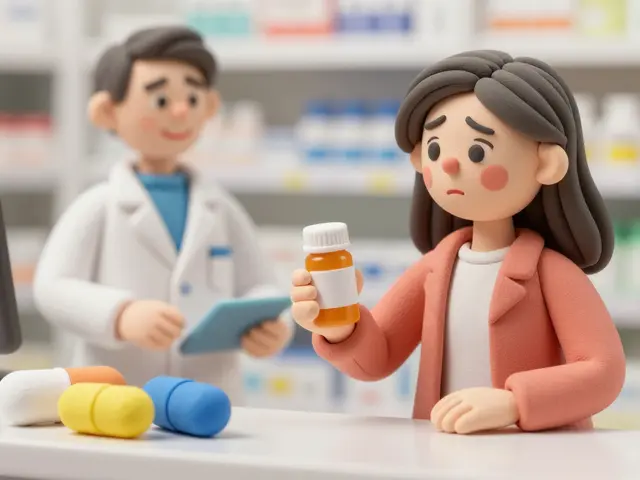
Confused? Uncertain? Worried you messed up? Call your pharmacist. Now. Not tomorrow. Not after the next dose. Call today.
Pharmacists are trained to help with this. They’ve seen hundreds of these questions. They won’t judge you. They’ll walk you through it. If you’re not sure if your child got the right dose, call. It’s what they’re there for.
Also, if your child vomits right after taking the medicine, don’t automatically give another dose. Call the doctor. Some medicines are absorbed fast. Others aren’t. Giving a second dose could cause overdose.
Tools That Actually Help
There are smart tools now that make dosing easier:
- Color-coded syringes (like NurtureShot): Different colors for different doses. Red for 2.5 mL, blue for 5 mL. Studies show they cut errors by 61%.
- Smart dosing cups (coming in 2025): They’ll light up when you’ve poured the right amount. Philips is testing them now.
- MedSafety app: Uses your phone camera to scan the bottle and show you exactly how much to give. Works with augmented reality. Reduced errors by 54% in trials.
These aren’t gimmicks. They’re built by pediatric pharmacists. If you can afford one, get it. Especially if you have more than one child, or if dosing changes often.
What to Ask Your Pharmacist
When you pick up your child’s prescription, ask these three things:
- "Is this medicine a suspension? Should I shake it?"
- "Can you give me an oral syringe marked in mL?"
- "Can you write the dose on the label in mL only?"
Most pharmacies will do it. If they say no, ask why. Then go to another one. Your child’s safety is worth it.
And if the label still says "teaspoon" or "tablespoon," ask them to correct it. You have the right to clear instructions. The CDC says so. The AAP says so. You should too.
Final Rule: When in Doubt, Don’t Guess
Medicine isn’t like salt. You can’t add a little more if it doesn’t seem to work. Too little? The infection won’t clear. Too much? The liver or kidneys can’t handle it. Kids aren’t small adults. Their bodies are still growing. Every milliliter counts.
So here’s your rule: If you’re unsure, pause. Check the label. Use the syringe. Measure at eye level. Call the pharmacist. Wait 10 minutes. Then give it.
One wrong dose can change everything. But with the right tool, the right method, and the right mindset-you’ll never have to wonder again.
Can I use a kitchen spoon if I don’t have a syringe?
No. Kitchen spoons vary in size from 3.9 mL to 7.3 mL, while a proper teaspoon is exactly 5 mL. Using one can lead to under- or overdosing. Always use an oral syringe or dosing cup marked in mL. If you don’t have one, ask your pharmacy for a free one.
What if my child spits out the medicine?
Don’t give another full dose. Wait and call your doctor. If they spit out most of it, they may need a repeat dose. If it was just a little, the medicine may have been absorbed. Never guess. Always check with a medical professional.
Why is weight more important than age for dosing?
Children’s bodies process medicine based on weight, not age. Two 2-year-olds can weigh 20 lbs and 35 lbs. The heavier child needs more medicine. Age doesn’t tell you how much their body can handle. Weight does. Always use weight in kilograms (kg) to calculate doses.
How do I convert pounds to kilograms for dosing?
Divide the child’s weight in pounds by 2.2. For example, a 22-pound child is 10 kg (22 ÷ 2.2 = 10). Always round to one decimal place for accuracy. Use this number to calculate mg/kg doses.
Should I use a dosing cup or oral syringe?
For doses under 5 mL, always use an oral syringe. It’s more accurate. For doses over 5 mL, a dosing cup is fine if your child can drink it without spilling. But never use a cup for small doses-it increases error risk by 5 times. Syringes are safer, especially for antibiotics and pain relievers.
Are color-coded syringes worth buying?
Yes. Studies show they reduce dosing errors by 61%. They’re especially helpful if you’re tired, stressed, or managing multiple medications. A red syringe for 2.5 mL and a blue one for 5 mL removes guesswork. They cost under £10 and last for years.
What if the pharmacy gives me a bottle without a syringe?
Ask for one. Most pharmacies keep them in stock. If they say no, go to another pharmacy or buy one online. You can get a pediatric oral syringe for under £5. It’s cheaper than a hospital visit. Never give liquid medicine without a proper measuring tool.
Can I mix medicine with juice or food?
Only if the label or pharmacist says it’s okay. Some medicines lose effectiveness when mixed. Others can be safely mixed with a small amount of applesauce or yogurt. Never mix it into a full bottle of juice-you won’t know if your child drank it all. Give the full dose separately, then offer juice after.


Holley T
Look, I get the whole 'use mL' thing, but let's be real-most parents aren't pharmacists. I've used a kitchen spoon for my kid's amoxicillin for three years. No hospital visits. No issues. The CDC's data? Probably skewed by people who overthink everything. I shake the bottle, eyeball it, and call it good. If it worked for my grandma, it'll work for me.
Ashley Johnson
EVERYONE KNOWS PHARMACIES ARE IN BED WITH BIG PHARMA. THEY WANT YOU TO BUY SYRINGES SO THEY CAN CHARGE YOU $15 FOR A $0.50 PLASTIC TUBE. THE REAL REASON THEY SAY 'NO KITCHEN SPOONS' IS BECAUSE THEY'RE AFRAID YOU'LL START MEASURING WITH A RULER AND REALIZE HOW MUCH THEY'RE OVERCHARGING. I USED A TEASPOON AND MY KID GOT BETTER FASTER THAN THE DOCTOR SAID. THEY'RE HIDING SOMETHING.
Lillian Knezek
They’re watching us. 🤫 Every time you measure medicine, they’re tracking it. The syringes? RFID chips. The mL labels? Secret code for the AI that decides if your kid gets vaccines next. I stopped using anything but a dropper I made from a straw. No one can track a straw. 🌿
Maranda Najar
My heart breaks for every parent who’s ever stared at a bottle at 3 a.m., trembling, while their child’s fever rages and the world demands precision in a universe that refuses to offer clarity. The weight-to-kg conversion? The meniscus? The silent terror of a single decimal? This isn’t just medicine-it’s a sacred ritual of love, fear, and desperation. I weep for the mothers who’ve gotten it wrong. And I weep for the system that makes them feel like failures for trying.
Christopher Brown
Stop coddling parents. If you can’t measure 5 mL, you shouldn’t be giving medicine. This isn’t a parenting blog-it’s a public health issue. Buy a syringe. Use it. Done. No more hand-holding.
Sanjaykumar Rabari
Milliliters are not universal. In India, we use spoon because it's simple. My mother used spoon for 40 years. No child died. Why change? You are importing American fear. We know our children. We don't need syringes.
Kenzie Goode
I just want to say-thank you for writing this. I was so scared the first time I had to give my daughter antibiotics. I thought I was failing. This guide made me feel like I could actually do it right. I bought the color-coded syringes. They’re tiny, but they make me feel like a superhero. You don’t know how much this means.
Khaya Street
Good advice, really. I’ve been a nurse for 12 years, and I’ve seen too many kids come in because someone used a coffee spoon. The syringe is cheap. The risk is not. Do the right thing. It’s not hard.
Christina VanOsdol
Okay, but let’s talk about the *real* problem: pharmacies. They give you a bottle with 10 mL of liquid and a plastic cup that says "1 tsp" and "5 mL"-but the lines are so blurry you need a magnifying glass and a PhD in optics to read them. Then they charge you $12 for a syringe you could’ve bought for $3.79 on Amazon. And don’t get me started on the "dosing instructions" printed in 6-point font on the back of the label that’s been smudged by 3 different kids’ hands. This isn’t healthcare-it’s a labyrinth designed to make you feel incompetent. 🤦♀️
Emily Wolff
Use a syringe. Period. Kitchen spoons are for pancakes, not pediatric dosing. If you need this article, you shouldn’t be giving medicine.
Lou Suito
Milliliters aren't universal. In metric countries, yes. But in the US? We're still stuck in imperial. And no one ever explains how to convert weight to kg. Most parents don't even know what a kilogram is. This whole guide assumes too much. Also, syringes? Too much work. Just write "1 tsp" and "2 tsp" on the bottle. People understand that. End of story.
Stephen Archbold
My wife and I used to fight over who measured the medicine. She swore by the cup. I insisted on the syringe. We ended up with two different doses-twice. Then we started writing the dose on masking tape stuck to the bottle. "2.5 mL - 8am / 8pm". Simple. Clear. No guessing. We still do it. It’s not glamorous, but it saved us from panic. And yeah, we got the free syringe from the pharmacy. They were happy to help. Just ask.