
Every year, over 130,000 people in the U.S. die from lung cancer. That’s more than colon, breast, and prostate cancers combined. Most of these deaths could have been prevented - not with a miracle drug, but with a simple scan. If you’re a current or former smoker, understanding lung cancer screening and what’s changed in treatment could literally save your life.
Who Should Be Screened? It’s Not Just Who You Think
For years, lung cancer screening was limited to heavy smokers over 55. But that changed in 2021, and again in 2023. Now, if you’re between 50 and 80, and you’ve smoked at least 20 pack-years, you qualify - no matter how long ago you quit. A pack-year means smoking one pack a day for a year. So if you smoked two packs a day for 10 years, that’s 20 pack-years. Or half a pack a day for 40 years. It adds up faster than you think. The old rule - that you had to quit within the last 15 years - is gone. Research shows people who quit 20 or even 25 years ago still have more than twice the risk of lung cancer than someone who never smoked. That’s why the American Cancer Society dropped the 15-year cutoff in March 2023. They estimated this single change could bring in another 15 million Americans into screening eligibility. But here’s the problem: only 18% of those who qualify actually get screened. Why? Many doctors still don’t know the updated guidelines. A 2022 survey found 42% of primary care doctors weren’t aware screening now starts at age 50 with just 20 pack-years. Others assume patients won’t show up. Or they don’t know how to start the conversation.The Scan That Saves Lives: Low-Dose CT
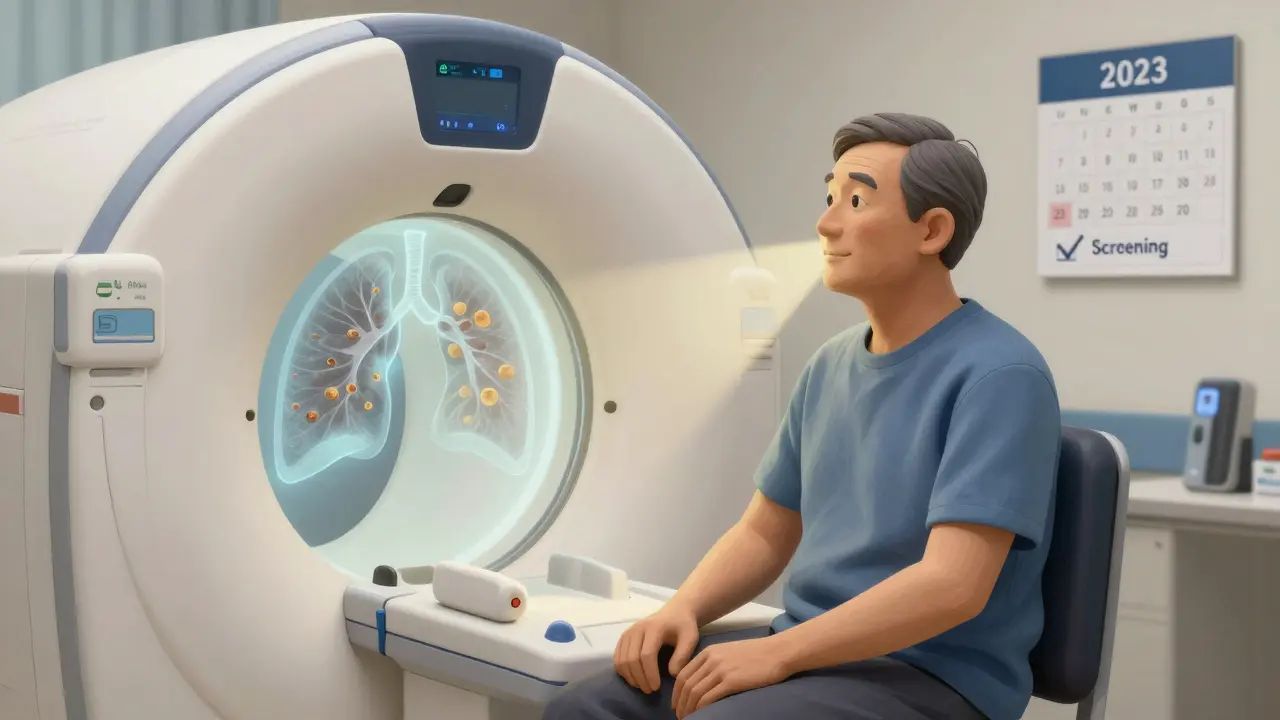
The only proven way to catch lung cancer early is a low-dose CT scan, or LDCT. It’s not a regular chest X-ray. It’s a quick, painless scan that takes less than 10 seconds. It uses 70-80% less radiation than a standard CT scan - less than you’d get on a cross-country flight. The machine takes hundreds of images of your lungs, and a radiologist looks for tiny nodules - growths smaller than a pea. The difference this scan makes is staggering. If lung cancer is caught before it spreads, the five-year survival rate jumps from 6% to 59%. That’s not a guess. That’s from the American Lung Association’s 2020 report. And yet, only 23% of lung cancer cases are found at this early stage. The rest are caught when symptoms appear - coughing blood, chest pain, weight loss. By then, it’s often too late.The False Alarm Problem - And How AI Is Fixing It
LDCT scans are powerful, but they’re not perfect. In the National Lung Screening Trial, 96.4% of positive results turned out to be false alarms. That means nearly every person flagged by the scan didn’t have cancer. But they still had to go through more scans, biopsies, and anxiety. That’s where AI comes in. In January 2023, the FDA approved the first AI tool for lung nodule analysis: LungQ by Riverain Technologies. It doesn’t replace the radiologist. It helps them. The software highlights suspicious areas, measures growth over time, and flags changes that might be missed by the human eye. In trials, it cut unnecessary follow-up scans by 22%. That means fewer invasive procedures and less stress for patients. Other tools are being tested to combine smoking history with genetics, air pollution exposure, and family history. The National Cancer Institute is launching the PACIFIC trial in 2024 to see if this kind of personalized risk scoring can identify high-risk people even before they smoke heavily.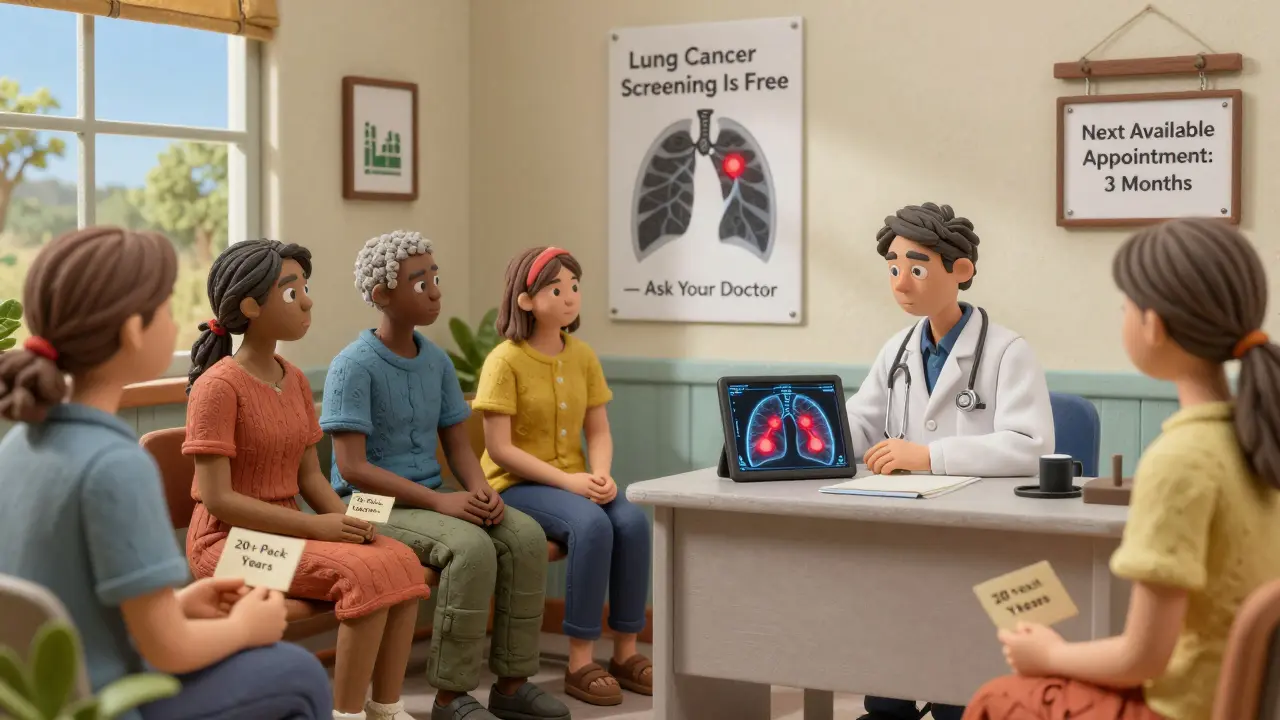
Targeted Therapy: Turning Early Detection Into Long-Term Survival
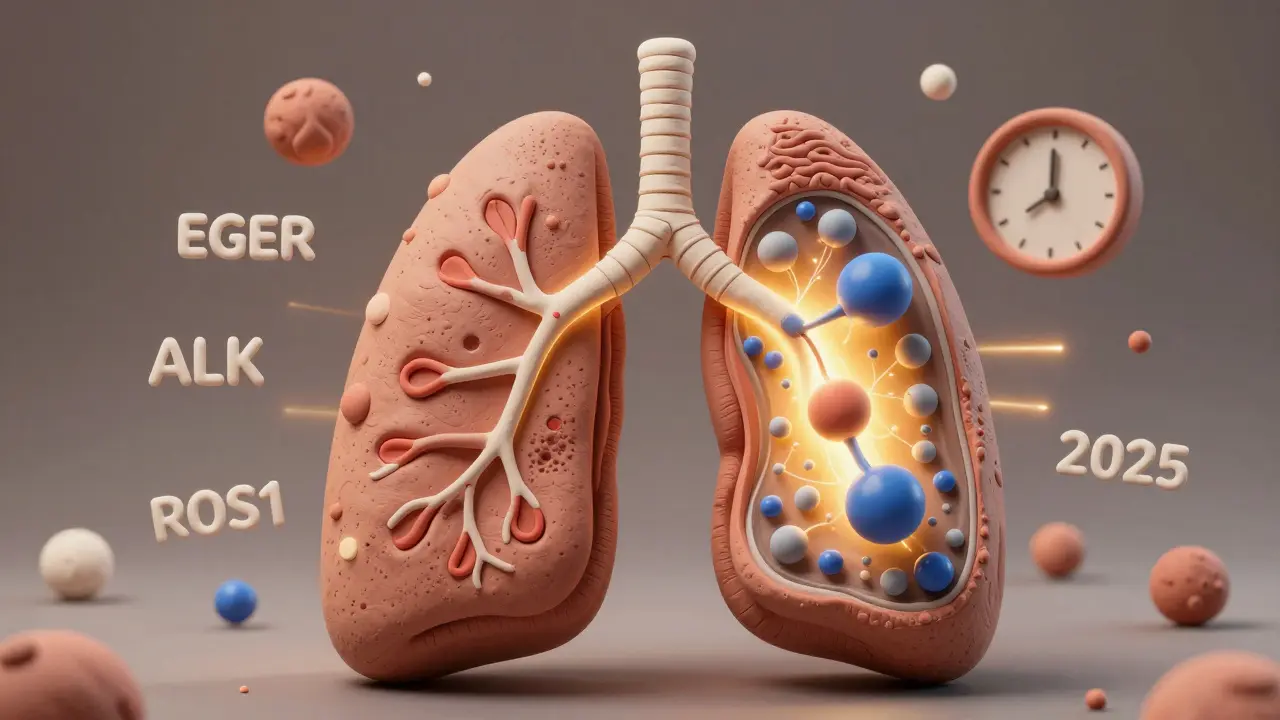
Screening finds cancer early. But what happens next? That’s where the biggest breakthroughs have happened in the last five years. Before 2020, surgery was the only option for early-stage lung cancer. Now, for patients with certain genetic mutations - especially EGFR - a drug called osimertinib is used after surgery. The ADAURA trial, published in the New England Journal of Medicine in 2021, showed this drug cut the risk of cancer returning by 83%. That’s not a small improvement. It’s life-changing. And here’s the key: screening catches these mutations early. The International Association for the Study of Lung Cancer predicts that by 2025, 70% of lung cancers found through screening will have targetable mutations. In late-stage cases, that number drops to 30%. That means screening doesn’t just find cancer earlier - it makes treatment more effective. Osimertinib isn’t a cure. But it turns a deadly diagnosis into a manageable condition. People who take it after surgery often live years longer - with fewer side effects than chemo. And it’s not just EGFR. New drugs are being developed for ALK, ROS1, MET, and RET mutations. Every time screening finds cancer early, it opens the door to these targeted treatments.Why So Few People Are Getting Screened - And How to Fix It
Only 2.6 million of the 14.5 million eligible Americans got screened in 2021. That’s a failure of the system, not the patients. First, access. There are only 2,800 ACR-accredited lung cancer screening centers in the U.S. Rural areas have 67% fewer than cities. If you live in Appalachia or the Deep South, you might have to drive two hours just to get a scan. Second, insurance. Medicare covers screening for people 50-77 with 20+ pack-years. But some private insurers still follow the old 55-80, 30-pack-year rules. If your plan doesn’t cover it, you pay out of pocket - $400-$700 per scan. Third, awareness. Black patients are 35% less likely to be screened than white patients. Rural residents are 42% less likely. That’s not about choice. It’s about who gets told. The fix? Three things:- Electronic alerts: When your doctor sees you in the office, a pop-up in the system should remind them: “Patient eligible for lung cancer screening.” A 2021 JAMA study showed this boosts screening rates by 32%.
- Patient navigators: Someone who calls you, helps book the scan, explains what to expect, and follows up. A 2022 Cancer Epidemiology study found this improves adherence by 27%.
- Quit-smoking support: 70% of screened smokers want to quit. But only 30% get help. Screening isn’t just about finding cancer - it’s a teachable moment. Programs that offer counseling and nicotine replacement during screening see double the quit rates.
What You Can Do Right Now
If you’re a current or former smoker aged 50-80 with a 20+ pack-year history:- Ask your doctor: “Am I eligible for lung cancer screening?” Don’t wait for them to bring it up.
- Find an accredited center. Use the American College of Radiology’s online tool to locate one near you.
- Get the scan annually. Even if you feel fine.
- Ask about quitting. If you still smoke, this is your best chance to stop - and your doctor should offer help.
What’s Next?
The future of lung cancer care is no longer just about scans or drugs. It’s about combining both. Liquid biopsies - blood tests that detect cancer DNA - are being tested right now. The idea? Find molecular signs of lung cancer before a tumor shows up on a CT scan. If successful, we might one day screen with a simple blood draw, then confirm with a scan only if needed. By 2030, experts predict screening programs will routinely check for genetic mutations at the same time as the scan. That means the moment you’re diagnosed - even if it’s stage 1 - you’ll already know which targeted therapy to start. This isn’t science fiction. It’s happening now. And if you’re eligible, you have a real chance to beat this disease - not by luck, but by action.Who qualifies for lung cancer screening today?
You qualify if you’re between 50 and 80 years old, have a 20+ pack-year smoking history (for example, one pack a day for 20 years), and currently smoke or quit within the last 15 years. The American Cancer Society’s 2023 guidelines removed the 15-year quit limit, meaning even those who quit more than 15 years ago may still be eligible - especially if they have other risk factors.
Is the lung cancer scan painful or dangerous?
No. The low-dose CT scan is quick, painless, and uses very little radiation - less than a standard CT scan and even less than some routine X-rays. You lie on a table, breathe in and out as instructed, and the scan takes less than 10 seconds. There’s no needle, no contrast dye, and no recovery time.
What if the scan shows something abnormal?
Most abnormal findings are not cancer. About 96% of positive scans turn out to be false alarms - often benign nodules or scar tissue. But follow-up is still needed. You may get another scan in 3-6 months to see if the nodule grows, or you might have a PET scan or biopsy. The key is not to panic. Early detection means these findings are often treatable.
Can I get screened if I never smoked?
Current guidelines focus on smokers because they account for 80-90% of cases. However, about 20% of lung cancer deaths occur in people who never smoked. Research is ongoing to find better ways to screen non-smokers - especially those with family history, radon exposure, or genetic risk factors. For now, screening is not routinely recommended for non-smokers unless they have very high-risk conditions.
Does insurance cover lung cancer screening?
Yes - if you meet the criteria. Medicare covers annual screening for beneficiaries aged 50-77 with a 20+ pack-year history who currently smoke or quit within the past 15 years. Most private insurers follow the same rules under the Affordable Care Act. But some plans still use outdated guidelines. Always check with your insurer before scheduling.




Kancharla Pavan
Let me get this straight - we’re telling people who smoked for decades that they can just get a scan and everything’s fine? No accountability? No consequences? You think a CT scan is a magic eraser for a 40-year habit? People don’t need screening - they need a wake-up call. You don’t get to poison your lungs for 20 years and then expect the system to bail you out with a $500 scan. This isn’t healthcare - it’s enabling. If you’re dumb enough to smoke, you’re dumb enough to die. Stop coddling poor life choices with taxpayer-funded scans.
And don’t even get me started on AI. We’re automating diagnostics because doctors are too lazy to read the guidelines? Brilliant. Next they’ll let ChatGPT diagnose your pneumonia. Pathetic.
Oliver Calvert
Screening works but only if you actually do it. The stats are clear - 18% of eligible people get screened. Why? Doctors don’t bring it up. Patients don’t ask. Insurance is a mess. It’s not about the tech or the science - it’s about the system failing at basic communication. A simple pop-up in the EHR should trigger a reminder. No excuses. We’ve had the tools for years. The problem is inertia. Fix the workflow not the guidelines.
Also - 20 pack-years is the threshold. That’s not a lot. Half a pack a day for 40 years. That’s your average office worker. This isn’t just for chain smokers. It’s for everyone who thought they were fine because they didn’t smoke a pack a day. Reality check: it adds up.
Liam Earney
Oh my god, I just read this whole thing and I’m crying - I mean, really, truly crying - because my uncle… he quit smoking in 1998… he was 52… he had that scan… they found a nodule… it was stage 1… he’s alive today… he’s walking his granddaughter down the aisle next month… and I just… I can’t believe… I mean… I didn’t even know… I thought lung cancer was a death sentence… I thought… I thought…
And now they’re saying 83% reduction with osimertinib? I mean… it’s… it’s… I don’t even know what to say… I’m so emotional… I just… I need to call my mom… she’s 54… she smoked… she quit… she’s eligible… I’m going to call her right now… I’m going to make her go… I’m going to drive her there if I have to… I just… I can’t believe…
Thank you… thank you for writing this… I didn’t know… I didn’t know…
Sam Pearlman
Wait wait wait - so you’re telling me that if I smoked two packs a day for 10 years, I’m eligible? But if I smoked one pack a day for 20 years? Same thing? So… 20 pack-years is 20 pack-years? No matter how you got there? That’s… that’s kind of beautiful. It’s not about how hard you smoked… it’s about how long you did it. That’s actually kind of fair.
Also - AI cutting unnecessary scans by 22%? YES. Finally. Someone’s listening. The last time I had a CT, I got a follow-up for a 3mm nodule. Two years later, it was still there. No growth. No cancer. Just anxiety. I hate the system. But this? This is progress. I’m not mad anymore. I’m hopeful. Let’s do this.
Steph Carr
Oh honey. You mean to tell me that the same system that won’t cover a $50 birth control pill but will pay for a $700 lung scan for people who ‘made bad choices’ is suddenly all about ‘early detection’ and ‘saving lives’? That’s not public health - that’s selective morality dressed up in lab coats.
And don’t get me started on ‘targeted therapies.’ We’re talking about a $15,000-a-month drug that extends life by 2 years for people who smoked. Meanwhile, a 19-year-old with asthma can’t get a nebulizer because her insurance says ‘it’s not medically necessary.’
Let’s not pretend this is about health. It’s about profit margins and who gets to live. But hey - at least we’re giving the smokers a fighting chance. I guess that’s something. Sarcasm out.
Brenda K. Wolfgram Moore
I’m 53. I quit smoking 12 years ago. I smoked 1.5 packs a day for 14 years. That’s 21 pack-years. I didn’t know I qualified. I thought I had to quit within 15 years - I did. But I didn’t know the cutoff changed. My doctor never mentioned it. I’m going to schedule my scan tomorrow. I’ve been fine. No cough. No pain. But I’m doing it. I’m not waiting for symptoms. I’m not waiting for someone else to tell me. I’m taking control.
To anyone else reading this - if you’ve ever smoked - even a little - ask. Don’t wait. Don’t assume. Just ask. It takes 10 seconds. It could save your life.
Linda Franchock
So let me get this straight - we’re saying if you smoked a pack a day for 20 years, you’re eligible, even if you quit 25 years ago? That’s wild. I mean - what if you smoked for 10 years, quit, got into yoga, started eating kale, and now you’re a vegan yoga instructor? Do you still get screened?
Yeah. You do. And that’s kind of beautiful. It’s not about who you are now. It’s about what your lungs went through. No judgment. No shame. Just science. I love that. I wish more health stuff worked like this.
Also - I’m not a smoker. But I have a cousin who’s 57, quit 18 years ago. I’m sending her this. She needs to know. She’s gonna hate me for it. But she’s gonna thank me later.
Prateek Nalwaya
This is one of those rare moments where science, policy, and humanity actually align. The 20 pack-year threshold? Genius. It’s not arbitrary - it’s calibrated to biological risk. The removal of the 15-year quit window? Long overdue. The AI tools? Finally, tech that doesn’t replace humans but elevates them. And osimertinib? That’s not a drug - it’s a revolution. We’re turning lung cancer from a death sentence into a chronic condition. That’s not progress - that’s transcendence.
And yet - the system still fails. Rural access. Insurance loopholes. Racial disparities. We’ve got the tools. We’ve got the data. We’ve got the will. What we’re missing is the political courage. The real tragedy isn’t the cancer - it’s the indifference. Let’s not let that be our legacy.
Agnes Miller
I just got screened last week. No nodules. But I’m so glad I did. My doc didn’t bring it up. I had to ask. Don’t wait. Just ask.