Imagine getting your liver checked without a needle, without surgery, and without waiting weeks for results. That’s the promise of noninvasive liver fibrosis tests - and they’re changing how doctors spot liver damage before it turns into cirrhosis or worse. Two main types are now used in clinics across the UK and beyond: FibroScan and serum scores like FIB-4, APRI, and ELF. Both avoid the risks of liver biopsy, but they work in completely different ways - and knowing the difference can save you time, money, and stress.
What FibroScan Actually Measures
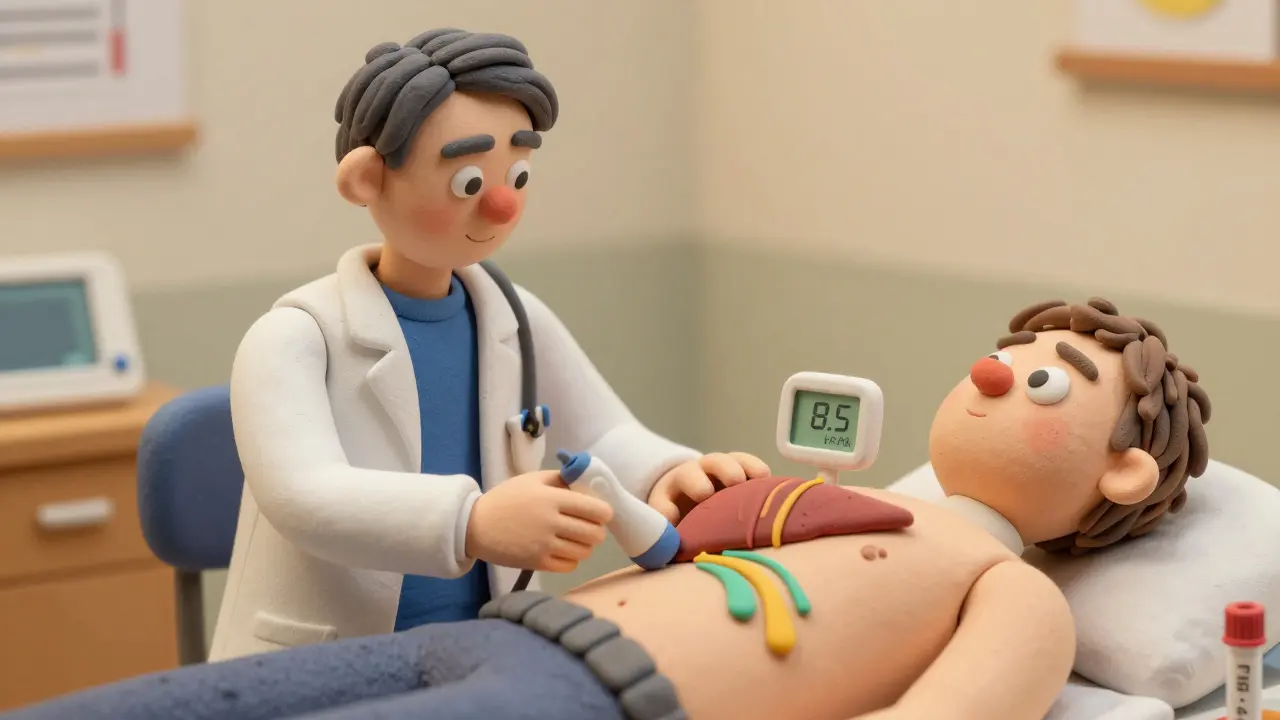
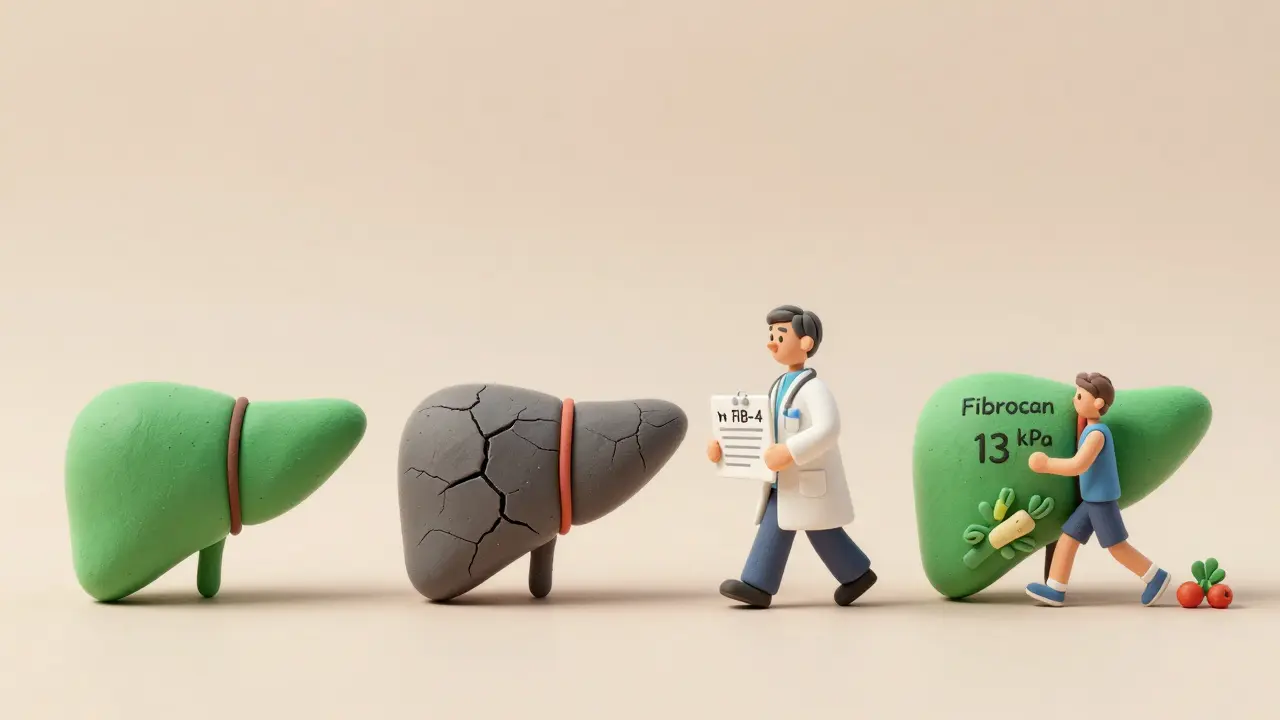
FibroScan is a handheld device that sends a gentle pulse through your skin and into your liver. It measures how stiff your liver is - because as scar tissue builds up, the liver gets harder. This stiffness is shown in kilopascals (kPa). A normal liver reads between 2 and 7 kPa. Above 7.1 kPa? That’s a red flag for fibrosis. Above 12 kPa? That often means advanced scarring, possibly cirrhosis.
The machine uses low-frequency waves (50Hz) and needs at least 10 good readings to be reliable. If your body mass index (BMI) is over 28, or if you have a lot of fat in your liver, the technician will switch to a special XL probe. Otherwise, the signal might not reach deep enough. That’s why some people - especially those with obesity - get failed scans. One Reddit user with a BMI of 38 said he had to try three times before the machine gave a usable result, adding $200 to his bill.
But FibroScan doesn’t just measure stiffness. It also gives you a CAP score - that’s Controlled Attenuation Parameter - which tells you how much fat is in your liver. Scores between 238 and 260 dB/m mean 11-33% fat. Above 290? That’s 67% or more. That’s severe fatty liver. The problem? CAP overestimates fat in obese patients. One study found it wrongly flagged 81% of mild cases as severe.
How Serum Scores Work (And Why They’re Surprisingly Powerful)
Serum scores are different. They don’t need a machine. They use your blood test results - things you’ve probably already had done for a routine checkup. The most common ones are FIB-4, APRI, and ELF.
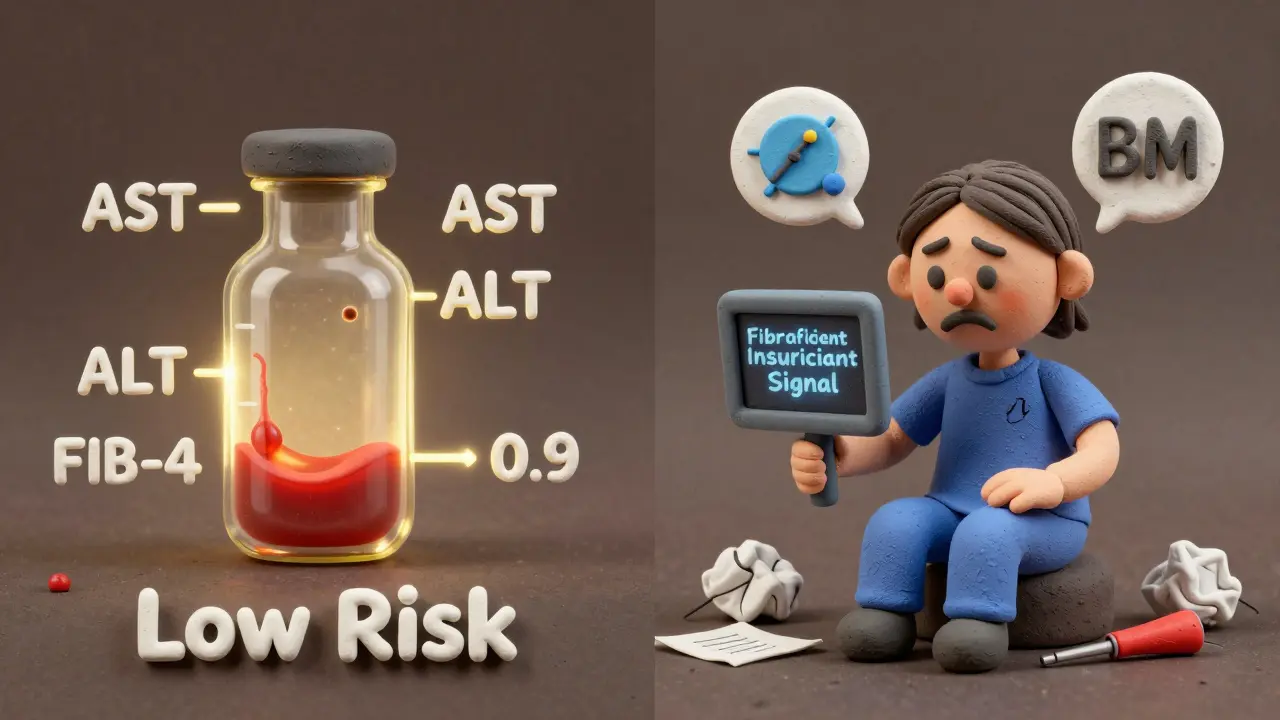
FIB-4 uses your age, AST (a liver enzyme), ALT (another liver enzyme), and platelet count. If your FIB-4 score is below 1.3, you’re very unlikely to have advanced fibrosis. That’s powerful. It means you might not need any further testing at all. But if it’s above 2.67, you’re at high risk. The catch? FIB-4 isn’t reliable under age 35. Its accuracy drops from 85% to 67% in younger adults.
APRI is simpler: just AST and platelets. A score over 2.0 suggests cirrhosis. It’s cheap and fast, but less precise than FIB-4. ELF is more complex - it looks at three proteins in your blood linked to scarring. It’s more accurate than FIB-4 for advanced fibrosis, but it’s not widely available and costs more.
Here’s the kicker: FIB-4 costs about $10 to run. FibroScan? $50 to $150. In the NHS, FIB-4 is now built into electronic health records. Doctors don’t even have to calculate it - the system does it automatically. One GP in Birmingham reported that after adding FIB-4 to their system, screening rates jumped from 12% to 67% of at-risk patients.
Which One Is More Accurate?
It’s not a simple answer. FibroScan is better at spotting advanced scarring - especially cirrhosis. One study showed it was 99% accurate at detecting F4 (the worst stage). But for earlier stages (F3), it missed nearly half the cases. In a 2023 study, FibroScan correctly flagged only 45.9% of patients with advanced fibrosis.
FIB-4? Even worse at catching advanced disease. It only caught 16.8% of those same cases. But here’s the twist: FIB-4 is excellent at ruling things out. If your score is below 1.3, there’s a 90% chance you don’t have advanced fibrosis. That’s why experts say: use FIB-4 first. If it’s low, you’re probably fine. If it’s high, then get a FibroScan.
That’s the EASL (European Association for the Study of the Liver) recommendation - and it’s backed by data. One study found this two-step approach cut the need for liver biopsies by 70%. Biopsies are risky. They can cause bleeding, pain, or even death in rare cases. Avoiding them is a win.
When Things Go Wrong
Neither test is perfect. FibroScan can give false highs if you’ve had a recent meal, if you have an active liver infection (like hepatitis flare-up), or if you have heart failure. The device doesn’t know the difference - it just sees stiffness.
Serum scores can be thrown off by things like recent alcohol use, kidney disease, or even being under 35. FIB-4 was never designed for young adults. If you’re 28 and have fatty liver, FIB-4 might say you’re fine - even if you’re not.
And then there’s the confusion factor. One patient told the NAFLD Foundation: “My FibroScan said F2. My FIB-4 said high risk. They did a biopsy - and it was F3. So both tests were wrong.” That’s not rare. Discordance happens. That’s why doctors don’t rely on one test alone.
The Real-World Game Plan
Here’s how it works in practice - especially in the UK and US clinics:
- Start with FIB-4. If your score is under 1.3, you’re low risk. No need for further testing - just monitor lifestyle.
- If FIB-4 is between 1.3 and 2.67, you’re in the gray zone. Get a FibroScan. This is where most patients end up.
- If FibroScan shows over 12 kPa, you likely have advanced fibrosis. Consider referral to a liver specialist.
- If FibroScan and FIB-4 disagree, use ELF as a tiebreaker - or consider a biopsy if the clinical picture is unclear.
This approach isn’t just theory. A 2023 NIH pilot program combined FibroScan, FIB-4, and ELF. Result? They avoided 82% of unnecessary biopsies - and still caught every case of cirrhosis.
What’s New in 2026?
The tech is getting smarter. Echosens just released FibroScan 730 with AI-powered reliability scoring. It cuts technical failures by 22%. That means fewer failed scans, fewer repeat visits, and less frustration for patients.
On the blood test side, a new score called FIB-5 came out in early 2024. It adds glucose levels to FIB-4 - making it much more accurate for people with diabetes and fatty liver. In one study, it hit 89% accuracy for advanced fibrosis in diabetic patients. That’s huge - because 70% of people with NAFLD also have prediabetes or type 2 diabetes.
Meanwhile, MRI-based elastography (MRE) is more accurate than FibroScan - but it costs 10 times as much and isn’t available in most GP clinics. Smartphone apps? Still experimental. Not ready for prime time.
What You Should Do
If you’ve been told you have fatty liver, or if you’re overweight, diabetic, or have high cholesterol - ask your doctor for a FIB-4 test. It’s already in your blood work. No extra needle. No appointment needed. Just a calculation.
If your score is borderline, ask about FibroScan. It’s quick, painless, and gives you results right away. You sit down. You breathe. You get a number. No waiting.
Don’t panic if results conflict. That’s normal. Don’t demand a biopsy unless your doctor says it’s necessary. Most people with early fibrosis can reverse it - with weight loss, less sugar, no alcohol, and regular movement.
The goal isn’t to find the perfect test. It’s to find the right path - and avoid the needle if you can.
Is FibroScan better than a liver biopsy?
FibroScan is safer and faster than a liver biopsy, and it’s just as accurate for detecting advanced scarring (cirrhosis). But it’s not perfect - it can miss early fibrosis and give false results in obese patients or those with inflammation. Biopsies are still the gold standard for exact diagnosis, but they’re only recommended when noninvasive tests disagree or when treatment decisions depend on precise staging.
Can I get a FibroScan at my GP’s office?
In the UK, FibroScan is available in most hospital liver clinics and some larger GP practices with specialist training. It’s not yet standard in every GP office. But FIB-4 is - because it’s calculated from routine blood tests. Ask your GP if they can run a FIB-4 score from your last blood work.
What if my FibroScan result is high but I feel fine?
Feeling fine doesn’t mean your liver is fine. Liver damage often has no symptoms until it’s advanced. A high FibroScan result means your liver has started to scar. The good news? In early stages (F1-F3), lifestyle changes - losing 5-10% of your body weight, cutting out sugar and alcohol, exercising - can reverse the scarring. Don’t ignore it.
Are serum scores like FIB-4 reliable for young people?
Not really. FIB-4 was designed for adults over 35. In younger people, its accuracy drops sharply because liver enzymes and platelet counts behave differently. If you’re under 35 and have fatty liver, FIB-4 might give you a false sense of security. FibroScan or ELF are better options - or ask your doctor about newer scores like FIB-5, which includes glucose and works better in younger diabetics.
Can I trust a low FIB-4 score to say I’m safe?
Yes - if your score is below 1.3, you have a 90% chance of not having advanced fibrosis. That’s strong enough to rule out serious liver damage without further testing. But if you have ongoing risk factors - obesity, diabetes, heavy alcohol use - you should still get checked every 2-3 years. Liver disease can progress slowly.