
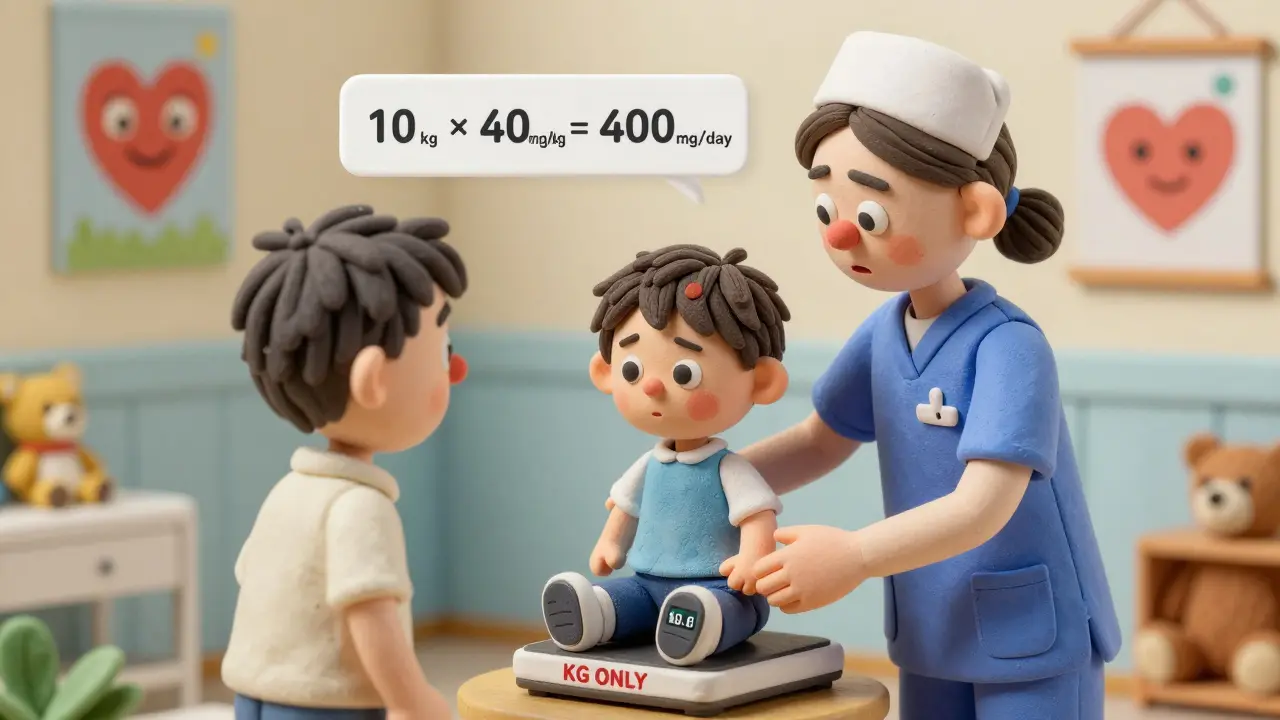
Getting the right dose of medicine for a child isn’t just about guessing based on age. It’s a precise science-and one mistake can be dangerous. In pediatric care, weight-based calculations are the gold standard for ensuring medications are safe and effective. Unlike adults, children’s bodies process drugs differently. Their organs aren’t fully developed, their water content varies, and their metabolism changes rapidly as they grow. That’s why a child weighing 10 kg needs a completely different amount than a 30 kg child-even if they’re the same age. Relying on age alone leads to errors in nearly one in three cases. But when you use weight and add a double-check system, you cut serious mistakes by two-thirds.
Why Weight Matters More Than Age
For decades, doctors used age-based dosing because it was simple. You’d look up a chart that said, “For a 2-year-old, give 5 mL.” But kids vary wildly in size. A 2-year-old could weigh 9 kg or 15 kg. Giving the same dose to both is like giving the same gas tank size to a motorcycle and a truck. That’s why the American Academy of Pediatrics updated its guidelines in 2022: weight-based dosing reduces errors by 43% compared to age-based estimates.Here’s the real problem with age-based dosing: children at the extremes of growth are most at risk. A tiny premature infant or a large adolescent with obesity doesn’t fit the “average” chart. Studies show age-based dosing has a 29% error rate for these kids. Weight, on the other hand, is measurable, objective, and repeatable. It doesn’t care if the child is 18 months or 8 years-it just tells you what the body can handle.
How Weight-Based Dosing Works
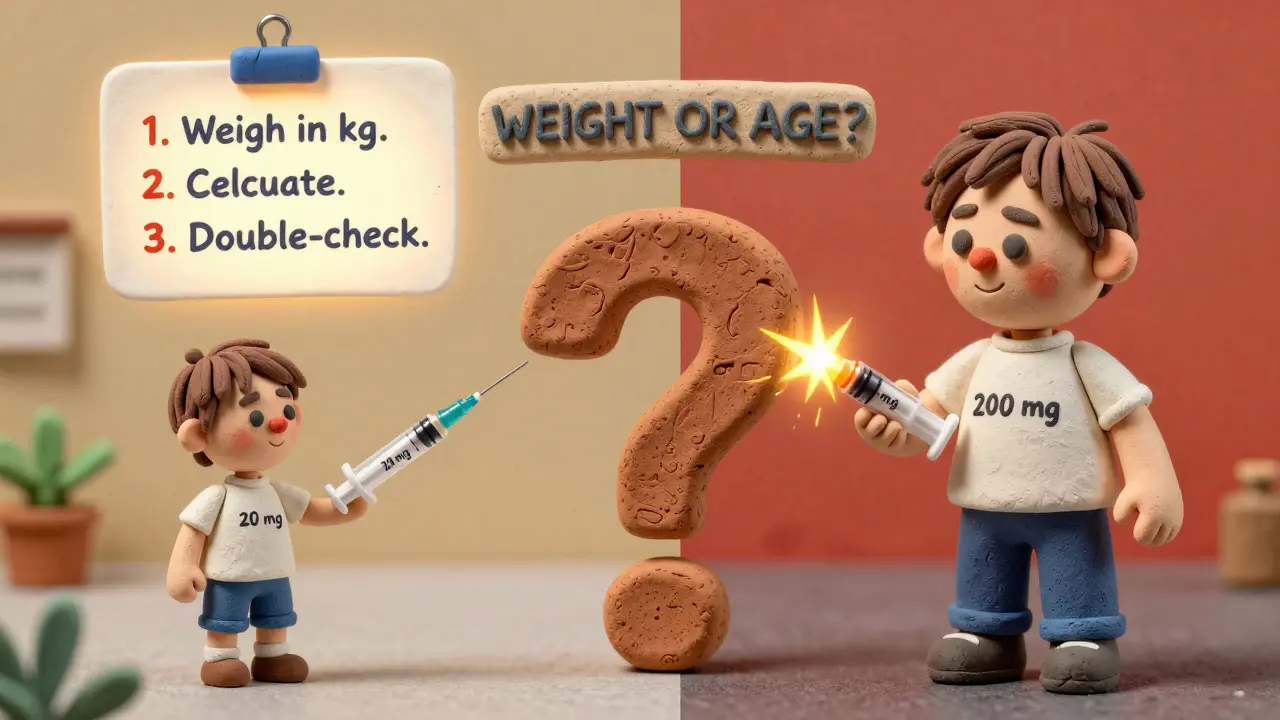
The process is straightforward but requires precision. There are three steps, and skipping or rushing any one of them can lead to harm.- Convert pounds to kilograms correctly. Use the exact conversion: 1 kg = 2.2 lb. Never round until the final answer. If a child weighs 44 pounds, divide by 2.2 to get 20 kg-not 20.4 or 19.8. Rounding too early creates a chain of errors.
- Calculate the total daily dose. Multiply the child’s weight in kg by the prescribed dose per kg per day. For example, amoxicillin at 40 mg/kg/day for a 20 kg child equals 800 mg per day.
- Divide by frequency. If it’s given twice daily, divide 800 mg by 2 = 400 mg per dose.
Let’s say a 22-pound child (10 kg) is prescribed amoxicillin at 40 mg/kg/day, split into two doses. The math: 10 kg × 40 mg/kg = 400 mg/day. Divided by two doses = 200 mg per dose. That’s it. But if you accidentally used pounds instead of kilograms-say, you multiplied 22 × 40-you’d get 880 mg per dose. That’s over four times the correct amount. That’s not a typo. That’s a hospital visit.
When Weight Isn’t Enough: Special Cases
Weight-based dosing works for most drugs-but not all. For some medications, especially those used in cancer treatment, body surface area (BSA) is more accurate. The Mosteller formula calculates BSA using both weight and height: √(weight in kg × height in cm / 3600). A 2021 study found BSA dosing improved accuracy by 18% for chemotherapy drugs. But it’s slower. It adds nearly a minute per dose, which matters in emergencies.Obesity changes the game too. In children with BMI above the 95th percentile, using actual body weight can lead to overdosing, especially with water-soluble drugs. The Pediatric Endocrine Society recommends using adjusted body weight: Ideal Body Weight + 0.4 × (Actual Weight - Ideal Body Weight). About 78% of children’s hospitals now use this method for certain medications. For fat-soluble drugs, like some seizure meds, actual weight may still be correct.
And then there are babies under six months. Their kidneys and liver aren’t mature. A 3 kg newborn might need 40-60% less of an aminoglycoside like gentamicin than a 3 kg toddler-even though their weight is the same. That’s not a calculation error. That’s developmental pharmacology. You have to know the drug, not just the number.
The Double-Check That Saves Lives
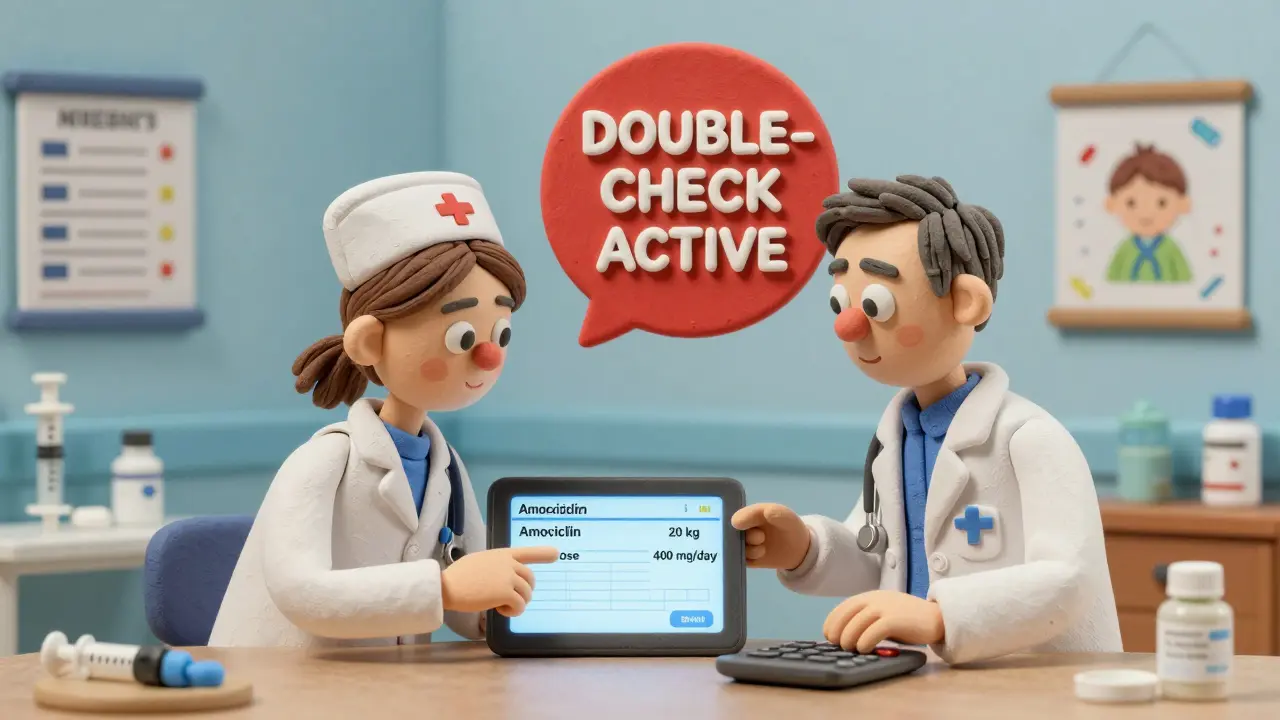
Calculating the dose is only half the battle. The other half is verifying it. The Institute for Safe Medication Practices says 32% of pediatric dosing errors come from unit confusion-mixing up pounds and kilograms. One nurse on Reddit shared how her hospital put bright red stickers on all scales that read: “WEIGH IN KG ONLY.” That simple fix cut conversion errors by half.Double-checking isn’t optional. It’s mandatory for high-alert medications like insulin, opioids, and chemotherapy. The Joint Commission requires two independent checks for these drugs. That means two licensed providers-usually a nurse and a pharmacist-do the math separately. If they don’t agree, they stop. No exceptions.
One nurse in a pediatric ICU described catching a 10-fold overdose. A resident ordered 200 mg of a drug for a 10 kg child. The correct dose was 20 mg. The nurse ran the numbers: 10 kg × 40 mg/kg/day = 400 mg/day max. The ordered dose was 200 mg per dose-that’s 400 mg/day. It was right at the limit. But the child was only supposed to get 20 mg per dose. The system flagged it because the dose exceeded the safe threshold. They caught it because they checked.
Technology Is Helping-But Not Replacing Humans
Electronic health records now have built-in safety nets. Epic Systems released pediatric dosing modules in 2023 that auto-calculate doses and flag anything outside expected ranges. If a provider enters a dose that’s more than 10% above or below the calculated safe range, the system pops up a warning. One hospital in California cut dosing errors by 52% after adding this feature.But technology isn’t foolproof. If the weight is entered wrong-say, 100 kg instead of 10 kg-the system will calculate a massive overdose and never question it. That’s why human verification still matters. A 2023 survey of 1,247 pediatric nurses found that 89% say weight-based calculations are essential. But 76% say the double-check saved them from a near-miss.
Common Mistakes and How to Avoid Them
The most frequent errors? Here’s what the data shows:- Unit confusion (38%): Using pounds instead of kilograms. Solution: Always document weight in kg. Make it the default on scales and charts.
- Decimal errors (27%): Writing 2.0 mg instead of 20 mg, or missing a zero. Solution: Use leading zeros (0.5 mg) but never trailing zeros (5.0 mg). Write 5 mg, not 5.0 mg.
- Ignoring organ function (19%): Giving the same dose to a child with kidney disease as a healthy one. Solution: Always check labs. Reduce doses for renal or liver impairment.
Training matters too. The Pediatric Nursing Certification Board requires all providers to pass a 25-question test with 90% accuracy every year. No certification without it. And hospitals that use simulation drills-where staff practice real cases with fake weights and meds-see fewer errors over time.
What’s Changing in 2025?
The FDA now requires all new drug applications to include pediatric dosing algorithms by 2025. The WHO updated its Essential Medicines List for Children in April 2023, adding weight-band dosing for 127 medications. That means instead of saying “give 10 mg/kg,” labels will now say “for children 5-10 kg: give 50 mg; for 10-20 kg: give 100 mg.” That’s a big step toward reducing calculation errors.Researchers are also exploring pharmacogenomics-testing genes that affect how kids metabolize drugs. Early studies show testing for CYP2D6 and CYP2C19 genes can reduce opioid side effects by 37%. But that’s still in the future. For now, weight + double-check is the foundation.
Dr. Gregory Kearns of the Pediatric Pharmacology Research Unit Network says it best: “Weight-based calculations will remain the essential foundation of pediatric pharmacotherapy for the foreseeable future.” Technology will help. Guidelines will improve. But the core hasn’t changed. Know the weight. Do the math. Check it twice.”
Why is weight-based dosing better than age-based dosing for children?
Weight-based dosing is more accurate because children vary widely in size-even at the same age. A 2-year-old could weigh 9 kg or 15 kg, and their body processes drugs differently based on that weight. Age-based charts assume an average size, which leads to errors in nearly 30% of cases. Weight-based dosing uses a measurable, objective number that directly correlates with how much medicine the body can safely handle.
What’s the correct way to convert pounds to kilograms for pediatric dosing?
Use the exact conversion: 1 kg = 2.2 lb. Divide the weight in pounds by 2.2 to get kilograms. Do not round the result until after you’ve completed the full calculation. For example, a child weighing 44 pounds is exactly 20 kg (44 ÷ 2.2). Rounding too early-like calling 44 pounds 20.4 kg-can lead to cumulative errors in the final dose.
When should body surface area (BSA) be used instead of weight for pediatric dosing?
BSA is preferred for chemotherapy drugs and some anticonvulsants, where the drug’s effect depends on how much surface area the body has to absorb and distribute it. Studies show BSA dosing improves accuracy by 18% for these drugs. However, it requires both weight and height measurements, which adds time. For most common medications like antibiotics or pain relievers, weight-based dosing is simpler and just as effective.
Why is a double-check required for high-alert pediatric medications?
High-alert medications-like insulin, opioids, and chemotherapy-can cause serious harm or death if given in the wrong dose. Even small errors, like a decimal mistake or unit confusion, can be fatal. A double-check, where two licensed providers independently calculate and verify the dose, reduces serious errors by 68%. It’s not just a best practice-it’s a safety standard required by The Joint Commission.
How do you handle dosing for obese children?
For obese children (BMI ≥95th percentile), using actual body weight can lead to overdosing with water-soluble drugs. The recommended approach is to use adjusted body weight: Ideal Body Weight + 0.4 × (Actual Weight - Ideal Body Weight). For fat-soluble drugs, actual weight may still be appropriate. Most children’s hospitals follow this guideline, and it’s now standard in pediatric pharmacology training.
What are the most common dosing errors in pediatrics?
The top three errors are: unit confusion (using pounds instead of kilograms-38%), decimal point mistakes (like writing 2.0 mg instead of 20 mg-27%), and failing to adjust for kidney or liver problems (19%). Hospitals reduce these by using standardized scales with kg-only labels, avoiding trailing zeros in dosing, and checking labs before giving certain drugs.





Bennett Ryynanen
Man, I saw a kid get 10x the right dose last year because the nurse grabbed the scale and it was set to lbs instead of kg. No joke. The kid was in the ICU for 3 days. We put red stickers on every scale after that. Simple fix. Why wasn’t this standard 10 years ago?
Aaron Bales
Weight + double-check. That’s it. No magic. No fancy tech. Just do the math and verify it. If your system can’t handle that, fix your system.
Deepika D
Let me tell you something - I’ve trained over 80 new nurses in my 12 years on the pediatric floor, and the number one thing I drill into them is this: weight is king. Not age. Not guesswork. Not ‘oh, he looks about 15 kg.’ We weigh every kid, every time, no exceptions. And we make them say the weight out loud before they even touch the med cart. One time, a new grad almost gave a 3-month-old 400mg of amoxicillin because she read ‘44’ on the chart and thought it was kg. Turned out it was pounds. She cried. I hugged her. Then we did a full debrief. That’s how you learn. Not by punishing - by building systems that catch the mistake before the kid gets hurt. And yeah, we use those red stickers too. And we’ve had zero weight-based dosing errors in the last 18 months. It’s not hard. It’s just mandatory. And if your hospital doesn’t have that? Push for it. Because one kid’s life is worth every extra minute you spend.
Stewart Smith
Wow. So we’ve known this since like 2005, but somehow we still need a 2000-word essay to remind people not to mix up pounds and kilograms? 🤦♂️
Darren Pearson
While the emphasis on weight-based calculations is commendable, one must not overlook the epistemological limitations of reductionist pharmacometric models in pediatric populations. The ontological variability of developmental pharmacokinetics cannot be fully encapsulated by algorithmic determinism. One must therefore interrogate the hegemony of quantification in clinical practice, particularly when biological complexity exceeds the parameters of linear scaling.
Chandreson Chandreas
weight + double check 🤝
but also... breathe. 🧘♂️
we’re humans, not calculators. if you’re stressed, you’ll mess up. slow down. talk it out. check again. the kid isn’t going anywhere. 🙏
Sara Stinnett
Oh, so now we’re pretending that ‘weight-based dosing’ is some revolutionary breakthrough? Please. The WHO has had guidelines for this since the 1980s. What’s really revolutionary is how little progress we’ve made in actual implementation. Hospitals still use paper charts. Nurses still eyeball weights. And we pat ourselves on the back for putting a red sticker on a scale like it’s a fucking Nobel Prize. This isn’t innovation. It’s triage-level damage control.
Jenny Salmingo
my cousin works in a kids’ hospital and she says the biggest help was just making everyone say the weight out loud before giving meds. like, ‘this baby is 8.2 kg’ - out loud. and then someone else says it back. sounds silly, but it works. simple stuff saves lives.
linda permata sari
I work in a rural clinic in Indonesia and we don’t even have digital scales. We use those old hanging ones. But we write the weight in kg with a big marker on the child’s arm. Not for show - so everyone sees it. No one forgets. We don’t need fancy tech. We need clarity. ❤️
Lawver Stanton
Okay, so let me get this straight - we’ve known for decades that kids aren’t just tiny adults, but we still treat them like they are? We use age-based charts like it’s 1978? We don’t train our med students on pharmacokinetic development until their third year? We let interns calculate doses on the fly while being yelled at by attendings? And then we act shocked when a kid gets poisoned? This isn’t a ‘safety protocol’ issue - this is a systemic failure of medical education. We’re training people to be human calculators instead of critical thinkers. And then we wonder why burnout is at 80%? The system is broken. The red stickers? Cute. The double-checks? Necessary. But the real problem? We still treat pediatric medicine like a side gig instead of the most delicate, complex, high-stakes specialty we have. Fix the culture. Fix the training. Fix the hierarchy. The math is the easy part.
Retha Dungga
weight is truth 🌍 but sometimes truth is heavy 🫂
we forget that behind every kg is a child who just wants to feel better
not a number
not a formula
just a kid
and we owe them more than math
we owe them care