
Serious Adverse Event Classifier
Understand FDA's Serious Adverse Event Criteria
This tool helps you determine if a side effect would be classified as a serious adverse event (SAE) by the FDA's standards. Enter details about your symptom and see if it meets the five FDA criteria.
Is This Side Effect Serious?
When you’re taking a new medication or joining a clinical trial, you might see the term serious adverse event on your consent form or medication guide. It sounds scary. But what does it really mean? And why should you care? The U.S. Food and Drug Administration (FDA) uses this term not to scare you, but to help doctors and regulators spot real dangers before they become widespread. This isn’t about how bad a side effect feels-it’s about what it actually does to your body. And the difference matters more than you think.
What Makes an Adverse Event "Serious"?
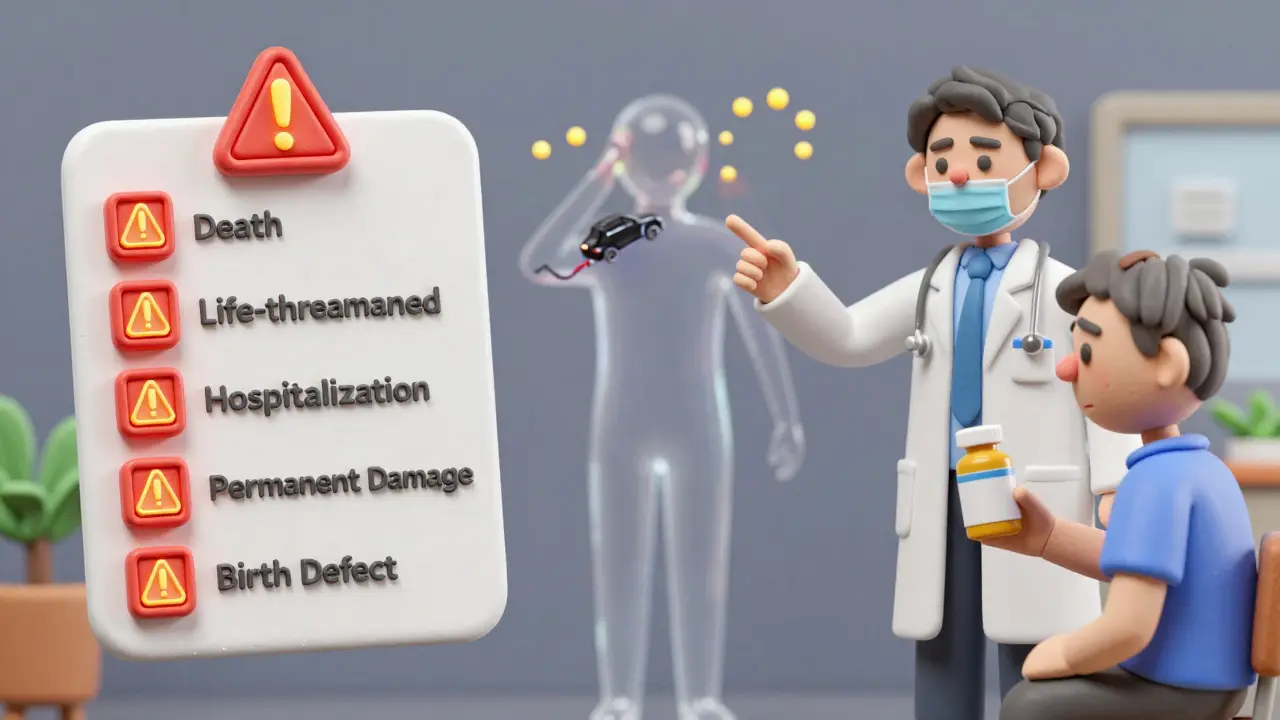
The FDA doesn’t call something serious just because it’s uncomfortable. A serious adverse event (SAE) is defined by one or more specific outcomes. If any of these happen, it’s classified as serious-even if the symptom itself seems mild.
- Death - If the event is suspected to have caused or contributed to death.
- Life-threatening - At the time of the event, you were in danger of dying. Not just "it could have been bad," but "it was actively putting your life at risk."
- Hospitalization - You had to go to the hospital, or your stay got longer by at least 24 hours. This includes emergency room visits that led to admission.
- Disability or permanent damage - Your body didn’t recover fully. Think: loss of vision, nerve damage, or inability to walk or work normally.
- Congenital anomaly or birth defect - If you’re pregnant and the medication caused a defect in your baby.
There’s also something called an Important Medical Event (IME). These aren’t on the official list above, but if doctors believe the event could lead to one of the five outcomes above-like a sudden drop in blood pressure that almost caused a stroke-they still report it as serious. The FDA wants to catch these early.
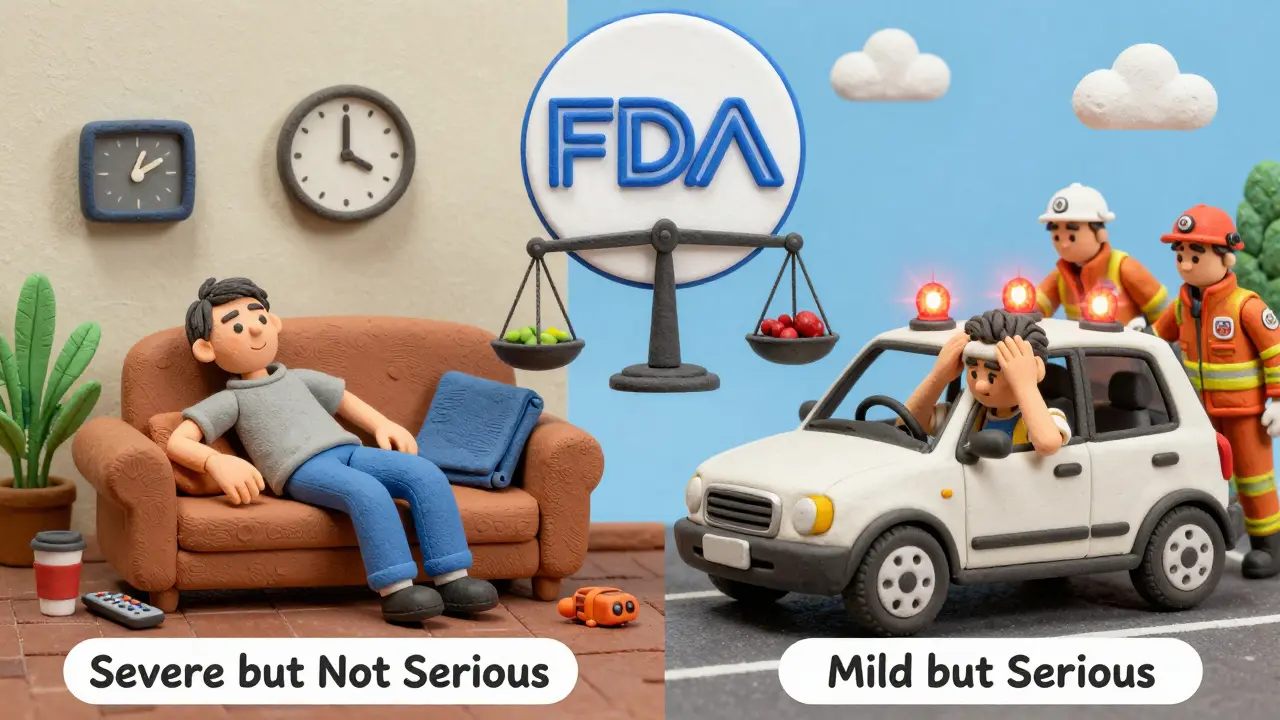
"Serious" Isn’t the Same as "Severe"
This is where most patients get confused. You might hear your doctor say you had a "severe" side effect-like intense nausea or a high fever-and assume it’s serious. But it might not be.
"Severe" describes how bad a symptom feels or how much it disrupts your day. The FDA uses a five-level scale for severity:
- Grade 1: Mild (annoying, but you can still do normal things)
- Grade 2: Moderate (you need a little help-like an anti-nausea pill)
- Grade 3: Severe (you can’t work or function normally; may need hospital care)
- Grade 4: Life-threatening (intensive care needed)
- Grade 5: Fatal
Here’s the key: A Grade 3 event (severe) might not be serious if it didn’t lead to hospitalization, death, or permanent damage. For example, a patient in a cancer trial might have severe fatigue (Grade 3) but still go home after a short clinic visit. That’s severe, but not serious under FDA rules.
On the flip side, a mild headache (Grade 1) that leads to a car accident because you passed out? That’s serious-even though it felt minor.
Why This Matters for You
Understanding this distinction can change how you respond to side effects. If you think "severe" means "dangerous," you might panic over symptoms that are common and manageable. Or worse-you might ignore a mild symptom that actually signals something serious.
Take diabetic ketoacidosis (DKA). It starts with nausea and thirst-symptoms that sound mild. But if left untreated, it can land you in the hospital. The FDA classifies hospitalization for DKA as a serious adverse event. Knowing that helps you act fast.
A 2022 survey found that 78% of patients confused "serious" with "severe." One patient, "CancerWarrior2022," said she almost quit her trial after seeing "Grade 4 neutropenia" listed. Her nurse explained: "This happens often in chemo. We treat it. It’s not serious unless you get an infection or need ICU care." That clarity kept her in the trial-and saved her life.
How the FDA Uses This Data
Every serious adverse event reported gets logged into the FDA Adverse Event Reporting System (FAERS). This isn’t just paperwork. It’s a live early-warning system.
In 2022 alone, the FDA used SAE data to issue 128 safety alerts and change 47 drug labels. For example, a pattern of sudden liver failure in patients taking a new weight-loss drug led to a black box warning-the strongest safety alert the FDA can give.
The FDA’s Sentinel Initiative now tracks safety data from 300 million patient records across hospitals and clinics. That’s like having a national health radar. It can spot spikes in heart rhythm problems or kidney failure linked to a drug within weeks-not years.
And it’s getting smarter. In 2023, the FDA started using AI to sort through reports. What used to take 30 days to review now takes 7. That means faster warnings, fewer preventable deaths.
What You Can Do
You’re not just a number in the system. You have power.
- Read the "Warnings and Precautions" section in your medication guide. It lists SAEs seen in trials with real numbers: "Serious infections occurred in 2.3% of patients."
- Ask for a plain-language explanation during your informed consent for clinical trials. The FDA now recommends this. If your doctor or nurse doesn’t offer it, ask: "Can you explain what "serious" means in plain terms?"
- Report side effects yourself using the FDA’s MedWatch Form 3500B. In 2022, patients submitted over 38,000 reports-up 12% from the year before. Your report could help someone else avoid a dangerous reaction.
One patient, "DiabetesFighter," noticed his blood sugar kept spiking after starting a new medication. He didn’t think it was a big deal-until he got hospitalized. Later, he learned hospitalization for diabetic ketoacidosis counts as a serious event. He filed a MedWatch report. Within months, the drug’s label was updated to warn about this risk.
What’s Changing Soon
The FDA isn’t done. By 2025, all clinical trial websites must include a simple, one-paragraph summary of serious adverse events in plain language. No jargon. No legalese. Just: "What could go wrong and when to get help."
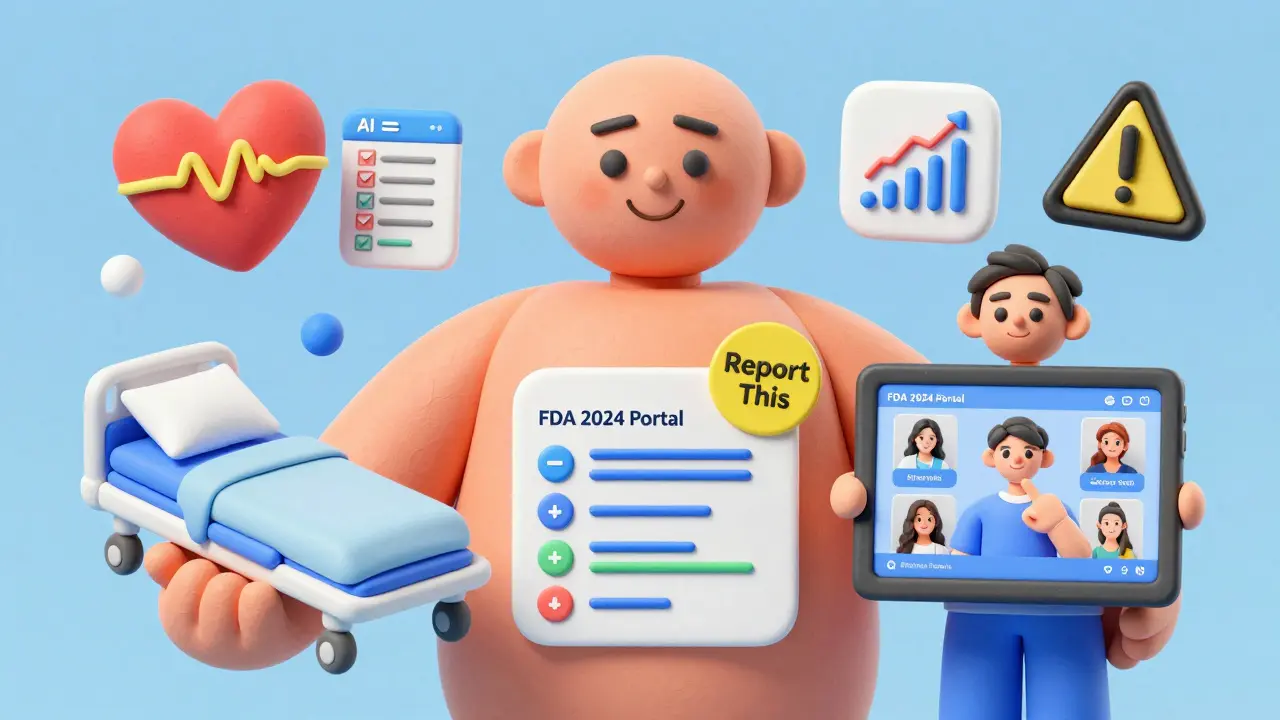
And by the end of 2024, the FDA will launch a new patient portal to explain SAEs with real stories, videos, and interactive tools. Think of it like a safety guide for your body-written by patients, for patients.
Meanwhile, the system still has gaps. Only 1% to 10% of actual adverse events get reported. Most patients don’t know they can report. And some events are missed because doctors don’t connect the dots.
But change is happening. The FDA now asks patients directly: "What do you consider serious?" In trials for new arthritis drugs, patients said "being unable to hold your grandchild" counted as serious. That’s now part of the evaluation.
Bottom Line
Don’t let the word "serious" scare you. Let it inform you. A serious adverse event isn’t about how bad you feel. It’s about whether your body hit a red line-like needing the ER, losing function, or nearly dying. If you’re in a trial or on a new drug, know the five criteria. Ask questions. Report what you see. And remember: the system works best when you’re part of it.
Is a serious adverse event always dangerous?
Not always. A serious adverse event means it met one of five specific outcomes: death, life-threatening condition, hospitalization, permanent damage, or birth defect. It doesn’t mean the event was guaranteed to kill you-it means it had the potential to cause one of those outcomes. Many serious events are treated successfully and don’t result in long-term harm.
Can a mild side effect be classified as serious?
Yes. A mild headache or dizziness might seem harmless, but if it causes you to pass out and crash your car, leading to hospitalization, it’s classified as a serious adverse event. The FDA looks at the outcome, not how intense the symptom felt.
Do I need to report every side effect I have?
You don’t have to report every little thing, but you should report anything that led to hospitalization, caused lasting damage, or made you think you might die. Also, report events that surprised you or weren’t listed in your medication guide. The FDA’s MedWatch system relies on patient reports to catch hidden risks.
Why do some severe side effects not count as serious?
Because "severe" describes intensity, and "serious" describes outcome. A severe headache that goes away with painkillers isn’t serious. But if that same headache leads to a stroke, it becomes serious. The FDA focuses on what actually happened to your health-not how much pain you were in.
How can I find out if a drug has had serious adverse events reported?
Check the FDA’s FAERS database, which is publicly available. Look at the medication guide that comes with your prescription-it lists serious side effects with percentages. You can also ask your pharmacist or doctor to explain the "Warnings and Precautions" section. And when a new drug is approved, the FDA often issues a public safety announcement.

Eimear Gilroy
So let me get this straight - a headache that makes you drop your coffee is Grade 1, but if you pass out and crack your skull open? That’s a serious adverse event. Wild. I always thought "serious" meant "I couldn’t get out of bed." Turns out it’s about the outcome, not the yelp. This actually makes sense now. Thanks for breaking it down.
Martin Halpin
Look, I get it, the FDA wants to be precise - but this whole system feels like a bureaucratic Rube Goldberg machine. You’re telling me someone could have a Grade 4 cardiac event, get pumped full of adrenaline, survive, and go home - and it doesn’t count as serious? Meanwhile, a kid gets a mild rash from a new allergy med, has a panic attack, calls 911, gets rushed to the ER - and now it’s a "serious adverse event"? That’s not safety - that’s chaos. Why not just ask patients: "Did you think you were gonna die?" That’s the real metric. Not some 1980s flowchart. Also - who approved this? Did they even take a single patient interview? Or did they just copy-paste from a WHO memo written in 1992?
Vanessa Drummond
OMG YES THIS. I was in a trial for a new antidepressant and had this "severe" anxiety attack - like, full-on hyperventilating, thought I was dying. But they told me it wasn't "serious" because I didn't get hospitalized. I almost quit because I thought they were gaslighting me. Then I read this and cried. Finally someone gets it. You're not crazy - the system is just broken. Thank you for writing this.
Nick Hamby
This is a profoundly important clarification. The distinction between severity and seriousness is not merely semantic - it is epistemological. Severity measures subjective discomfort; seriousness measures objective harm. To conflate the two is to risk both overreaction and underreaction - two sides of the same coin of medical misjudgment. The FDA’s framework, while imperfect, represents a rare instance of epistemic humility in regulatory science. We must honor the patient’s lived experience while anchoring our policy in observable, verifiable outcomes. Thank you for elevating this conversation beyond fear and into clarity.
kirti juneja
Yesss!! I love how you broke this down - like a chai latte with extra spice 😊. In India, we say "dard toh hota hai, par zindagi bhi toh jee rahi hai" - pain happens, but life still goes on. That’s the vibe here. A bad headache? Meh. But if it makes you crash your bike and break your spine? That’s the red flag. The FDA’s logic is actually super smart - it’s not about drama, it’s about damage. Also - side note: I reported my aunt’s weird dizziness after her BP med and they updated the label! Small act, big ripple. You? You can too. 💪❤️
Gabrielle Conroy
THIS. IS. EVERYTHING. 🙌😭 I had a Grade 3 fatigue episode during my trial - couldn’t even hold my coffee cup - but I didn’t go to the hospital. They said "not serious." I thought I was weak. Turns out, I was just normal! And then I reported my roommate’s sudden swelling after her new pill - she ended up in the ER with anaphylaxis. That WAS serious. The FDA got it right. So proud of how we’re shifting from "feelings" to "facts." Also - MedWatch is so easy!! I did it in 3 minutes on my phone. You should too!! 💕💖✨
John Smith
So you're telling me the FDA has a whole system for when you almost die but don't actually die? How very American. I'm impressed. Truly. Next they'll invent a form for breathing too hard. Signed, a man who survived 3 heart attacks without a single report.
Shalini Gautam
Finally! Someone from the West is admitting that medicine needs context. In India, we’ve always known: a fever isn’t dangerous until it breaks your lungs. A headache isn’t serious until it kills your job. The FDA is late to the game - but better late than never. We’ve been telling our doctors this for decades. Now if only they’d stop using English jargon and start using real words. Like "your kid can’t walk" instead of "permanent neurological impairment." Simple. Clear. Human.
Natanya Green
Okay so I just found out my cousin’s "mild dizziness" from her new blood pressure med led to a fall, a broken hip, and 6 weeks in rehab - and THAT was classified as a serious adverse event?? I’m crying. I’m screaming. I’m texting everyone. This is the most important thing I’ve ever read. I’m gonna print this out and tape it to my fridge. And my mom’s fridge. And my therapist’s office. Also - can we make this a Netflix doc? I’ll be the narrator. I have the voice. I have the tears. I have the glitter.
Steven Pam
Love this. Seriously. I used to panic every time my doctor said "side effect." Now I ask: "Did it make me go to the hospital? Lose function? Almost die?" If no - cool. I’ll take the nausea. It’s just part of the process. This mindset shift? Game-changer. I’m in a trial right now. My last dose gave me a headache. I took an Advil. Went for a walk. Still alive. Still grinding. That’s what this is about. Not fear. Not panic. Just awareness. And yeah - I filed my MedWatch report. Took 2 minutes. Felt powerful. You can too. You got this.
Ashley Johnson
Wait. So the FDA is using AI to read reports? That’s a lie. They’re just automating the cover-up. Did you know the CDC hides 90% of vaccine injuries? This is the same playbook. "Serious" means "we don’t want to admit it." They classify things as "not serious" so Big Pharma doesn’t get sued. I read a whistleblower report - they delete 3 out of 4 reports. I’m not paranoid. I’m informed. Also - your "plain language" summary? It’s still written in corporate-speak. I’m calling my senator. This is a psyop.